Two free guides. One small creative adventure. Start your adventure here!

Warp Chat: Which Sci-Fi Universe Would You Actually Want to Live In?

I love science fiction because it lets us go somewhere impossible without actually having to deal with the consequences.

You can visit Arrakis.

You can walk onto a Federation starship.

You can wander through Coruscant, poke around an abandoned alien station, or watch somebody open a portal that is very obviously going to become a problem.

Then you close the book or turn off the screen and go make dinner.

Which raises a much more interesting question.

What if you could not leave?

That is where I want to start Warp Chat, a weekly Epic Again discussion built around the questions science fiction leaves rattling around after the story is over.

And the first one is pretty simple:

Which sci-fi universe would you actually want to live in, and which one would be an absolute nightmare?

There is one rule.

You are not the hero.

No secret powers.

No mysterious destiny.

No plot armor.

You are just some person who lives there.

You need somewhere to sleep. You probably have neighbors. You might need a job. You have to figure out transportation, healthcare, food, taxes, local laws, and whether the giant object in the sky is normal or a reason to start running.

That changes the answer pretty quickly.

A great story does not always make a great place to live

A lot of my favorite science-fiction universes would be terrible places to actually wake up in.

That is not a flaw.

Most of them are interesting because something has gone wrong.

There are wars.

Governments are collapsing.

Corporations have way too much power.

Ancient machines are waking up.

Somebody has opened the sealed door everybody was specifically told not to open.

Great story.

Terrible Tuesday.

That is the distinction I keep coming back to.

There are worlds I love reading about that I would never, under any circumstances, move my family into.

Adventure is fun when you know the credits eventually roll.

Living there means asking different questions.

Is the hospital good?

Can I walk outside at night?

Does the government occasionally vaporize cities?

How often do ancient cosmic beings return?

These things matter.

The Culture is probably the easy answer

If I had to pick a universe based purely on quality of life, Iain M. Banks’ Culture is hard to beat.

It is basically post-scarcity.

Food is handled.

Housing is handled.

Medicine is absurdly advanced.

You can travel, make art, study something for two hundred years, change your body, do nothing for a while, or disappear into some bizarre hobby nobody else understands.

Honestly, that sounds pretty good.

The catch is that much of the civilization is managed by incredibly powerful artificial intelligences called Minds.

And I mean incredibly powerful.

They are smarter than you.

They know more than you.

They are better at running almost everything than you.

That is where my answer gets a little less automatic.

I like the Culture.

I am not completely sure how comfortable I would be living inside a society where the machine running the ship could probably predict what I am going to do before I have finished deciding to do it.

Still, if the alternative is getting drafted into an interstellar war somewhere else, I can probably learn to live with the sarcastic spaceship.

Star Trek is probably where I would actually choose

The Federation is the answer I keep landing on.

Maybe that is boring.

I am fine with boring.

Replicators exist.

Healthcare is wildly better than ours.

People are generally educated.

Basic survival does not seem to dominate every waking moment.

Humanity has somehow managed to move beyond at least some of the dumb things we currently spend our time fighting over.

You can also explore the galaxy if that is your thing.

Personally?

I am not sure I am joining Starfleet.

Watching Star Trek makes starship life look exciting because the camera follows the interesting people.

The camera does not spend much time with the crew member who gets assigned to Deck 14 right before something tears through the hull.

I think I would be perfectly happy on a nice Federation world.

Maybe visit a starbase.

Look at some ships.

Drink something weird at Quark’s.

Then go home.

I have kids. My tolerance for surprise alien invasions has gone down.

Star Wars looks much worse when you are not a Jedi

I love the Star Wars galaxy.

I absolutely do not want to live there.

At least not during most of the eras we actually see.

The galaxy looks incredible from a distance.

Thousands of worlds.

Ancient civilizations.

Spaceports.

Droids.

Ships everywhere.

Alien cultures.

You could probably find some quiet planet, start over, and disappear.

That part is appealing.

Unfortunately, the political situation is almost always a disaster.

The Republic collapses.

The Empire takes over.

Then the Empire collapses.

Then everybody has to figure out what comes next.

Then somehow there is another giant authoritarian military force with an even bigger superweapon.

At some point I am moving somewhere without strategic value and hoping nobody discovers it.

That is also the thing about Star Wars.

We imagine ourselves as Han Solo.

Statistically, we are much more likely to be the guy whose speeder gets destroyed because the protagonists were having a chase scene through his neighborhood.

Firefly is cool until you need a dentist

The Firefly universe has a kind of life I find weirdly appealing.

Small ship.

Small crew.

Fix your own stuff.

Take jobs.

Move around.

Eat together.

Try to stay out of trouble.

There is something human about it.

It feels dirty and patched together in a way that makes the world easy to imagine living inside.

Then I remember the part where the whole system is deeply unequal.

Healthcare is not exactly guaranteed.

The Alliance can be oppressive.

Some colonies are barely hanging on.

And there are Reavers.

So maybe I like the idea of living on Serenity more than the actual reality.

Give me the ship.

Give me the kitchen table.

Give me the found family.

Maybe also give me Federation medical care.

I am already cheating.

Stargate might actually be manageable

The Stargate universe is a strange one because your answer depends almost entirely on whether you know what is happening.

If you are an ordinary civilian on Earth, life could be pretty normal.

You go to work.

You complain about traffic.

You have no idea that somebody was fighting an alien god through a giant ring yesterday.

That might actually be the best arrangement.

The problem starts when you join Stargate Command.

Now every week somebody asks you to walk through a portal to an unknown planet where absolutely nobody can guarantee there will be breathable air, friendly locals, or a functioning return trip.

I love exploration.

I am also pretty attached to coming home.

So I think I would stay Earth-side.

Maybe give me a job somewhere near the program.

Not too near.

Warhammer 40,000 is an immediate no

There is no debate here.

I love Warhammer 40,000.

I paint the miniatures.

I like the lore.

I enjoy how completely excessive the entire setting is.

I do not want to live there.

At all.

There are almost no good outcomes.

You might live on a hive world where billions of people are stacked on top of each other.

You might end up on some brutal industrial planet.

You could get drafted.

You could meet aliens.

You could meet Chaos.

You could discover that your neighbor has been worshipping something with too many arms.

The Imperium itself is hardly reassuring.

Even the people supposedly protecting humanity are part of a gigantic authoritarian machine fueled by war, fear, religion, sacrifice, and paperwork.

And that is before the Tyranids arrive.

This is a universe where “quiet farming planet” feels less like a lifestyle and more like the opening twenty minutes before something horrible happens.

Wonderful fiction.

Hard pass.

The Alien universe is almost worse because it feels normal

Warhammer 40,000 is so enormous and grotesque that it almost becomes abstract.

Alien bothers me more because I can imagine working there.

That is the problem.

You are not some legendary warrior.

You work for a company.

You have a contract.

There are safety procedures.

The equipment is old.

Your employer keeps sending people into situations it definitely knows are dangerous.

That part feels believable.

Then somebody finds the egg.

No.

Absolutely not.

The moment anyone says, “We found some kind of biological specimen,” I am resigning.

Weyland-Yutani can keep the pension.

The Matrix might be the worst answer because you may already be trapped

The Matrix gets ugly once you remove the cool coats and martial arts.

Most people are not Neo.

They are batteries.

Worse, they do not even know it.

That hits differently from a universe where you can at least see the monster coming.

In Alien, I know there is a xenomorph.

In Warhammer, I know something awful is happening because the sky has turned red and people are screaming about daemons.

Inside the Matrix, I could have a completely normal morning and never realize my entire reality is artificial.

That is terrifying.

I think I would rather know the problem exists.

Probably.

Ask me again after I see the real world outside the simulation.

Black Mirror scares me for another reason

Black Mirror might be the most uncomfortable answer on this list because it rarely feels very far away.

Nobody needs to invent faster-than-light travel.

There does not need to be an alien invasion.

Somebody creates a useful new piece of technology.

People adopt it.

Companies find ways to make money from it.

Society decides this is normal.

Then, somewhere along the way, everyone realizes the thing has changed human behavior in ways nobody really planned for.

That is much harder to dismiss.

I can look at Warhammer 40,000 and say, “Well, at least we do not have Chaos Gods.”

Black Mirror occasionally feels more like somebody moved one slider five years forward.

I don’t like that nearly as much.

The ordinary life test changes everything

The more I think about this question, the less interested I am in what universe has the coolest technology.

I want to know what my day looks like.

Where do I live?

What does breakfast cost?

Can my kids go outside?

Is medicine available?

Do I have time to make things?

Can I travel?

Does some enormous government monitor everything I do?

Is artificial intelligence helpful, dangerous, or both?

How often does somebody accidentally wake up an ancient enemy?

That is where worldbuilding gets interesting for me.

The giant fleet is cool.

The map is cool.

The twenty-thousand-year timeline is cool.

But eventually somebody has to take the trash out.

What does that life feel like?

That is the question that makes a fictional place turn into an actual world.

It is also something I keep thinking about while building the Original Universe here at Epic Again.

Big empires and ancient history are fun to design.

I can lose hours doing that.

The harder part is figuring out what it means to be some ordinary person living underneath all of it.

That is where I think a setting really starts working.

You can find more of those conversations in the science-fiction section, along with more of my ongoing worldbuilding and the Epic Again podcast.

Your Turn: Warp Chat #1

So now I want your answer.

And remember, you actually have to live there.

Give me three things:

  1. The science-fiction universe you would choose
  2. What you would actually do there
  3. The universe you would refuse to live in

You do not get to say you are a Jedi unless your normal life already suggests that mysterious space wizards are recruiting you.

You do not automatically get a starship.

You are probably not saving the galaxy.

Pick the world where you would actually want to wake up on an ordinary Tuesday.

For me, I think I am taking the Federation.

Nice planet.

Replicator.

Good healthcare.

Occasional trip to a starbase.

And I am staying very, very far away from Warhammer 40,000.

Your turn.
Creative Spark: How Exploring Sci-Fi Worlds Can Rekindle Your Own Creativity

Some ideas hit all at once.

Others sit around for years waiting for something to wake them back up.

That has happened to me more times than I can count.

I can go through long stretches where I feel like I should be making more. Writing more. Finishing more of the ideas that keep circling around in my head.

Then I read a book.

Watch a movie.

Paint a miniature.

Play a game that drops me into some strange place I have never seen before.

And suddenly something starts moving again.

That is one of the reasons I keep coming back to science fiction.

I do not think it creates imagination out of nowhere.

I think it gives imagination somewhere to go.

That is where I want to start Creative Spark, a monthly Epic Again series about getting creativity moving again without pretending the rest of life disappears first.

Science Fiction Starts With a Dangerous Question

Most science fiction begins with some version of:

What if?

That is about as simple as a creative prompt can get.

What if humanity actually spread across the stars?

What if memories could be bought and sold?

What if artificial intelligence became part of everyday life instead of something sitting behind a screen?

What happens if a society solves one huge problem and accidentally creates five new ones?

You can keep going forever.

That is the fun part.

A question that takes ten seconds to ask can turn into planets, cities, religions, governments, ecosystems, technology, wars, families, and some poor person who still has to get up and make breakfast in the middle of all of it.

Science fiction gives us permission to mess with things we normally accept as fixed.

Change gravity.

Remove scarcity.

Make death optional.

Put humanity underground.

Give everybody perfect memory.

Make communication between stars take decades.

Then follow the mess that creates.

That is where the creative part gets interesting for me.

The first idea is usually easy.

The consequences are where the world starts growing.

There is research suggesting that actively engaging with science-fiction ideas can support creative thinking. One study looking at science fiction, creativity, and moral imagination found that participants engaging with science fiction showed stronger creative performance on a later design task than a comparison group.

What I find more interesting is the idea underneath that.

It was not just about sitting in front of science fiction and absorbing it.

They were thinking about it.

That feels familiar.

The stories that stick with me are usually the ones I keep arguing with after they are over.

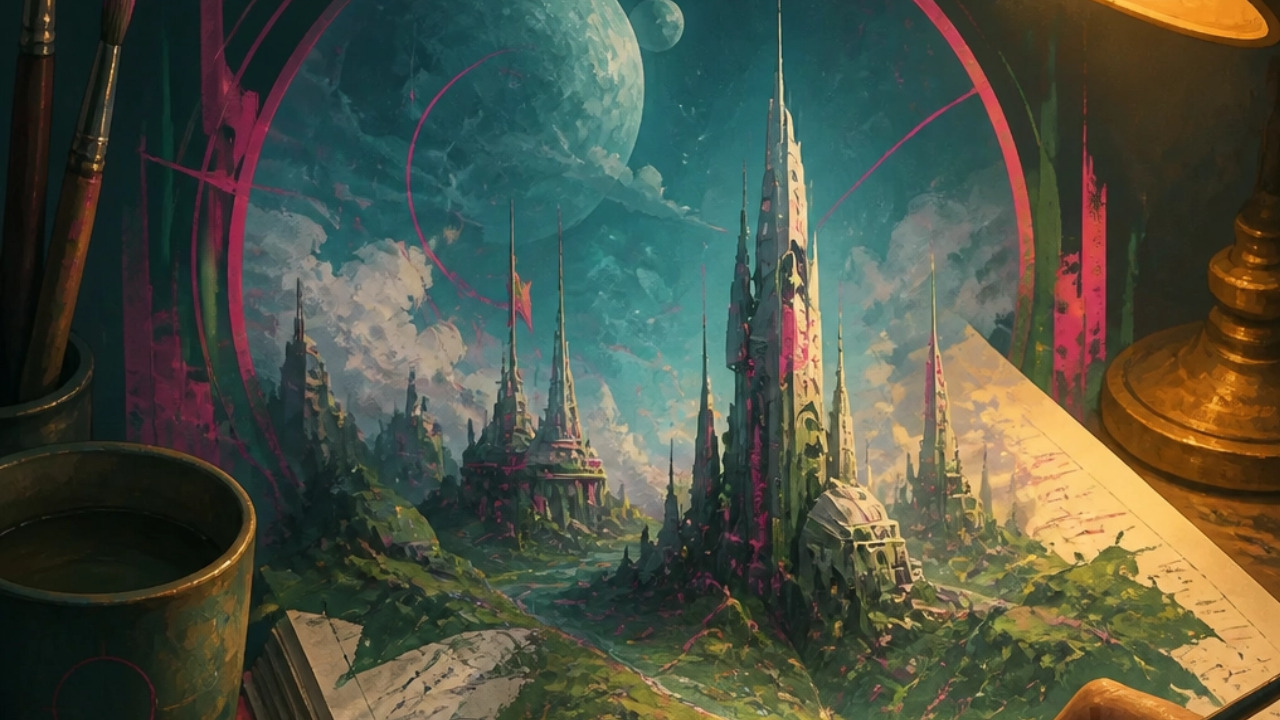
An open sketchbook transforming into a detailed alien city and worldbuilding map

Worldbuilding Is Basically Asking “Then What?”

Worldbuilding can sound intimidating.

You hear the word and immediately picture maps covering an entire wall, twelve thousand years of fictional history, invented languages, family trees, trade routes, religious schisms, and somebody explaining a currency system nobody asked about.

It can be that.

It does not have to start there.

Most of the time it begins with one thing.

Say you have a city on a planet where massive storms never stop.

Fine.

How do people get around?

Maybe nobody builds tall buildings.

Maybe the city is underground.

Where does food come from?

How does somebody make money?

Who owns whatever technology keeps everyone alive?

What happens when that system breaks?

Now you are building a world.

You did not need a map.

You needed another question.

That is what I like about worldbuilding when I am trying to get unstuck creatively.

It gives the imagination some rails without telling it exactly where to go.

Start with a red desert.

That is just an image.

Now say the people living there collect all their water from morning fog.

Better.

Then decide the families who control the fog collectors are also the families with political power.

Now something is happening.

You can feel the world starting to push back.

I find the same thing happening with miniature painting.

A figure starts as plastic.

Then I pick colors.

Add wear.

Change the base.

Suddenly I am wondering where this person has been.

Why is the armor damaged?

Who made the weapon?

What kind of place leaves that color of dust behind?

That is part of what keeps pulling me deeper into miniature painting.

The miniature becomes a tiny worldbuilding prompt sitting on the desk.

It does not need a complete answer.

It just needs to make me ask one more question.

I Get Stuck When I Demand the Finished Thing Too Early

This is probably one of my bigger creative problems.

I want to know whether the idea is worth doing before I have actually done enough with it to find out.

That sounds ridiculous when I write it down.

Still true.

I want the finished story.

The finished article.

The finished paint scheme.

The finished world.

And if I cannot see that finished version clearly enough, I can convince myself the idea is not ready.

Sometimes I just kill it there.

Science fiction is useful because the genre is very comfortable with unfinished questions.

What happens if people can share memories?

Maybe it creates empathy.

Maybe privacy collapses.

Probably both.

What if a machine can predict violent crime incredibly well?

Sounds useful.

Until it predicts you.

What happens when people live for three hundred years?

Maybe relationships become deeper.

Maybe everyone gets really good at avoiding commitment.

You do not need to decide immediately.

Stay with the question.

Turn it around.

Make the optimistic version.

Then make the ugly version.

Usually the interesting version is somewhere in between.

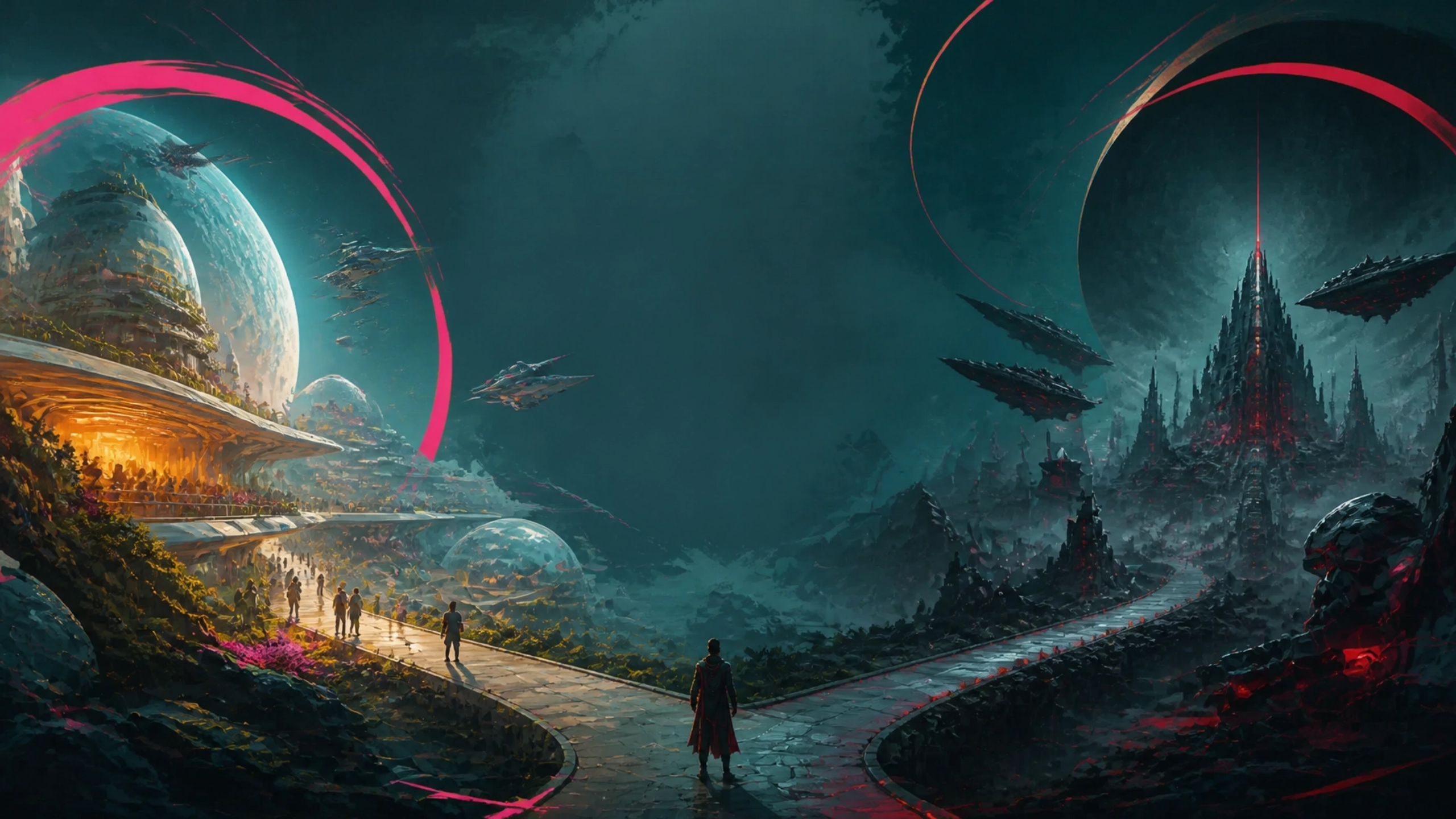
Three circular portals showing alternative futures and speculative worlds

That is where science fiction becomes useful beyond cool technology and alien planets.

It lets us take an idea and poke at it.

Who benefits?

Who gets left out?

Who controls it?

Who hates it?

What does the first generation think about it?

What does the fifth generation think is completely normal?

Now we are getting somewhere.

A Few Ways I Use Sci-Fi to Get Creativity Moving

I do not think the answer is just consuming more stuff.

Trust me, I am perfectly capable of buying another book and calling it creative research.

Sometimes that counts.

Sometimes I am just buying another book.

The useful part is doing something with the idea afterward.

Here are a few easy ways to start.

1. Steal the Question, Not the Answer

Pick something from a story that stuck with you.

Do not copy the spaceship.

Figure out why the spaceship interested you.

Maybe it is because everyone on board lives for generations.

Good.

That is your question now.

What happens when a ship becomes somebody’s entire world?

Or maybe the interesting thing was a city controlled by an algorithm.

Forget the specific city.

Ask what happens when people stop understanding how the rules governing their lives are being made.

Take the question somewhere else.

That is usually more useful than borrowing the surface.

2. Write Something Tiny

Do not start with Chapter One.

That is how you accidentally give yourself homework.

Write 100 words.

A courier lands on the wrong moon.

Someone finds an old robot under their house.

A city changes its laws every morning.

A kid gets a message from the adult version of themselves.

That is enough.

You only need one person, one problem, and enough room for something to happen.

If you want to keep going afterward, great.

If not, you still made something.

3. Give an Ordinary Object a Different World

Pick something sitting near you.

A coffee mug.

Headphones.

A key.

A receipt.

Now pretend it came from somewhere else.

Who owns it?

What is it made from?

Is it valuable?

Disposable?

Illegal?

Would somebody from that world understand why you use it the way you do?

This gets weird faster than you would think.

A key gets especially interesting in a society where nobody owns physical property.

Now why does it exist?

There is your story.

4. Make Something You Can Touch

Draw a bad map.

Seriously.

It can be terrible.

Paint a miniature.

Cut images out and make a mood board.

Build something out of cardboard.

Make a fake newspaper clipping from your fictional city.

Sketch a building you have no idea how to actually draw.

The point is getting the idea out of your head.

Sometimes the moment it becomes physical, you notice something you could not see while you were just thinking about it.

A small creative worktable where a miniature structure and blank materials become an imagined ecosystem

Creativity Has to Fit Inside the Life I Actually Have

This is the part I keep coming back to.

I can create the perfect imaginary version of my creative life pretty easily.

I have hours every day.

The office is clean.

Nobody needs anything.

I am completely rested.

Every idea works.

Apparently I also live in science fiction.

My actual life has work, family, responsibilities, unfinished chores, tired evenings, kids, schedules, and plenty of days where I do not feel especially creative.

Waiting for all of that to clear out is not a plan.

That was a big part of why I wrote Returning to Creativity: Why I’m Making EpicAgain.

I am trying to figure out how creativity fits inside the life I already have.

Not some imaginary life where I suddenly get six uninterrupted hours every afternoon.

Sometimes I get ten minutes.

Fine.

Ten minutes is enough to write down a strange idea.

Or sketch a doorway.

Or paint one part of a miniature.

Or think through why the people in some imaginary city never build windows.

That still counts.

I am slowly trying to stop treating small creative work like it is the consolation prize.

Sometimes small is how you stay connected.

The Spark Usually Looks Smaller Than I Expect

I think I spent a long time expecting creativity to come back dramatically.

Some huge idea.

A rush of motivation.

Suddenly I would be writing every night and finishing projects again.

That sounds nice.

It is also not usually how it happens.

More often, I notice something.

A color.

A line in a book.

A weird ship design.

A miniature somebody else painted.

Then I start thinking about it.

One question shows up.

Then another.

Maybe I make a note.

That is usually the spark.

Tiny.

Easy to ignore.

And if I follow it for a little while, sometimes it turns into something bigger.

Keep Following the Weird Thing

I am still figuring out exactly what Creative Spark is going to become.

That feels appropriate.

Some months it will probably be writing.

Other months painting, worldbuilding, hobbies, routines, movies, games, or whatever else has managed to get my imagination moving.

I do not want this series to become another collection of advice telling busy people they just need better discipline.

That is not what I am looking for.

I want to pay attention to the things that actually make me want to create again.

Science fiction happens to be one of the biggest.

It gives me impossible places to visit.

Then it sends me home with questions.

Every once in a while, one of those questions refuses to leave.

That is usually when I know I should follow it.

Returning to Creativity? 20 Sci-Fi Worlds to Rekindle Your Creative Spark

Sometimes creativity does not disappear.

It just gets harder to reach.

I know that feeling pretty well. The notebook stays closed. The idea you were excited about a week ago suddenly feels flat. You still like the same books, movies, games, and worlds you always have, but for some reason they feel farther away than they used to.

When I get stuck there, I usually end up back in science fiction.

Not because reading another book magically fixes anything.

It usually doesn’t.

But science fiction is very good at shaking loose the part of my brain that starts asking questions again.

What would it actually feel like to live on a world with almost no water?

Maybe the alien really is alien, instead of a person with different skin and a strange forehead.

If travel between worlds depends on one resource, what does that do to politics?

And what happens to a civilization where nobody really has to work?

Those questions are often enough to get something moving again.

So this is not a ranking of the twenty greatest science-fiction worlds ever made. I am not trying to settle that argument.

These are twenty settings I keep finding useful when I want to start imagining again.

Some are enormous.

Some barely explain themselves.

A few are probably more memorable because of one great idea than because every corner of the world makes perfect sense.

That is fine too.

1. Arrakis, Dune by Frank Herbert

Arrakis is still one of the best examples of what happens when a world starts with one brutal fact and actually follows it all the way through.

There is almost no water.

That affects everything.

Clothing. Religion. Politics. Hospitality. War. Trade. Death.

Then Herbert adds spice, which happens to be the most valuable substance in human civilization, and suddenly this miserable desert planet becomes one of the most important places in the universe.

That is the part of Dune I keep coming back to.

The setting doesn’t feel built out of random cool ideas stacked on top of each other. Most of it feels connected.

Change the water supply and you change the culture.

Change who controls spice and you change politics far beyond Arrakis itself.

When I am trying to build a world and it starts getting bloated, Arrakis is a good reminder to stop adding things for a minute and ask whether I have fully explored the consequences of what is already there.

2. Ringworld, Ringworld by Larry Niven

Sometimes I need the exact opposite lesson.

Sometimes the idea needs to get much bigger.

Larry Niven’s Ringworld is a gigantic artificial structure wrapped around a star.

It is ridiculous in scale.

That is why it works.

Just trying to picture the thing starts creating questions.

How do you manage weather on something that size?

What happens to cultures separated by distances larger than entire planets?

Who built it?

Why?

What breaks after thousands or millions of years?

Ringworld is where I go when I catch myself thinking too small.

Not every story needs a megastructure, obviously.

But sometimes the interesting version of an idea is not another city or colony.

Sometimes you need to blow the walls out.

3. Solaris, Solaris by Stanisław Lem

A lot of science fiction says it wants to imagine alien intelligence.

Then the alien starts talking like a human within twenty minutes.

Solaris does something much stranger.

The planet is covered by an ocean that appears to be intelligent.

Maybe.

It might be trying to communicate.

Maybe.

It might also be doing something humans are simply incapable of understanding.

That uncertainty is the whole reason it works for me.

There is a temptation in worldbuilding to explain everything eventually.

Name it.

Categorize it.

Write the encyclopedia entry.

Solaris pushes in the other direction.

Maybe the unknown gets to stay unknown.

And maybe the fact that humans cannot understand something is more interesting than another scene where somebody translates the alien language.

4. Rama, Rendezvous with Rama by Arthur C. Clarke

Rama is basically one enormous unanswered question flying through the solar system.

Humans find it.

Then they go inside.

They start exploring, but understanding never really catches up.

I love that.

Clarke gives you corridors, strange systems, landscapes inside a spacecraft, machinery doing things nobody fully understands.

Then he lets you sit with it.

There is a lot of confidence in that kind of restraint.

You do not have to explain the ancient machine five minutes after the characters discover it.

Sometimes the locked door is better while it is still locked.

An open book transforming into a desert planet, orbital ring, alien ocean, and cylindrical spacecraft

5. The Culture, Iain M. Banks

Most science fiction is very comfortable with scarcity.

There is not enough food.

Not enough fuel, land, or time.

The Culture makes a different problem.

What happens when you mostly solve that stuff?

This is a civilization where incredibly powerful artificial intelligences called Minds do much of the heavy lifting. Material needs are basically handled.

So the interesting problems move somewhere else.

Should the Culture interfere with other civilizations?

Can you claim to value freedom while quietly manipulating entire societies?

What does ambition even look like when you can have almost anything?

I like the Culture because it reminds me that a setting does not need everybody fighting over bread to create conflict.

Give people everything.

They will find something else to argue about.

Probably something worse.

6. The Hainish Cycle, Ursula K. Le Guin

Le Guin is one of the writers I return to when I need to remember that worldbuilding is about people before it is about maps.

The Hainish stories move between different human societies scattered across different worlds.

Each one changes some assumption.

Gender.

Family.

Politics.

Social structure.

Language.

Then Le Guin follows the consequences.

That is what makes these stories so useful.

The planet itself can be interesting, but the real question is usually what kind of people emerge from living there.

If you change one cultural assumption, what else has to change with it?

That question can keep you busy for a very long time.

7. Hyperion and the Worldweb, The Hyperion Cantos by Dan Simmons

Hyperion should probably feel like too many things smashed together.

Religion.

Artificial intelligence.

Instant travel.

Poetry.

Pilgrimage.

Time problems.

Ancient mysteries.

Body horror.

Somehow it holds.

Mostly.

And that “mostly” is part of why I like it.

There is a weird confidence to a setting that lets myth and technology occupy the same space without constantly stopping to explain how they are supposed to fit together.

I think about that a lot when building science fiction.

We sometimes get obsessed with making everything line up perfectly.

Real cultures are messy.

Belief does not disappear because somebody invented a faster spaceship.

Old stories survive new technology.

People carry contradictions with them.

A world probably should too.

8. Panem, The Hunger Games by Suzanne Collins

Panem is not the biggest world on this list.

It might be one of the clearest.

You know very quickly who has power and who does not.

More importantly, you can see it in everyday life.

Food.

Clothing.

Jobs.

Travel.

Television.

Public ceremonies.

Even the way people are expected to perform emotion becomes political.

That is useful.

When I am thinking about some giant empire or government in a fictional world, it is easy to get stuck up at the policy level.

Who runs what?

Which faction controls which region?

Fine.

But what does that mean for somebody making breakfast?

That is where the world actually starts to feel real.

9. The Matrix

The world of The Matrix works because almost everything looks normal.

Office buildings.

Apartments.

Phones.

Traffic.

Bad cubicles.

Then somebody tells you none of it is real.

That one shift changes everything.

I still think this is one of the cleanest science-fiction premises ever built.

What if the world you accept every day is fake?

You can build a lot from that question.

More importantly, you do not need seventeen pages of setup to understand why it matters.

Sometimes worldbuilding gets stronger when the central idea can be said in one sentence.

10. The Star Wars Galaxy

Star Wars is probably one of the reasons I love science fiction in the first place.

And yes, I know it is as much fantasy as science fiction.

I don’t care.

The galaxy feels enormous because places actually feel different from each other.

Tatooine does not feel like Coruscant.

Coruscant does not feel like Endor.

A grimy little cantina and a giant capital city can exist in the same setting without flattening each other.

There is also a looseness to Star Wars that I think is worth remembering.

Not everything needs a technical explanation.

a strange creature can just be sitting at the bar.

Sometimes the old ship looks old because people have been repairing it for years.

That weird monk has a laser sword.

Worldbuilding can have rules without becoming allergic to fun.

11. The Star Trek Universe

Star Trek comes at science fiction from almost the opposite direction.

The unknown is usually something worth approaching.

Maybe carefully.

Sometimes very carefully.

But curiosity matters.

A lot of Star Trek episodes are basically philosophical problems wearing alien makeup.

What counts as life?

When should you interfere?

Who gets rights?

What happens when technology changes a society faster than its culture can handle?

That structure is great for creative work.

Build a world around a question and then drop people into it.

You do not always need a giant war.

Sometimes the problem is two civilizations trying to understand each other badly.

That is plenty.

12. The Halo Universe

Halo hooked me with big ring-shaped worlds and soldiers fighting aliens.

The thing that made the setting stick was everything buried underneath that.

The Forerunners.

The Flood.

Covenant religion.

Human history.

Ancient technology nobody alive fully understands.

The setting constantly gives you the feeling that everyone is living in the ruins of something much bigger than themselves.

That is a good feeling to steal.

Not the actual ruins.

The sense of age.

I like worlds where the current civilization did not invent everything it uses.

Someone came before.

Something happened.

Most people only understand pieces of it.

History should leave junk behind.

13. Mass Effect’s Milky Way

Mass Effect might be one of my favorite examples of making a galaxy feel connected.

Not just populated.

Connected.

Species have fought wars.

Governments remember old grudges.

Trade routes matter.

Technology spreads between cultures.

People stereotype each other.

Alliances exist because of things that happened before the player ever showed up.

That history gives the setting weight.

The krogan are not simply “the warrior species.”

The quarians are not simply “the people in suits.”

Everybody has baggage.

That is what makes them feel alive.

If two cultures have known each other for hundreds of years, they should have opinions about each other.

Probably unfair ones.

A collage of a neon simulated city, starship bridge, alien architecture, and distant planets

14. No Man’s Sky

No Man’s Sky is different because most of its worlds are generated by systems.

That could have made the whole thing feel empty.

Sometimes it does.

But there is also something creatively useful about seeing familiar ingredients recombine into things you would not have chosen yourself.

Maybe you get a red ocean.

Another planet has some bizarre animal wandering around.

Then you land on a frozen world filled with giant plants.

Eventually you find a landscape that just looks completely wrong.

Randomness can break habits.

That is useful when you keep designing the same planet over and over without realizing it.

Give yourself a few rules.

Roll something unexpected.

Then make it make sense.

15. The Dying Earth of Cage of Souls

I love settings that feel old.

Not fake-old, where somebody put moss on a ruin.

Actually tired.

Cage of Souls takes place on an Earth so far into the future that humanity itself feels like something that has already had its moment.

Things are breaking.

Knowledge has been lost.

Nature has become strange.

People keep living anyway.

That is a very different kind of worldbuilding than imagining the shiny new colony.

What does civilization look like after the golden age?

What do people keep fixing long after they have forgotten how it was originally built?

Decay creates its own kind of creativity.

16. The Mulefa World, His Dark Materials

The Mulefa are one of those ideas that could have been completely ridiculous.

They use naturally occurring seed pods as wheels.

That sentence should probably not work.

But it does because the biology, environment, and behavior connect.

That is the lesson I take from it.

You can get very strange.

You just have to follow through.

“Weird” is not the same thing as random.

If an animal evolves in a strange way, what else changes around it?

How does it move?

What kind of terrain does it need?

What does that do to tools and culture?

Keep asking.

Eventually the weird thing starts feeling obvious.

17. Pyrrus, Deathworld by Harry Harrison

Pyrrus is basically a planet that wants humans dead.

The plants are dangerous.

So are the animals.

Even the environment itself seems determined to make survival miserable.

The whole ecosystem appears to respond to human presence with escalating hostility.

I like it because the planet itself becomes part of the conflict.

A lot of fictional environments are scenery.

Characters travel across them while the actual story happens somewhere else.

Pyrrus will not let you do that.

The world is the problem.

That is a useful question to ask when designing a setting.

What if the environment stopped being background?

18. The Grid, Tron

I love the basic trick behind Tron.

Take something abstract and make it physical.

Programs become people.

Data becomes geography.

Computer systems become places you can actually enter.

Once you start thinking that way, the exercise gets strange pretty quickly.

What does a memory look like if you can walk into it?

What would an argument look like as a physical place?

Could a rumor move through a city?

Could a lie decay?

You can get a lot of creative mileage out of turning something invisible into something with shape.

19. Mars, Total Recall

The Mars of Total Recall already has enough going on without the memory stuff.

Colonies.

Corporations.

Workers.

Terraforming.

Political control.

Then the story starts messing with whether the main character’s memories are even real.

That makes the setting feel unstable in a way I really enjoy.

The physical world is dangerous.

So is your own perception of it.

I tend to like stories that make reality slippery.

Not everything needs a giant twist.

But uncertainty can change how a reader looks at every part of a world.

20. Guardians of the Galaxy

This one is here because science fiction is allowed to be fun.

That sounds obvious.

Sometimes I forget it anyway.

The cosmic side of Guardians of the Galaxy throws weird planets, alien prisons, dead civilizations, outlaw crews, giant space stations, ridiculous creatures, and old technology into the same universe.

It moves.

It jokes.

Then every once in a while it gets surprisingly sad.

I like that mix.

A world does not have to stay in one emotional lane.

You can have grief sitting next to something completely ridiculous.

You can have wonder without treating everything like sacred scripture.

Sometimes the strange planet can just be a strange planet.

A person walking through an unfinished science-fiction city made of sketches, portals, maps, and alien ecology

How I Actually Use This Stuff

I don’t think the useful part of reading science fiction is finding something cool and copying it.

That usually leads somewhere pretty obvious.

The better move is figuring out what made the idea stick.

Take Arrakis.

The useful lesson is not “build a desert planet.”

It is consequences.

Take Solaris.

The lesson is not “make an intelligent ocean.”

It is letting something remain genuinely unknowable.

Ringworld is scale.

Mass Effect is history between cultures.

Panem is power showing up in ordinary life.

Those ideas can go somewhere completely different.

One exercise I like is grabbing three of them and forcing them into the same small scene.

Do not design the entire galaxy.

Write somebody eating dinner.

Or repairing a machine.

Or trying to get home.

Maybe the world has Arrakis-style resource scarcity, Mass Effect-style political history, and something nobody understands lurking underneath it like Solaris.

Fine.

What does that do to dinner?

That sounds small because it is small.

That is the point.

I have spent enough time dreaming up giant civilizations to know that the giant civilization is usually the easy part.

The hard part is making one person feel like they actually live there.

What do they complain about?

Think about what they take for granted.

Maybe they are absolutely wrong about something everyone around them accepts as obvious.

And there should be things they never bother explaining because, to them, everybody already knows.

Start there.

The big map can wait.

That is part of what I am trying to do with Epic Again anyway.

I want to go back through the science fiction that made me love this stuff in the first place, find the pieces that still get my imagination moving, and use some of that energy to build something of my own.

You can find more of that in the science-fiction collection and the Books category.

The Original Universe is where a lot of my own worldbuilding is slowly starting to take shape.

And if the bigger problem is finding the time or energy to make anything at all, I have also been writing about making time to create and about why science fiction still feels like home.

I don’t really believe creativity comes back because you finally find the perfect system.

Sometimes you just see one strange idea and your brain starts chewing on it.

That can be enough.

One question turns into another.

Then maybe there is a person.

A place.

A problem.

And suddenly you are building again.

Science Fiction and Identity: Why It Still Feels Like Home

I keep coming back to science fiction. Not necessarily the same books, movies, games, or fictional universes. Some stay with me longer than others. Some change when I come back to them. A few probably survive better in memory than they do under close inspection years later. But the genre itself never really seems to leave. Give me a ruined civilization, an impossible machine, a distant world, a collapsing empire, or a messy argument about whether something that looks human actually is human, and I’m interested. There is something familiar about those stories even when everything inside them is deliberately strange. That is probably why science fiction still feels a little like home.

At Some Point, Stories Stop Being Things You Watched

There are stories you enjoy and move on from. Then there are stories that somehow become part of the equipment you use to understand every story that comes afterward. You recognize ideas because you’ve seen another version of them before. New worlds remind you of old ones. A character makes a choice and somewhere in the back of your head another character from another story is standing there making the opposite one. The references accumulate. Eventually, being a lifelong science fiction fan isn’t just a list of things you have watched or read. Those stories become part of your vocabulary. And I don’t mean trivia. Knowing the designation of every spaceship in a fictional navy is certainly a kind of knowledge, although perhaps one best deployed carefully at dinner parties. I mean the ideas underneath it. The questions. The types of worlds that immediately make sense to you because you’ve spent so much time wandering around inside variations of them. There is actual research behind the idea that fiction can become entangled with the way we understand ourselves. Work on fiction reading and narrative identity has explored how fictional stories can interact with memories, emotions, and the stories people construct about their own lives. I don’t need science to tell me that a good story can stick with someone. But it is interesting that the sticking part may be more important than we usually admit.
Some stories stop being things you consumed. They become part of the language you use to understand everything that comes after them.

Science Fiction Gave Me Questions Bigger Than the Spaceships

To be clear, the spaceships help. I am not above a good spaceship. But the thing that keeps pulling me toward science fiction isn’t really the technology. It’s what the genre gets to do with it. Science fiction can take a question we already have and make it enormous. What makes someone human? Now make a machine that remembers being human. What happens when political power becomes too concentrated? Now stretch the empire across thousands of worlds. What happens when technology advances faster than our ability to decide whether we should use it? Give humanity another twenty thousand years and see how badly we can complicate the answer. This is one reason questions of identity are so persistent in science fiction. The Encyclopedia of Science Fiction‘s entry on identity runs through clones, memory changes, cyborgs, uploaded minds, duplicated people, parallel selves, and all the other cheerful ways the genre has found to make “Who am I?” substantially more difficult. And that is just one question. Science fiction gives us room to ask what happens to faith when civilization changes beyond recognition. Whether progress actually makes people better. What survives when institutions collapse. What happens when survival requires a moral compromise. Whether humanity can escape the same cycles if we just move them to another planet. Sometimes the answer is hopeful. Sometimes everyone is eaten. It’s a flexible genre.

The Worlds I Keep Circling Back To Aren’t Very Much Alike

This is part of what makes trying to explain a lifelong attachment to science fiction difficult. “Science fiction” covers an absurd amount of territory. Dune, Blade Runner, and Warhammer 40,000 can all fit somewhere beneath the same enormous genre umbrella, but they are doing very different things once you get underneath the machinery. And I think that difference is part of the appeal.

Dune Makes the Future Feel Ancient

One of the things that stands out to me about Dune is how little its distant future feels like the clean technological future we are often promised. It is full of old houses, inherited power, religion, ritual, prophecy, political marriages, human ambition, and institutions that have had enough time to become almost geological. The technology is futuristic. The people remain extremely human. That is more interesting to me than a future where technical progress conveniently solves all the old problems. Civilization can invent astonishing things and still carry pride, greed, faith, fear, loyalty, tribalism, love, and the desire for power right along with it. Apparently those fit in the luggage.

Blade Runner Turns Humanity Into the Question

Blade Runner comes at science fiction from somewhere else entirely. Its technology matters, but the more interesting problem is what happens when the distinction between a manufactured person and a “real” person becomes harder to defend than everyone would prefer. Memory. Mortality. Empathy. Creation. Identity. The machinery exists to make those questions unavoidable. That kind of science fiction sticks with me because the speculative idea isn’t merely there to make the world look different. It puts pressure on something we already believe.

Warhammer 40K Asks What Happens When Everything Goes Wrong

Warhammer 40,000 takes a somewhat less restrained approach. Humanity reaches the distant future and discovers that nearly every problem can, in fact, become worse. Much worse. But underneath the enormous armies, impossible scale, religious imagery, alien civilizations, psychic horrors, and machinery decorated with a statistically concerning number of skulls, there are still recognizable questions. What happens when institutions survive longer than anyone remembers why they existed? What does faith look like when it becomes inseparable from political power? What happens when survival becomes the justification for almost anything? What parts of humanity survive an empire that has forgotten most of its own history? The setting exaggerates everything until it becomes grotesque. And sometimes exaggeration makes an idea easier to see.

Coming Back to Old Science Fiction Is a Strange Experience

The interesting thing about returning to old stories is that the story has been sitting there doing absolutely nothing. You are the thing that changed. That can be inconvenient. Something that once seemed incredibly profound may suddenly sound like it was written by a philosophy student who discovered Nietzsche two hours ago. Characters you barely noticed can become the most interesting people in the story. A straightforward hero can look more complicated. A villain’s argument can become more understandable without becoming correct. And themes that went straight past you before can suddenly become impossible to miss. That’s one reason I don’t think sci-fi nostalgia is quite enough to explain why these stories keep mattering. Nostalgia wants the old thing to remain exactly where we left it. Good science fiction often doesn’t cooperate. You bring more life back with you every time you return. Family. Work. Faith. Failure. Responsibility. Things you’ve learned. Things you were very certain about before discovering that certainty was doing most of the work. The story hasn’t grown up. You have.
The story hasn’t changed. You bring a different person back to it.

Being a Science Fiction Fan Becomes Its Own Language

Spend enough time around science fiction and you start collecting a weird shared vocabulary. Not literally the vocabulary, although there is plenty of that too. The references. The visual shorthand. The arguments that apparently have no natural end point. You can tell another fan that something feels very Dune, very cyberpunk, very Star Trek, very grimdark, or suspiciously like someone reinvented a concept science fiction writers have been worrying about since before either of you were born. And they probably know what you mean. Fandom becomes a kind of shared cultural memory. That doesn’t mean everyone likes the same things. If anything, science fiction fandom has produced heroic amounts of disagreement over stories about imaginary futures. But even the arguments come from caring about the same broad territory. The ships matter because somebody imagined them. The lore matters because we spent time learning it. The stories matter because they gave us something worth arguing about afterward. At a certain point, saying “I’m a science fiction fan” tells people something about you that goes beyond a preferred shelf at the bookstore.

Science Fiction Also Taught Me What I Want to Create

This is probably where science fiction connects most directly to what I’m doing with EpicAgain now. There is a point where consuming fictional worlds starts creating another urge. You start wondering how they were built. Why this civilization works the way it does. Why the writer chose this technology but rejected another. What assumptions are hiding underneath the setting. What you would change. What question you would ask instead. And eventually, at least for me, looking at other people’s worlds makes me want to build some of my own. That is a big part of why worldbuilding has a place inside EpicAgain. I don’t want to reproduce Dune, Blade Runner, Warhammer 40,000, or any of the other things feeding the creative machine. I want to understand why parts of those worlds work, what questions underneath them continue to bother me, and then push those questions somewhere else. That is also what I’m beginning to do through the original universe I’m building here. Science fiction gave me worlds to explore for years. Now I want to see what happens when I start building one.

Home Doesn’t Have to Mean Comfortable

Calling science fiction “home” sounds warmer than a lot of science fiction deserves. There are dying worlds. Totalitarian states. Body horror. Alien parasites. Machines asking uncomfortable questions about personhood. Entire civilizations making decisions that suggest somebody should perhaps confiscate the keys. Cozy. But I don’t mean home as comfort. I mean recognition. I know this territory. I know the kinds of questions hiding behind the impossible technology and ruined civilizations. I recognize the curiosity that drives someone to imagine a world that doesn’t exist and then spend an unreasonable amount of time deciding how its transportation system works. The details change. The scale changes. The future changes. The urge behind it feels familiar.
Science fiction feels like home not because it is comfortable. It feels like home because my imagination recognizes the territory.

I’m Still Looking for the Next One

There is a trap waiting for anyone who has loved something for a long time. You can start believing the best version of it already happened. The best movies were the ones you grew up with. The best books were the ones you found at exactly the right age. Everything new gets judged against a memory with twenty years of polishing behind it. I don’t want to do that. Part of The Creative Return is going back to things that mattered to me, but the point isn’t to live there. I want to find new stories too. New writers. New worlds. New ideas that make me reconsider old ones. Stories that irritate me for interesting reasons. Stories that do something I would never have thought to do myself. And somewhere in all of that, I want to make some stories of my own. Maybe that is the real reason science fiction still feels like home. I know this kind of place. I still don’t know what I’ll find in the next room. “`

Returning to Creativity: Why I’m Making EpicAgain

Life got busy. The imagination never left. I don’t think I ever stopped being creative. I just stopped making enough things. There is a difference between those two ideas, though it took me a while to notice it. The interests were still there. Stories still pulled me in. Games, art, strange worlds, history, miniatures, writing, design, and all the other things that make my brain wander off somewhere interesting never really disappeared. But actually creating something of my own? That got pushed further and further down the list. Life has a pretty effective system for doing that. Work needs attention. Family needs attention. The house needs something. There is another practice, appointment, project, deadline, bill, email, or small domestic emergency involving an object that worked perfectly yesterday. None of those things are bad. Most of them matter quite a bit. But somewhere in all of that, I started missing a part of myself I hadn’t realized I was neglecting. That is a big part of why I’m making EpicAgain.

I Don’t Think Creativity Ever Really Left

When people talk about returning to creativity, it can sound like creativity is something we completely lose. I’m not sure that’s what happened to me. I never stopped being interested in creative things. If anything, I probably surrounded myself with more of them. Books. Games. Movies. Art. Miniatures. Ideas. Projects I wanted to try. Things I wanted to learn. Stories that sent my brain down completely unnecessary rabbit holes for the next three days. The problem was that enjoying creative things and making creative things slowly became two different parts of my life. Consuming is easy to fit into the cracks. You can watch something after everyone goes to bed. Read a few pages. Scroll through somebody else’s artwork. Look at a beautifully painted miniature and confidently think, I should try that sometime. Sometime is very accommodating. It never complains when you move something there. Creating asks a little more from you. You have to start, you have to make choices. You have to be bad at something for a while. Sometimes you need space, tools, uninterrupted time, or enough mental energy left at the end of the day to form a coherent thought. And slowly, without making any deliberate decision to stop, I made less.

I don’t think the creative part disappeared. I think it got crowded.

Life Got Busy. Then It Stayed Busy.

There was no dramatic moment when I packed away creativity and announced that adulthood had officially begun. That would almost be easier. Instead, responsibilities accumulated in the very ordinary way they tend to. Career. Family. Schedules. Commitments. Things that needed to be handled because I was the person who needed to handle them. One season of life rolls into another, and eventually you realize something you meant to get back to has been waiting for years. I think that happens to a lot of adults. Especially when we start treating creative work as the thing we are allowed to do once everything else is finished. That sounds responsible. It is also a fantastic way to never create anything again. Because everything else is never finished. There will always be laundry, always be work, always be another email somebody decided was urgent at 4:47 on a Friday afternoon. There will always be a reason that tonight would be easier if you just watched something instead. And again, none of this makes adulthood the enemy. I like my life. The people and responsibilities filling it are not obstacles standing between me and some imaginary pure creative existence. I’m not trying to escape them so I can retreat to a candlelit tower and finally finish my masterpiece while somebody else figures out what the kids are eating. That isn’t the point.

If creativity matters, it probably has to exist inside the life I actually have. Not the life I might have once things calm down.

That question, how to make creativity fit inside a life that is already full, is something I want to keep exploring through Making Time to Create.

My Kids Made Me Notice What Was Missing

One of the strange things about becoming a parent is getting a front-row seat to imagination before adulthood has had much chance to organize it. Kids don’t need everything to have a purpose. They can become interested in something because it is interesting. Kids can make something because making it sounds fun. They can care deeply about an idea that has absolutely no measurable effect on quarterly performance. There is something refreshing about that. And watching my kids has made me think more about my own relationship with creativity. Not because I suddenly decided I needed to become some sort of model Creative Dad who turns every Saturday into an elaborate family craft project. That sounds exhausting for everyone involved. It was simpler than that. Their excitement reminded me how much I still wanted to make things myself. How much I missed following an idea just because I wanted to know where it went. How much I missed learning something new without needing it to advance my career, improve a metric, solve a problem, or become useful in some defensible adult way. And maybe most importantly, it made me think about what I want them to see in me. I want my kids to know adulthood does not have to mean slowly trading every curiosity you have for responsibility. You can be responsible and still make things. People can take care of people and still have interests of your own. You can build a career, raise a family, have obligations, be tired more often than seems medically reasonable, and still decide that imagination deserves some room. I needed that reminder too.

Returning to Creativity Doesn’t Mean Going Back

I think this is the part of returning to creativity that interests me most. I’m not trying to go backward. There is no previous version of me waiting somewhere that I need to recover perfectly. I’m older now. My interests are different. The skills are different. Life’s responsibilities are definitely different. So are the things I want to make. That means rediscovering creativity cannot just be nostalgia. I don’t want to recreate exactly how I thought or worked twenty years ago. I want to take whatever survived those twenty years and see what it can do now. The things we experience while creativity sits quietly in the background still become part of us. Work teaches things. Parenthood teaches things. Failure certainly teaches things, although it tends to use a fairly obnoxious curriculum. All of that comes back with you. So maybe returning is the wrong mental picture. This feels more like continuing something that went quiet for a while.

You are not loading an old save file. You are starting the next part with a much stranger inventory.

That idea is really the heart of The Creative Return. I’m less interested in recreating who I used to be than figuring out what that creative part of me looks like now.

So I’m Making EpicAgain

EpicAgain is my attempt to give all of this somewhere to happen. Not just somewhere to talk about wanting to create. Somewhere to actually create. I want to write more. Build worlds. Tell stories. Paint things. Learn new skills. Explore games and hobbies that catch my attention. Dig into ideas that probably do not need to become anything useful. Try projects that might work and some that almost certainly won’t. I want to document parts of that process too. Not because I think my way of doing any of this will become the definitive method for creative adults everywhere. It won’t. I’m figuring it out. That is part of the point. EpicAgain can be a place for finished things, but I also want it to be a place for the messy middle. The learning. The experiments. The half-formed ideas that become better ideas. The projects that change direction halfway through because the original plan turned out to be terrible. I’ll use What I’m Learning for some of those discoveries, Writing Updates for the stories and worlds taking shape, and Monthly Progress as a place to occasionally look up from the workbench and see whether any of this is actually moving. There should be room for all of it. Because I suspect one of the things that keeps adults from rediscovering creativity is the feeling that we should already be good at whatever we choose to do. Kids generally have no such problem. Adults will avoid trying something for six years because the first attempt might look slightly embarrassing. I would like to get over that.

I Don’t Know Exactly What This Turns Into Yet

There is a temptation when starting something like EpicAgain to pretend the entire map already exists. It doesn’t. I have ideas. Plenty of them, probably more than is useful. But I don’t know exactly which projects will stick. I don’t know which hobbies will become long-term obsessions and which ones will send me enthusiastically buying supplies before quietly disappearing three weeks later. Just like I’ll never know what I will make that I’m genuinely proud of. I also don’t know what I’m going to make that will look ridiculous in hindsight. Probably several things. Good.

I don’t want EpicAgain to become a monument to having everything figured out. I want it to be evidence that I started.

And then kept going. Some weeks that might mean a lot gets made. Other weeks, life will win. That doesn’t mean the whole thing failed. I think I spent too long unconsciously treating creativity as something that required ideal conditions. Enough time. Enough energy. The right setup. A fully developed idea. Permission, apparently, from an imaginary committee that has never once returned my emails. I’m less interested in waiting for that now. Building EpicAgain will be where I document some of this site’s own evolution too, including the parts that change once I actually start using the thing instead of endlessly planning what it could become.

Maybe You Never Lost It Either

If you found this because you are thinking about your own personal creative journey, maybe some of this feels familiar. Maybe there was something you used to make. You wrote stories. Drew constantly. Played music. Built models. Took photographs. Painted. Designed games. Made videos. Invented worlds. Took things apart and rebuilt them into something they were absolutely not intended to become. Then life got bigger. And that part of you got smaller. Or at least quieter. I don’t think the answer is necessarily to blow up your schedule, find six uninterrupted hours every day, and announce to your family that you are now pursuing Art. Most of us probably need something much less dramatic. Make one thing. Pick something back up. Try the hobby you keep watching other people enjoy. Write the page. Paint the miniature. Draw the bad drawing. Build the weird little project nobody asked for. See if that part of you is still there. I have a feeling it probably is. That is what EpicAgain is for me. Not going back. Making something again.