Two free guides. One small creative adventure. Start your adventure here!

Your Healer UI Has Become a Cockpit: The 3-Layer Setup That Helps You See the Dungeon Again

The tank’s health drops. A warning flashes. Something on the floor begins glowing in the deeply suspicious way that means it would rather you weren’t standing there.

And where are your eyes?

On five little rectangles in the corner of the screen, trying to figure out which icon just changed color.

If you’ve ever finished a dungeon and realized you barely saw the dungeon, welcome to a peculiar healer problem. We have become extraordinarily good at building interfaces that tell us everything, then wondering why we feel as though we can see nothing.

This isn’t an argument for deleting your addons, throwing away years of muscle memory, or healing entirely by vibes. Some information is essential. Some customization is an accessibility need. And some healers genuinely thrive with a dense, carefully designed layout.

But if your screen feels more like a flight deck than a fantasy adventure, there is a gentler way to organize it. You don’t need to rebuild everything tonight. You need to decide what deserves your attention right now, what can wait for a glance, and what belongs on a shelf until you actually need it.

I call it the Three-Layer Healer UI.

The real problem: every alert thinks it’s the main character

Most healer interfaces don’t become crowded overnight. You add a party frame because you need to track health. Then a cooldown display because you missed a defensive. Then an alert because you missed the cooldown display. Then a second alert because the first alert was hiding behind your character’s feet.

Each addition makes sense on its own. Together, they can become a small parliament of urgent flashing rectangles, all demanding the floor.

The trouble is not simply how much information you have. It’s how many things are competing to be noticed at the same moment. A dispellable debuff, a teammate’s missing health, an upcoming boss ability, and a cosmetic buff timer do not deserve equal visual authority.

When everything is urgent, you spend energy deciding what to look at before you can even decide what to do. That extra decision is especially rough for returning players who are already relearning spell names, dungeon routes, and what half the new glowing effects mean.

So the goal is not minimalism for its own sake. A beautiful empty screen that conceals a lethal debuff is not a successful design. The goal is a readable hierarchy: the right information, in the right place, at the right moment.

The Three-Layer Healer UI

Think of your screen as three zones, each with a different job. The closer information sits to the action, the faster it should help you make a decision. The farther away it sits, the less frequently you should need it during a pull.

Layer 1: Act Now, near your character

This is the information that changes what you do in the next second or two. It belongs near the area where you already watch movement, enemies, and your character.

Examples include an important enemy cast, a dangerous ground effect, a critical personal defensive becoming available, or a boss warning that means move now. Your exact selection will depend on the content you play and the tools your version of WoW supports.

Layer 1 should be small and selective. You are not trying to reproduce your entire action bar in the center of the screen. You are giving the genuinely urgent information a clear place to land.

A useful test: if this indicator vanished for ten seconds, could that cause an immediate mistake? If yes, it might belong here. If the answer is merely ‘I like knowing it,’ it probably doesn’t.

Be careful with duplicates. If the game already provides a clear warning for an important cast, ask whether another giant icon and a second sound actually help. Sometimes they do. Sometimes they just make the first warning harder to notice.

Keep your character and the surrounding floor visible. A warning that helps you survive one mechanic but hides the next one is a remarkably expensive bargain.

Layer 2: Patient Status, in your party or raid frames

This is your healer’s workbench: who needs help, who is in danger, who has a relevant effect, and which teammate needs your next spell.

For five-player content, place your party frames close enough to your normal field of view that checking them feels like a glance rather than a journey. They do not have to sit directly beneath your character. They do have to be easy for you to read while moving.

Make health levels unmistakable. Make important dispellable effects visible. Keep relevant heal-over-time or class-specific status information where you can interpret it without deciphering a row of tiny stamps. If you use click-casting or mouseover bindings, preserve the controls that let you respond comfortably.

But resist the temptation to turn every frame into a miniature character sheet. A teammate’s health, a dangerous debuff, and a major defensive may matter during a pull. A dozen minor icons often don’t.

Here is the question that cleans up Layer 2: ‘Will this change who I heal, what I cast, or whether I wait?’ If not, it may not need permanent space on your patient frames.

Readable is more important than compact. If you need larger frames, stronger contrast, or more obvious debuff markers, use them. This framework is about reducing competition for your attention, not making everything tiny.

Raid healing may require different positioning, sizes, and priorities than a five-player dungeon. That is fine. The layers are a decision-making model, not a sacred pixel map.

Layer 3: Reference, farther from the action

This is the shelf for information that helps you plan but does not need to interrupt every moment: longer cooldowns, secondary utility, less urgent resource details, or a boss timeline you consult between bursts of action.

Put it at the edges of your comfortable viewing area, not in a place where you will never find it. Reference does not mean irrelevant. It means you choose when to look, instead of the interface constantly dragging your eyes there.

For example, knowing that a large healing cooldown will be ready in forty seconds may shape your plan. You probably don’t need a flashing centerpiece announcing that fact for the entire forty seconds.

This is also where optional information can live when you’re learning a specialization. A returning Restoration Shaman might appreciate a visible reminder of a utility ability. A Preservation Evoker learning unfamiliar tools may want more reference support for a while. As the knowledge becomes familiar, some reminders can graduate off the screen.

Your UI should be allowed to change as you learn. Keeping training wheels forever isn’t a moral failing, but you also don’t have to keep every training wheel you have ever attached.

The 20-minute cockpit audit

Before changing anything, take a screenshot of your current UI and save your existing profile or layout if your tools allow it. The ability to go back makes experimentation far less intimidating.

Now open your interface somewhere safe, preferably outside combat, and look at every cluster of icons, bars, warnings, and frames.

First, label each cluster: Act Now, Patient Status, or Reference. Don’t move anything yet. Just decide what job it is supposed to do.

Second, circle duplicates. Do you have two different indicators for the same cooldown? Three warnings for one mechanic? A buff icon repeated in the center, on your target, and inside your party frames? Decide which version you actually use.

Third, identify the orphans. These are elements you cannot confidently place in any layer. Maybe they were important two expansions ago. Maybe a guide told you to install them. Maybe you simply don’t remember what they do.

Don’t immediately delete an orphan if it might be important for accessibility, class mechanics, or difficult content. Hide or disable one low-risk item at a time, make a note of what you changed, and test in forgiving content. If something important disappears, restore it.

Fourth, check your sightline. Can you see your feet, the nearest enemy cast, and your party’s health without sweeping your gaze from one edge of the monitor to the other? If not, consider moving the most important clusters closer together.

Finally, stop. Twenty minutes is enough for one pass. This is supposed to make your next dungeon easier, not become a six-hour home renovation project with a side quest in font selection.

Try the UI detox dungeon

The best way to test an interface is to use it, but please don’t make an unfamiliar high-stakes key your experimental laboratory. Pick an easy dungeon or other forgiving group content appropriate to your level. Tell friends you’re testing your UI if that makes the run more comfortable.

Run 1: Notice

Play with your current setup. After each boss, ask yourself: Where were my eyes? What did I miss in the world? Which alert actually changed my decision? You are gathering evidence, not grading your performance.

Run 2: Remove one duplicate

Choose one redundant indicator or nonessential visual element. Disable only that item. Keep the information you rely on for dangerous mechanics, dispels, accessibility, and healing decisions. Run similarly easy content again.

Run 3: Reposition

Move one important element into the layer where it belongs. Maybe party frames come a little closer to center. Maybe a long cooldown tracker moves away. Maybe a warning gets smaller so you can see the floor beneath it.

Run 4: Keep what earns its place

After another run, ask what you missed. Restore anything whose absence made play less safe or more stressful. Keep changes that made your decisions clearer. There is no trophy for having the fewest addons, and no shame in discovering that a particular tracker really is useful.

If you have only twenty minutes tonight, do one stage. The experiment works better as a series of small adjustments than as a dramatic midnight purge.

What Midnight changed, and what it didn’t

World of Warcraft’s Midnight era makes this conversation especially relevant. Blizzard changed how combat addons can access and process live combat information, while continuing to allow many kinds of visual customization. In its official explanations, Blizzard drew a distinction between displaying information and having addons analyze combat state to make decisions.

The built-in interface has also been evolving. Blizzard’s Midnight pre-expansion notes describe improvements to the Cooldown Manager, boss warnings, and layout options. Later notes included larger default raid frames and additional customization. Those are useful starting points, especially for someone rebuilding an old healer setup.

That does not mean the default UI is perfect for every healer. It also does not mean every addon is gone or that a third-party frame package is automatically better. Different specializations, group sizes, and accessibility needs still call for different solutions.

Start by seeing what the current game already shows you. Then add or customize only what solves a problem you can name. Check current patch notes before following an older setup guide, because a once-essential workaround may now be built in, or an older addon feature may no longer work the same way.

Most importantly, do not confuse the game’s changing addon rules with the underlying principle. Whether an indicator comes from Blizzard’s UI or an addon, it still needs a clear job.

How to tell whether your UI is actually better

A cleaner screenshot is pleasant, but it isn’t the victory condition. After a few low-pressure runs, look for changes in your experience.

Did you notice more of the dungeon around your character? Were dangerous casts or floor effects easier to catch? Could you identify the teammate who needed help without reading six other icons first? Did you feel less compelled to stare at the frames between every spell?

There is also a less obvious measure: how easily could you recover after a mistake? A useful interface should help you regain your bearings, not punish you with another avalanche of alerts.

If you miss critical information, the layout needs another adjustment. If you can finally see the encounter while still keeping your party safe, you’re moving in the right direction.

You are allowed to look up from the dashboard

Healing can feel intensely personal. Someone’s health bar empties and your brain immediately starts writing a performance review. That pressure makes it tempting to install one more warning, one more tracker, one more safety net.

Sometimes the missing piece really is information. Other times, the missing piece is space to notice what is already happening.

The Three-Layer Healer UI is not a perfect configuration you download. It is a habit of asking every visual element to justify the attention it consumes: Do I need to act now? Do I need to understand a patient’s status? Or is this useful reference material for later?

Try one small change before your next easy dungeon. Save your old layout, move one thing, remove one duplicate, and pay attention to how the run feels. You can always put something back.

Azeroth is full of wonderful, ridiculous things happening beyond the party frames. The point of building a better healer UI is not to become a more efficient rectangle-watcher.

It’s to heal your group and still get to see the adventure.
 

You Do Not Need a Warhammer PhD: The Beginner’s Road From “That Army Looks Cool” to Your First Game

It usually starts with one miniature.

A towering armored warrior. A strange little goblin riding something with far too many teeth. An elegant alien skimmer that looks like it should be illegal to park in a normal garage.

You stop scrolling. You look closer. You think, “That looks cool.”

And then you make the dangerous mistake of asking the internet how to start Warhammer.

Suddenly you are being introduced to several fictional millennia, multiple game systems, army-building advice, rules discussions, painting equipment, edition changes, and an argument about which faction is supposedly doomed this month. You came here because of one excellent plastic wizard. Now you appear to be enrolling in a postgraduate program.

The good news is that Warhammer does not require an entrance exam. The bad news is that the hobby has so many interesting doors that beginners often try to walk through all of them at once.

So here is a smaller plan: pick the door that matches what made you curious. You can open the others later.

First, Decide What You Actually Want From Warhammer

Warhammer is not one activity. It is a collection of overlapping hobbies. Some people spend their evenings painting individual models. Some want tactical games with friends. Others get lost in novels, art, factions, and the absurdly elaborate history of these worlds. Plenty eventually do all three, but that does not mean you have to start with all three.

Try this question: if you could only do one Warhammer thing next weekend, what would make you happiest?

Door One: “I want to paint something.”

Door Two: “I want to play a game.”

Door Three: “I want to explore the story.”

That answer is your starting point, not a lifetime contract. Choosing a door means you can stop researching the entire hobby and do one real thing.

Door One: I Want to Paint Something

If the miniature itself grabbed you, start there. You do not need an army list to paint a miniature. You do not even need to know whether its faction wins games.

Your first quest is wonderfully unimpressive: choose one model you genuinely like and get paint on it.

One model. Not a starter army. Not a thirty-color shopping basket. Not a beautifully organized workstation that requires moving the dining room into the garage.

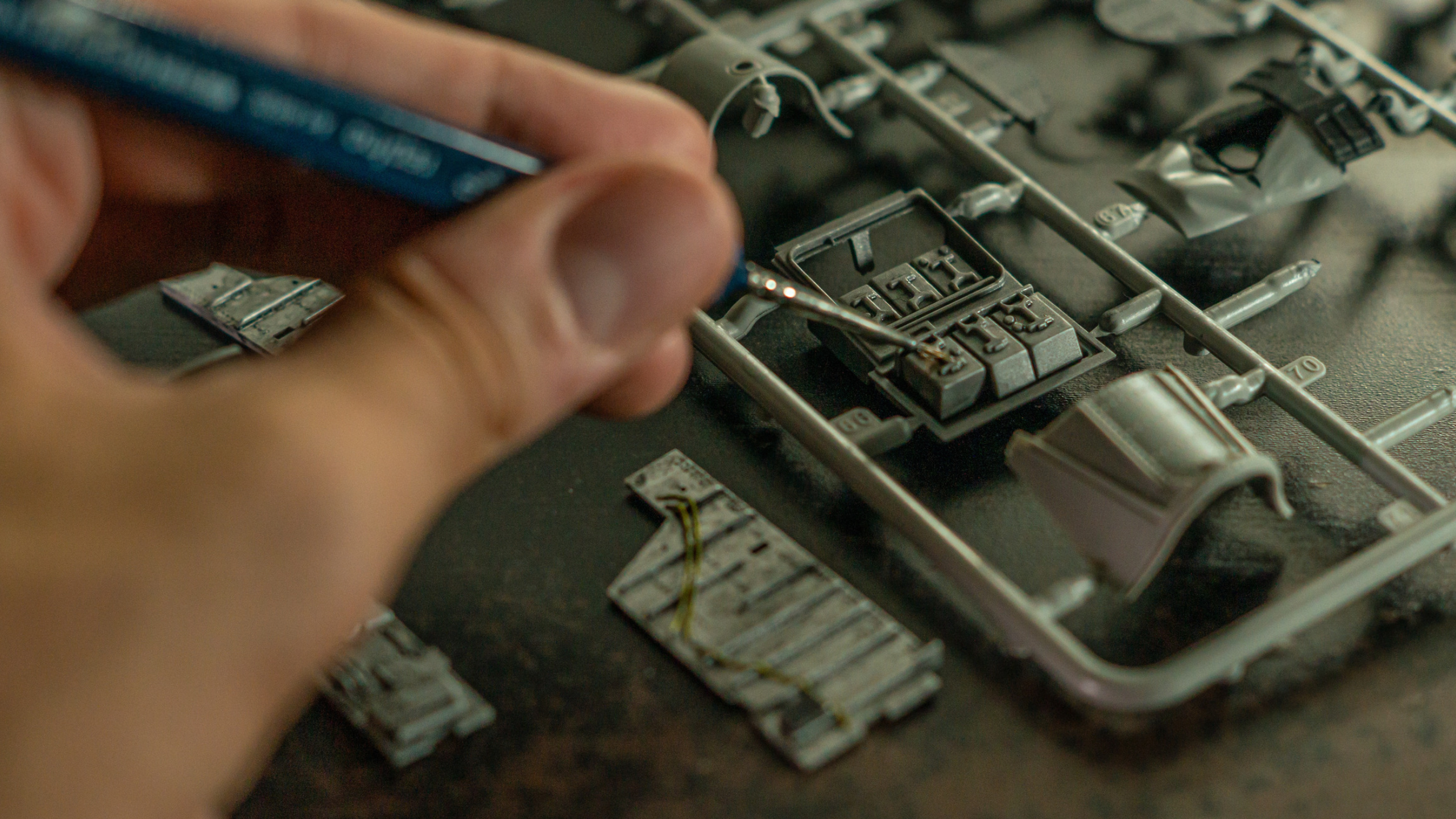
Look for an introductory miniature-and-paint set if you want a straightforward bundle. Warhammer Colour publishes beginner tutorials covering basic preparation, basecoating, shading, drybrushing, and other techniques. You can follow one simple guide or pick a few colors and experiment.

A sensible first setup is a model, the supplies needed to assemble it safely, an appropriate primer if the paint process calls for one, a small selection of paints, a brush, water, and a surface you can clean. Follow safety instructions for tools and paints, especially around children. You can acquire fancy lighting and seventeen specialty brushes after you know you enjoy holding the first one.

For your first paint session, aim to finish one visible section. An armor plate. A cloak. A shield. A suspiciously expressive goblin face.

The first model is not a job interview. It is a place to find out whether you enjoy the process.

When I started choosing an Aeldari army, I was interested in how the models looked and how much room they gave me to experiment with color. The project even took a different turn when my daughter became interested in pink space elves. That was a useful reminder: a paint scheme can be a creative choice, not a test of whether you copied the box correctly.

If you discover that you love painting but do not particularly care about playing, you are still doing Warhammer. No imaginary hobby inspector is going to confiscate your brush.

Door Two: I Want to Play a Game

If the appeal is moving tiny armies across a table, making risky decisions, and watching dice ruin your excellent plans, begin with a format designed to be manageable.

For Warhammer 40,000, look at Combat Patrol. It uses compact, predefined forces so you can learn the game without immediately building a giant custom army list. As of the July 2026 update, Games Workshop says the Combat Patrol rules in its Warhammer 40,000 app are free, without needing a Codex or subscription for that content. Check that the specific force you are considering is supported in the current app, especially if you are buying an older secondhand box.

For Warhammer Age of Sigmar, look at Spearhead. It is a smaller format using predefined forces from dedicated boxed sets, with downloadable rules for each Spearhead. It is built to get players into games without first assembling a sprawling army.

Neither option means “buy the box immediately.” In fact, I would suggest the opposite first.

Your first quest is to watch or join one introductory game. Ask a local hobby shop, club, or Warhammer store whether someone runs demonstrations or beginner nights. Ask whether you can borrow an army or watch a teaching game. A friendly player explaining why that unit just charged the wrong thing can be more useful than three hours of video tutorials.

If you are learning with a friend, use a beginner-oriented starter set or arrange to borrow suitable forces, dice, terrain, measuring tools, and any format-specific cards or materials. Free rules do not necessarily mean you already own every physical thing required for a game. Check the current format requirements before purchasing.

For game one, measure success by what you understood, not the final score. Did you learn how a turn works? Did you move toward an objective? Did you understand one ability better by the end? Excellent. Your troops have already achieved more than many fictional military commanders.

Door Three: I Want the Story

Maybe you are here because the setting caught you. That is a perfectly good reason to start, and it may be the least expensive door to open.

Warhammer 40,000 offers a far-future galaxy full of empires, aliens, ancient grudges, and a truly irresponsible quantity of skulls. Age of Sigmar is a high-fantasy setting of realms, gods, monsters, cities, and armies with very different ideas about civilization.

Do not start with a demand to understand the complete timeline. Pick one faction you find intriguing and one conflict involving them.

Your first quest is to answer three questions: Who are these people? What do they want? Who or what is in their way?

Read a short official faction introduction, sample a story, or explore a beginner-friendly novel connected to that group. If a character or setting hooks you, follow it. If not, switch factions. There is no prize for stubbornly studying a corner of the lore you do not enjoy.

The lore door can also lead to painting or gaming later. A favorite character might make you want a model for your shelf. A battle you read about might make you curious about how the tabletop game represents it. But the reading was never just preparation. Enjoying the world is already participation.

Warhammer 40,000 or Age of Sigmar?

You can spend days researching which game is the better investment. A simpler question is which world you want to spend time in.

Does science-fiction warfare, alien technology, and ancient space civilizations make you curious? Start by exploring 40K.

Do you want fantastical creatures, magical realms, monsters, and armored heroes? Age of Sigmar may be the more interesting doorway.

This is not a claim that one is easier, cheaper, or better for everyone. Your local community matters too. If your friends play one game every Thursday and nobody nearby plays the other, that is useful information if tabletop gaming is your goal.

And if you are mostly painting or reading, the local player count matters much less. The best universe for your first miniature may simply be the one whose models you keep coming back to look at.

Choosing a Faction Without Turning It Into Homework

There is a temptation to search for the best beginner faction. That can help if you know exactly what kind of game experience you want, but “best” is often doing far too much work in that sentence.

Try the Three-Yes Test instead.

First: Do I like looking at these models? You may spend many evenings assembling and painting them. Visual interest matters.

Second: Does the faction’s general story or battlefield personality interest me? You do not need to know every rule. You just need a reason to be curious.

Third: Can I imagine enjoying a small first project with them, even if I lose my early games or change my color scheme?

If you have three yeses, you have a strong candidate. If you only have one, keep exploring before making a large purchase.

I chose Aeldari because their fast, specialized style interested me, their models looked fun to paint, and the idea of space elves made the project feel inviting at home. That choice does not guarantee easy games. It gives me a reason to keep learning.

Rules and competitive rankings can change. Your affection for a weird little army of tree spirits, skeletons, or futuristic warriors is a much sturdier foundation.

The “Do Not Buy Yet” Box

Warhammer has a remarkable ability to make the next purchase feel like the thing standing between you and having fun. Sometimes it is. Often it is not.

Before you know which door you enjoy, postpone the big army expansion, the premium painting station, the huge collection of paints, and the stack of faction books you have not yet learned how to use.

If you are painting, one small project will teach you what supplies you actually need next.

If you are playing, confirm the current rules and materials for your chosen format, and ask your local group what they use before buying books or older boxed sets. A standalone force box may not include an opponent’s army, a board, terrain, or all the accessories needed to play.

If you are reading, do not buy six novels because someone says they are essential. Finish one story and see whether you want another.

There is no shame in buying hobby supplies you love and can afford. But buying everything before doing anything can turn curiosity into an expensive waiting room. Your goal is to discover the activity, not assemble a museum gift shop.

Your Seven-Day First Quest

You do not need seven days of free evenings. Think of this as seven tiny decisions you can spread across a week or two.

Day 1: Pick your door. Painting, playing, or story. Write it down.

Day 2: Choose two factions that catch your eye. Do not research the entire roster.

Day 3: Give each faction the Three-Yes Test. Pick one to explore first.

Day 4: Find your smallest next action. One miniature, one beginner game, or one short piece of lore.

Day 5: Check what you already have or can borrow. Make a short shopping list only if something is genuinely missing.

Day 6: Spend twenty minutes doing the hobby, not preparing to do it. Put down paint, watch or join the teaching game, or read the story.

Day 7: Ask what you want to do again. That is your next quest.

Notice what is missing: no deadline to finish an army, no requirement to memorize every rule, no pressure to select a permanent faction, and no promise that the first miniature will look like the studio photograph.

If life interrupts halfway through, nothing has been lost. Pick up at the next small action. Hobbies are allowed to fit around real life.

A Note to the Veteran Helping a New Player

If a friend asks how to get into Warhammer, you have a wonderful opportunity to make the door smaller rather than showing them the entire castle.

Ask what attracted them first. Then help them do that thing.

If they love painting, hand them a model and a brush. If they want to play, offer a simple teaching game with borrowed miniatures. If they love the story, recommend one approachable entry point connected to a faction they already like.

Save the competitive meta, edition history, and fifteen exceptions to the rules for the moment they become useful. Enthusiasm is generous, but a fire hose of knowledge can feel remarkably similar to a locked gate.

The best introduction is one that leaves someone excited to come back.

You Are Allowed to Begin Before You Understand

There will always be more Warhammer than you know. More models, more stories, more rules, more painting techniques, more opinions about whether that particular shade of blue is technically correct.

Good. That means the hobby has room to grow with you.

You do not need to master it before you start. You need one small reason to begin and one next action that fits your actual life.

That model you stopped scrolling for? Go look at it again. Decide whether you want to paint it, play with it, or learn why it exists.

Pick a door. Take the tiny first quest. The rest of the world can wait until you are ready to explore it.

Warhammer Pile of Shame? Build a Hobby Queue Instead

Your Pile of Shame Is Lying to You: Turn the Gray Mountain Back Into a Hobby

The first box is exciting. You open it, look at the sprues, imagine the colors, and briefly become the kind of person who absolutely has a plan for every miniature.

Then another box arrives. Perhaps there is a starter set you wanted, a character model that looks fantastic, or a discount that seemed rude to ignore. Life gets busy. A few assembled models wait for primer. A few primed models wait for paint. Somewhere in the cupboard, an unopened army is developing its own civilization.

Warhammer players have a name for this: the pile of shame.

It is a funny name right up until you start believing it. A hobby that was supposed to offer a few hours of creativity begins to resemble a warehouse with a very disappointed manager.

Here is the part I think we get wrong: unpainted plastic is not a debt. It is a collection of possible projects. The problem begins when every box on the shelf gets an equal vote in what you should do next.

You do not necessarily need to paint faster. You need to be able to choose again.

When the Joke Starts Sounding Like an Invoice

The pile of shame joke works because nearly everyone who collects miniatures recognizes some version of it. We buy a model because it looks wonderful. We set it aside for a free weekend. Then the free weekend goes somewhere else, usually into laundry, errands, family plans, or recovering from the week.

There is nothing especially mysterious about that. A miniature is not an emergency. It should be allowed to wait.

But the language we use changes how the shelf feels. If every unpainted model is unfinished business, then even sitting down to paint one miniature can feel insufficient. You finished a Guardian? Lovely. There are forty-nine more behind it, and the large centerpiece model has been staring at you since spring.

Now your hobby session has a performance review.

That does not mean every collection is healthy or every purchase was wise. Buying beyond your budget or available space deserves an honest look. But guilt is a poor project manager. It tells you everything is urgent while offering no useful advice about where to begin.

What helps is separating the pleasure of owning options from the decision of what you want to work on next.

Stop Counting Models. Start Counting Hours.

A pile of forty miniatures sounds like one number. It is not one amount of work.

Forty simple infantry models are different from forty highly detailed characters. A single large vehicle might take more of your attention than an entire squad. Assembly, cleanup, priming, painting, basing, and the inevitable moment when you decide the shoulder pads need another color all count.

So make a rough estimate in hours. Not because you should schedule every brushstroke, but because time is the resource your adult life actually asks you to manage.

Imagine ten infantry models that you think will take forty-five minutes each to paint to a finish you like. That is roughly seven and a half hours, before setup or assembly. Add a centerpiece you expect to spend four hours on, and you are already looking at more than eleven hours. Those are examples, not universal painting speeds.

If you paint for thirty minutes twice a week, eleven hours represents quite a few evenings. That is not a moral failing. It is a useful reality check.

Write an estimate beside each project: one short session, a few sessions, or a longer project. If numbers make the hobby feel too much like work, use those categories instead.

The point is not to calculate how far behind you are. It is to stop promising yourself that you will finish an entire army during the mythical weekend when nothing else happens.

The Three-Box Hobby Queue

Here is the system I would use to give the shelf some breathing room. You need three boxes, three shelves, or three headings on a piece of paper. The containers can be imaginary. The decisions should be real.

Box One: Next 5 Models

Choose five miniatures you actually want to work on next. Not the five you feel most guilty about. Not necessarily the five that have been waiting longest. The five that would make you happy to sit down with a brush.

If you are working on a large vehicle or monster, let that count as several slots, or even the whole box. Five is a limit on active attention, not a weekly quota.

Keep these models easy to reach, ideally with the paints you need nearby. When you finally get twenty quiet minutes, you should not have to negotiate with the entire collection.

Box Two: Later

This is the home for projects you still genuinely want. That squad you plan to use in a future game? Later. The terrain piece that needs a clear table and a free afternoon? Later. The army you love but are not ready to start? Also Later.

Later is not a punishment box. It is a way of saying, “I still like this, and I do not have to do it today.”

Revisit it when the Next 5 are done or when your interests change. You do not need to keep shuffling every model around each night.

Box Three: Maybe Never

This is the most useful box and, for some of us, the hardest.

Maybe you bought an army because the rules sounded exciting two editions ago. Maybe you planned a huge display board before realizing you prefer painting individual characters. Maybe you inherited models that simply do not interest you.

You are allowed to change your mind.

Maybe Never does not require an immediate sale or dramatic purge. It simply removes the project from the list of promises you keep making to yourself. Later, you can trade it, gift it, sell it, use it for experiments, or leave it on the shelf without pretending it has a deadline.

The useful question is not “How much did I spend on this?” That money is already spent. The useful question is “Would I choose to spend my next ten hobby hours on this?”

Let One Joy Project Break the Rules

Every good system needs one rule that keeps it from becoming another boss fight.

For this one, it is the joy project.

At any time, you can move one miniature into your active space simply because you want to paint it. A strange little character. A monster you have been thinking about for months. A bright pink space elf that does not match the color scheme you originally planned.

No explanation required.

This is not permission to scatter twenty unfinished projects across the table. Keep the joy project to one at a time, and decide whether it replaces a Next 5 slot or temporarily sits beside it.

Why make an exception? Because a hobby queue should protect curiosity, not train it to ask permission.

When I wrote about restoring old Aeldari Guardians, the interesting part was not clearing inventory. It was having inexpensive models that gave me room to experiment with a black-and-pink scheme, make mistakes, and see what worked. The experiment was the hobby. The finished tally was secondary.

A 20-Minute Reset for the Gray Mountain

You do not need to spend an entire Saturday cataloging plastic. In fact, please do not turn this into a spreadsheet project unless spreadsheets are secretly your second hobby.

Set a timer for twenty minutes. For the first five, gather the obvious unfinished projects into view. You do not have to empty every cupboard. Start with the shelf or box that bothers you most.

For the next five, pick your Next 5. Put them somewhere visible and accessible. Ask which models you would choose if nobody were keeping score.

Spend another five sorting the rest into Later and Maybe Never. If a model is difficult to place, Later is fine. You are not making a legally binding declaration to the High Lords of Terra.

Use the last five minutes to make the first session easy. Put out the brush, select two or three paints, and write down the first action: “Prime the base,” “Paint the cloak,” or “Try pink on one shoulder plate.”

Stop when the timer ends. You can improve the system later. Today you are just making it easier to begin.

What If the Buying Really Is the Problem?

It would be too easy to say every pile is harmless and every new box is self-care. Sometimes collecting outruns the budget, the storage space, or the time you actually want to spend building and painting. That is worth noticing without turning it into a character judgment.

Try a pause before the next purchase. Ask three questions: Do I have room for it? Can I comfortably afford it? Do I want this model enough to give it some of my limited hobby time, or do I mostly want the feeling of buying something new?

If the answers are uncomfortable, set a spending limit, make a wishlist, or try a thirty-day pause on new kits. Those are boundaries, not punishments.

There is no universal rule that says you must finish a box before buying another. Some people enjoy collecting, converting, and planning as much as painting. That is a legitimate part of the hobby when it fits their means and brings them pleasure.

The warning sign is not the raw number of unpainted models. It is when purchases stop feeling like choices and start creating stress.

Your Miniatures Do Not All Need the Same Finish

Another trap hides inside the word “finished.”

A rank-and-file unit you want on the table may only need a straightforward color scheme and a tidy base. A character you love might deserve three evenings of careful highlights. A used miniature might be a test model whose entire purpose is to survive several questionable color decisions.

Those are different jobs. Give them different definitions of done.

If you play organized events, check the event’s painting requirements before deciding what is table-ready. But at your own hobby desk, you can decide whether a model is a practice piece, a playable unit, or a display project.

I like separating “ready to enjoy” from “perfect.” Perfect has a remarkable ability to keep moving whenever you get close to it.

There is no prize for giving every belt buckle the same amount of attention, especially if doing so makes you dread the next session.

A Week With Five Models, Not Fifty Promises

Suppose your Next 5 are four infantry models and one character. You have a couple of short evenings and perhaps one longer session. What does progress look like?

On the first evening, you clean up two models and decide on the base colors. That counts. On the second, you paint armor on one miniature. Also counts. If the weekend opens up, you finish a base, add a wash, or start the character. If it does not, the models are still waiting exactly where you left them.

Nothing about this requires finishing five models in seven days. “Next 5” is a focus limit, not a weekly quota.

At the end of a session, leave yourself a tiny instruction for next time. One sentence is enough. “Finish the helmets.” “Try the brighter green.” “Find the missing shield.” Future-you should not need twenty minutes to remember what past-you was doing.

If a week passes without painting, the queue has not failed. It has simply stayed put while you lived your life. That is one of its better features.

Sometimes the Best Hobby Decision Is Letting a Project Go

There may be a box on your shelf that belongs to an older version of you. Someone with different tastes, different plans, or a wildly optimistic estimate of how much free time adulthood would provide.

You do not owe that version of yourself an entire painted army.

You can keep a favorite miniature and pass the rest along. You can sell a kit to fund the project you actually want. You can decide that assembling models is fun even when painting them is not. You can leave something unfinished because the experience of working on it was enough.

This matters especially when the hobby is part of how you are trying to reconnect with creativity. The goal is not to recreate a younger person’s endless weekends. It is to find something that fits the life you have now.

The Shelf Should Invite You Back

The next time you look at your unpainted Warhammer collection, try not to see a list of overdue assignments.

See five models you want to touch next. See a Later box full of options. See a Maybe Never box that is allowed to be honest. Give yourself one joy project that can interrupt the plan when curiosity shows up with a paintbrush.

You might still have a lot of gray plastic afterward. That is fine. The number on the shelf was never the whole problem.

The better question is whether, when you finally have half an hour to yourself, the shelf makes you want to sit down and create something.

If it does, the mountain is becoming a hobby again.

Stop Looking for an Original Character: Build One Beautiful Contradiction Instead

You sit down to make a new character.

This time, you tell yourself, they are going to be original.

Not another edgy rogue.

Not another noble paladin.

Not another bard who attempts to seduce anything with a measurable pulse.

Definitely not another mysterious orphan with a hood, two daggers and a relationship with eye contact that could best be described as hostile.

You are going to create something nobody has ever seen before.

Three hours later, your character is the exiled half-vampire heir to a forgotten moon kingdom who carries the soul of an ancient dragon, cannot remember their true name, secretly serves two rival gods and owns a sentient hat.

The hat has trauma.

We may have overcorrected.

There is nothing wrong with wanting your character to feel fresh. Most of us do.

The problem is the assumption hiding underneath that goal:

A good character must begin with an original concept.

I don’t think that’s true.

In fact, trying to eliminate every recognizable trope can make character creation harder than it needs to be. You start judging ideas by whether anyone has done them before rather than whether they give you something interesting to roleplay.

And people have done almost everything before.

Warriors have been reluctant.

Necromancers have been sympathetic.

Paladins have doubted their faith.

Rogues have secretly had hearts of gold.

Somewhere, someone has probably already played your incredibly specific mushroom wizard.

That’s fine.

Originality doesn’t have to come from inventing a character nobody has ever imagined.

It can come from combining familiar pieces in a way that creates tension.

That’s where the Contradiction Engine comes in.

Tropes Aren’t the Enemy

Before we build anything, we need to stop treating tropes like creative contamination.

A trope is just something recognizable.

The noble knight.

The greedy rogue.

The curious wizard.

The angry barbarian.

The idealistic priest.

The charming bard.

You see a few details and immediately understand roughly what kind of character has walked into the tavern.

That’s useful.

Especially in roleplay.

Other players need something they can react to.

If your character requires a twelve-minute explanation before anyone understands what kind of person they’re talking to, you may have created an excellent short story protagonist and a slightly exhausting tavern companion.

Recognizable archetypes give people handles.

They provide expectations.

And expectations are valuable because expectations can be broken.

That’s where things get interesting.

An edgy rogue is not automatically a bad character.

A noble paladin is not automatically boring.

A flirtatious bard is not inherently a creative crime.

The problem starts when the archetype is the entire character.

If everything the rogue says, believes, fears and wants can be predicted from the words “edgy rogue,” there isn’t much left to discover.

You don’t need to destroy the archetype.

You need to give it something to fight with.

The Contradiction Engine

The basic method is simple.

Start with four pieces:

Archetype → Contradicting Value → Ordinary Pleasure → Social Weakness

That’s it.

You do not need a bloodline chart.

You do not need six pages of historical events.

You do not need to know what your character ate on their seventh birthday unless something truly catastrophic happened to the cake.

You need enough tension to generate decisions.

Let’s break it down.

Step One: Pick an Archetype

Start with something familiar.

Seriously.

Do not try to impress anyone yet.

Pick the thing you actually want to play.

Maybe it’s:

  • A knight
  • A thief
  • A priest
  • A scholar
  • A mercenary
  • A necromancer
  • A hunter
  • A noble
  • A healer
  • A soldier
  • A bard
  • A wandering mage

You can get more specific if your setting calls for it, but the point is to choose something immediately understandable.

Let’s use:

A warrior.

Right now, that isn’t much of a character.

That’s fine.

We haven’t turned the engine on yet.

Step Two: Give Them a Value That Creates Friction

This is the important part.

Ask:

What does this person deeply believe that makes being this archetype difficult?

Not quirky.

Difficult.

There is a difference.

“A barbarian who enjoys reading” is a nice detail.

It tells us something about them.

But unless reading creates meaningful choices, it probably won’t drive much roleplay.

Now try:

A warrior who is terrified of violence but believes protecting other people is sacred.

That creates a problem.

They don’t want to fight.

They may hate fighting.

They may freeze before a battle.

They may secretly envy people who can walk away.

But when someone else is threatened, their values drag them toward the exact thing they fear.

Now we have decisions.

Do they intervene?

Do they hesitate?

Do they resent the people who rely on them?

Do they feel ashamed of being afraid?

Do they mistake courage for fearlessness?

That character can walk into dozens of scenes and produce different outcomes without needing a prophecy.

That’s the goal.

Contradiction Is Not Just “The Opposite”

There is a tempting shortcut here.

Take an archetype and reverse it.

Strong warrior who hates fighting.

Greedy rogue who gives money away.

Necromancer who loves life.

Done.

Sometimes that works.

But the strongest contradictions usually aren’t just opposites.

They are competing truths.

Both sides of the character should make sense to them.

Consider the necromancer.

You could write:

A necromancer who hates death.

Interesting.

But let’s push it.

A necromancer who believes preserving life is sacred and studies death because they cannot accept how easily people disappear.

Now necromancy isn’t a random reversal.

It comes from the value.

Maybe every corpse is evidence of failure.

Maybe they preserve bodies with extraordinary care.

Maybe they find casual attitudes toward death horrifying.

Maybe other people assume they’re morbid while they privately think everyone else is disturbingly comfortable with mortality.

The contradiction isn’t decoration.

It shapes how they see the world.

That’s when it becomes useful.

Try the “Both Things Are True” Test

A good contradiction usually allows you to say:

Both of these things are genuinely true.

The warrior is afraid.

The warrior believes protecting people matters more than their fear.

Both are true.

The priest wants certainty.

The priest cannot stop questioning doctrine.

Both are true.

The noble genuinely believes in duty.

The noble also desperately wants a life that belongs to them.

Both are true.

You don’t need to decide which side is “the real character.”

The tension between them is the character.

Step Three: Give Them Something Wonderfully Ordinary

Characters become strange when every detail exists at maximum dramatic intensity.

They have a sacred oath.

A tragic childhood.

A forbidden power.

A bitter rival.

A secret destiny.

A scar given to them by the Emperor of Pain.

And then you ask what they do when everyone stops adventuring for ten minutes and the character appears to shut down like someone unplugged them.

People have ordinary things.

Your character should too.

Give them one completely mundane pleasure.

Maybe they love:

Fresh bread.

Fishing.

Bad romance novels.

Cooking.

Collecting cheap souvenirs.

Card games.

Tea.

Dancing badly.

Expensive soap.

Watching thunderstorms.

Fixing broken furniture.

Trying every local dessert they encounter.

This sounds small.

It isn’t.

Ordinary pleasures create easy roleplay.

Your grand tragic necromancer suddenly has an opinion about pie.

Your terrifying mercenary spends twenty minutes trying to bargain for a ridiculous ceramic bird.

Your ancient wizard knows more about regional cheeses than arcane politics.

These things give other characters somewhere safe to meet them.

Not every interaction needs to expose trauma.

Sometimes you need something to talk about while waiting for the dragon.

Step Four: Give Them a Social Weakness

Not a combat weakness.

Not “vulnerable to silver.”

Not “loses control when angry and becomes more powerful.”

That is suspiciously close to a feature.

Give them something that makes relationships harder.

Maybe they:

Cannot admit when they are wrong.

Try to fix people’s problems when people only wanted to be heard.

Apologize constantly.

Treat every disagreement like a debate.

Become overly formal when nervous.

Cannot accept compliments.

Assume people are angry with them.

Tell the truth at spectacularly inconvenient times.

Avoid asking for help.

Promise things they cannot realistically deliver.

Get jealous easily and hate that they do.

Now your character has friction with other people.

That matters because roleplaying games are social.

You can write the most fascinating internal monologue ever created, but eventually another character is going to say hello.

You need something to happen next.

Put the Four Pieces Together

Let’s build a few.

The Cowardly Warrior

Archetype: Warrior

Contradicting value: Terrified of violence, but believes protecting vulnerable people is sacred.

Ordinary pleasure: Loves cooking breakfast for other people.

Social weakness: Tries to hide fear behind sarcasm and sometimes comes across as cruel.

That character doesn’t need much more before you can start playing.

You already know what happens when danger appears.

You know what happens around a campfire.

You know what might go wrong in a tense conversation.

That’s a lot of fuel from four decisions.

The Life-Preserving Necromancer

Archetype: Necromancer

Contradicting value: Believes life is precious and studies death because they cannot accept losing people unnecessarily.

Ordinary pleasure: Collects pressed flowers.

Social weakness: Talks about grief clinically when other people need empathy.

Suddenly “necromancer” is not the personality.

It is the lens.

Imagine this character meeting someone who recently lost a family member.

They genuinely want to help.

They probably have more experience with death than almost anyone.

And they are absolutely terrible at saying the right thing.

That is a scene.

The Questioning Priest

Archetype: Devout priest

Contradicting value: Desperately wants certainty but cannot stop questioning doctrine.

Ordinary pleasure: Loves terrible mystery novels.

Social weakness: Turns sincere conversations into theological discussions when uncomfortable.

Now imagine someone asks them a simple question about faith.

They want to give reassurance.

They also see twelve philosophical problems hiding inside the wording of the question.

There goes the afternoon.

The Honorable Thief

Here’s one where the contradiction isn’t simply “thief but nice.”

Archetype: Professional thief

Contradicting value: Believes promises are sacred.

Ordinary pleasure: Loves street performances.

Social weakness: Holds grudges far longer than they should.

This person will happily steal your jewelry.

But if they gave you their word, that is different.

Now you have a moral system.

It may not be everyone else’s moral system.

That makes it even better.

The Gentle Monster Hunter

Archetype: Monster hunter

Contradicting value: Believes most dangerous creatures are frightened animals or misunderstood beings until proven otherwise.

Ordinary pleasure: Keeps a little notebook rating inns.

Social weakness: Gives dangerous people too many second chances.

Now every hunt contains a question.

Is this creature actually a monster?

When does compassion become recklessness?

What happens the first time their mercy gets someone hurt?

That’s an entire character arc waiting quietly inside one contradiction.

Why This Works Better Than “Being Original”

The problem with originality as a goal is that it gives you nothing useful to measure.

How original is original enough?

Has someone else played this before?

Does your character resemble a book character?

What if someone at another table had basically the same idea in 2017?

You can spiral forever.

But ask:

Does this character contain a meaningful tension that creates choices?

Now you can answer.

A contradiction produces motion.

It gives your character two things they want that may not peacefully coexist.

Duty and freedom.

Safety and curiosity.

Faith and doubt.

Mercy and justice.

Recognition and privacy.

Independence and belonging.

Those conflicts are ancient.

That’s not a problem.

We’ve been telling stories about them for thousands of years because they keep working.

The particular way your character wrestles with them is where the personality appears.

Complicated Does Not Mean Deep

This is another trap worth avoiding.

You can have an incredibly complicated character who isn’t especially deep.

They may have:

Three aliases.

Four organizations hunting them.

Two secret parents.

An ancient curse.

A missing sibling.

A mysterious tattoo.

A prophecy.

An evil duplicate.

And the hat.

We cannot forget the hat.

But if every situation produces the same response, there isn’t much character underneath all that architecture.

Depth doesn’t come from the number of facts in the backstory.

It comes from how beliefs collide when the character has to choose.

A simple farmer who desperately wants adventure but believes abandoning their family would be unforgivable may contain more useful roleplay tension than someone carrying seventeen paragraphs of supernatural lore.

Complexity is information.

Depth is pressure.

They can coexist.

They are not the same thing.

Your Character Does Not Need to Surprise Everyone

Sometimes we become so focused on avoiding clichés that we forget what roleplay actually requires.

Your character does not need to make everyone at the table gasp when you explain the concept.

They need to be interesting to interact with.

Those are completely different goals.

“A paladin who believes strongly in justice” sounds incredibly familiar.

Fine.

What kind of justice?

What happens when justice conflicts with mercy?

What happens when the law protects someone cruel?

What happens when breaking an oath would save someone innocent?

What happens when the paladin discovers they were wrong?

Now we are roleplaying.

The archetype gave us the starting position.

The contradictions give us somewhere to go.

You Also Don’t Need to Reveal Everything Immediately

One of the nice things about building characters this way is that you can discover them during play.

You don’t need to explain:

“My character is a cowardly warrior whose sacred belief in protection conflicts with his fear of violence.”

Please don’t.

That’s a character design note.

Let everyone else meet the person.

Maybe they notice he jokes before fights.

Maybe he volunteers to cook.

Maybe he hesitates when combat starts.

Maybe he steps forward anyway when someone is threatened.

Eventually another character asks why.

Now the contradiction has become a relationship instead of a biography.

That is much more interesting.

The Contradiction Engine in Five Minutes

If you’re staring at a blank character sheet right now, try this.

Pick an archetype you genuinely enjoy.

Then finish these four sentences:

I am a __________.

But I deeply believe __________, which makes that difficult because __________.

When nothing important is happening, I love __________.

Other people sometimes struggle with me because I __________.

Done.

You probably don’t have a finished character.

Good.

You have something better.

You have somewhere to start.

One Final Test: Does the Contradiction Create Decisions?

Before adding another paragraph of lore, ask one question:

Will this contradiction affect what my character actually does?

If not, it may simply be a fun detail.

Fun details are good.

Keep them.

But don’t confuse them with the engine.

“A barbarian who enjoys poetry” might be charming.

“A barbarian who believes anger makes people dangerous and is terrified of becoming the kind of person everyone expects them to be” changes decisions.

“A noble who likes sleeping outdoors” is texture.

“A noble who believes deeply in their family’s duty but has discovered that the family itself may be corrupt” creates pressure.

The best contradictions force choices.

And choices are where roleplay lives.

Stop Trying to Invent Something Nobody Has Seen

You probably aren’t going to create the first warrior.

Or rogue.

Or paladin.

Or conflicted priest.

Or charming criminal.

Or reluctant hero.

Good.

You don’t need to.

Start with something recognizable.

Give it one belief that makes the archetype harder to live with.

Give the character something ordinary to enjoy.

Give them one way they make relationships unnecessarily difficult.

Then start playing.

You can add the lost kingdom later if you really need it.

Maybe even the sentient hat.

But first, give the character something to wrestle with.

Because originality isn’t always inventing a new piece.

Sometimes it is taking two familiar pieces that don’t sit comfortably together and asking:

What happens when both are true?

That’s usually where the interesting character has been hiding.

The Tank Exploded. Was That Actually Your Fault? A Healer’s Guide to Knowing What You Could Have Saved

Then the tank is at half health.

Then the tank is at 10%.

Then the tank has become a decorative feature of the dungeon floor.

All of this seems to happen in roughly the amount of time it takes your brain to form the sentence:

Wait, what happened?

And if you are anything like a lot of healers, the next thought arrives almost automatically.

I should have healed more.

Maybe.

But maybe not.

That distinction is one of the most important things you can learn as a healer in World of Warcraft.

Healing puts you in a strange psychological position. Your job involves watching everyone’s health bars, so when one of those bars reaches zero, it feels personal. The evidence is sitting right there on your screen in giant empty rectangles.

Someone died.

You were the healer.

Case closed.

Except Warcraft has never really worked that way.

Tanks have tools for reducing the damage they take. Damage dealers have mechanics to avoid, enemies to interrupt and abilities that can help keep themselves alive. Healers have to choose the right spell, target and cooldown at the right moment.

Those responsibilities overlap.

Blizzard was talking about this shared responsibility as far back as Cataclysm-era dungeon design. Tanks were expected to manage incoming damage and pull appropriately, DPS were expected to understand mechanics and interrupts, and healers were expected to respond intelligently rather than somehow compensate for every mistake the other four players could manufacture.

The exact spells have changed. The dungeon design has changed. Healing itself has gone through enough redesigns to qualify for several separate archaeological periods.

The basic lesson has survived.

Being responsible for the health bars does not make you responsible for every health-bar failure.

The trick is learning how to tell the difference.

The Most Dangerous Healer Question: “Was That My Fault?”

I haven’t played at a genuinely high level since Mists of Pandaria, so I’m not going to pretend this is a cutting-edge Mythic+ dissertation written from the summit of the current competitive ladder.

It isn’t.

This is something much more basic, and I think much more useful to someone learning to heal:

How do you decide whether a death was actually something you could have prevented?

Because “I should have healed harder” is not an answer.

It is barely even a sentence.

Healing is a decision-making role. That has been part of Blizzard’s philosophy around healing for a very long time. Choosing the right tool for the situation, deciding who needs help first and reacting to incoming damage are fundamental parts of the role.

Sometimes you will make the wrong decision.

Good.

Not good good. Dead tank good is rarely good.

But those are the mistakes you can learn from.

The problem starts when you treat every death exactly the same. If you blame yourself for things you couldn’t control, you aren’t actually reviewing your play anymore. You’re just practicing feeling bad.

So instead, put deaths into one of three buckets.

The Three-Bucket Death Review

Every meaningful death can usually be thought about as one of three things:

Mine to Solve

Shared Responsibility

Never Mine to Solve

These are not courtroom verdicts.

You are not assigning dungeon crimes.

The purpose is to identify where your next improvement actually lives.

Bucket One: Mine to Solve

Let’s start with the uncomfortable one.

Sometimes it absolutely was you.

The damage was healable.

You had the tools.

You had the time.

And you made the wrong decision.

Maybe a big healing cooldown sat unused while the group slowly collapsed.

Maybe you panicked and dumped several expensive heals into someone who wasn’t actually in danger while another player quietly vanished.

Maybe you were staring at the party frames and missed something happening to your own character.

Maybe you knew heavy damage was coming but didn’t prepare for it.

Maybe you simply pressed the wrong button.

Congratulations.

You found something useful.

That might sound sarcastic, but I mean it.

A mistake that belongs in Mine to Solve is one of the best things you can find because you can actually do something about it.

The question becomes:

What could I do differently next time?

Not:

Why am I terrible at healing?

One of those questions leads to improvement.

The other leads to staring suspiciously at your character-selection screen wondering whether maybe today is finally the day you become a Hunter.

A death probably belongs here when:

  • The incoming damage was reasonably survivable.
  • You had a useful heal or cooldown available.
  • You had enough time to react.
  • There wasn’t another major mechanic preventing you from responding.
  • A different decision from you probably changes the outcome.

Notice that last word.

Probably.

You don’t need perfect certainty.

You’re trying to identify a reasonable lesson.

If your answer is, “I had a major cooldown available and completely forgot it existed,” fantastic. Next dungeon, your goal is not “be a better healer.”

Your goal is:

Remember that cooldown during heavy group damage.

Much easier.

Bucket Two: Shared Responsibility

This will probably be the largest bucket.

Warcraft groups are five people creating one enormous pile of decisions.

Sometimes several of those decisions go wrong at once.

A dangerous enemy cast isn’t interrupted.

A DPS takes avoidable damage.

The tank’s mitigation comes up late.

You react slowly.

Another mechanic goes off.

Someone moves somewhere inconvenient.

Now three health bars are plummeting, the tank is taking heavy damage, your strongest cooldown isn’t available, and your mouse has begun reconsidering its employment contract.

Could you have played better?

Possibly.

Could everyone else have played better?

Also possibly.

Welcome to Shared Responsibility.

This bucket matters because healer anxiety often turns complicated failures into simple ones.

You see:

Player died.

Your brain translates:

Healing failed.

But imagine a player takes a large hit from something avoidable, doesn’t use a defensive, then immediately gets hit by unavoidable group damage.

Could exceptional healing save them?

Maybe.

Does that mean the entire sequence becomes the healer’s responsibility?

No.

There is an important difference between:

“I could have saved that.”

and

“I should have been required to save that.”

That distinction is enormous.

Great healing sometimes rescues other people’s mistakes. That is part of what makes healing fun. Someone makes a mistake, everything catches fire, and somehow you hold the group together with two cooldowns, questionable mana efficiency and whatever spiritual agreement Restoration Shamans have apparently signed with water.

Those moments feel fantastic.

But saving a mistake does not retroactively make the mistake your responsibility.

A death probably belongs here when:

  • Your healing decisions could have been better.
  • Another player also missed an important defensive, interrupt or mechanic.
  • Multiple mistakes stacked together.
  • The situation became dangerous because the group’s execution broke down.
  • Better play from several people could have changed the result.

Your review here should not become:

Whose fault was it MORE?

That way lies madness.

Instead ask:

What part of this mess was actually mine?

Maybe the tank missed mitigation.

Fine.

Could you still have used a cooldown earlier?

That’s your lesson.

Take it.

Leave the tank’s lesson with the tank.

You already have enough buttons.

Bucket Three: Never Mine to Solve

This is the bucket new healers often struggle to accept exists.

Sometimes someone dies and there was no reasonable healing decision that would have saved them.

A mechanic instantly kills someone.

A player repeatedly stands in avoidable damage.

The tank takes an enormous hit without using something the encounter expects them to use.

Someone gets so far away or behind terrain that you cannot heal them.

A required mechanic is ignored.

Several preventable abilities go uninterrupted and the resulting damage overwhelms the group.

At some point, healing stops being the answer.

You are a healer, not a warranty covering every possible decision another player can make.

This isn’t about becoming dismissive.

You shouldn’t start watching people die while muttering, “Bucket Three,” like some sort of tiny dungeon bureaucrat.

The point is understanding that Warcraft contains damage that players are expected to prevent, avoid, interrupt, mitigate or otherwise handle before healing ever becomes the final answer.

Blizzard’s own dungeon guidance has historically emphasized exactly that. Tanks manage incoming damage. DPS deal with mechanics such as interrupts and dangerous ground effects. The healer is part of that system rather than a replacement for everyone else’s responsibilities.

A death probably belongs here when:

  • The player died essentially instantly from a failed mechanic.
  • No heal you had available could realistically cover the incoming damage.
  • The player made themselves impossible to heal through positioning.
  • Required damage reduction or encounter mechanics were ignored.
  • The group accumulated more incoming damage than healing could reasonably overcome.

There is still something you can learn from these deaths.

Maybe you can recognize the situation earlier next time.

Maybe you can reposition before the chaos starts.

Maybe you can communicate something before another attempt.

But that is different from saying:

I failed because I didn’t heal enough.

Sometimes there wasn’t enough healing in the world.

The Question That Changes Everything

When someone dies, don’t immediately ask:

“Could I have healed them more?”

You almost always could have healed someone more.

There is theoretically always another spell you might have cast, another global you could have squeezed in, another target you could have prioritized.

That question creates an impossible standard.

Instead ask:

“Was there a reasonable decision available to me that probably changes the outcome?”

That is a much better question.

If yes, you’ve found something to practice.

If maybe, you’re probably somewhere in Shared Responsibility.

If no, stop trying to invent a healing solution to a non-healing problem.

That alone can take an enormous amount of pressure out of learning the role.

The 60-Second Post-Dungeon Death Review

You do not need combat logs.

You do not need three addons.

You do not need to replay the dungeon like the Zapruder film.

When the run ends, pick one or two deaths that bothered you and spend about a minute asking five questions.

1. What actually killed them?

Was their health slowly falling?

Did they suddenly lose most of it?

Did several people get hit together?

Was there an obvious mechanic involved?

You are trying to separate healing pressure from something going wrong.

2. Could healing realistically have changed it?

Not theoretically.

Realistically.

Could one of your normal heals have stabilized them?

Could a cooldown have saved the situation?

Did they die so quickly that there was no meaningful window to respond?

This question alone will move a surprising number of deaths out of the “I failed” pile.

3. Did I have something available?

Look at your own toolkit.

Was an emergency heal ready?

Was a defensive or major healing cooldown sitting unused?

Could you have positioned differently?

Were you caught casting something low priority while someone was in real danger?

If the answer is yes, you may have found your improvement.

4. What else contributed?

Did the tank have a way to reduce the damage?

Was something interruptible?

Was the damage avoidable?

Did several mistakes happen at once?

You’re not searching for someone else to blame.

You’re reconstructing the situation accurately.

That’s a very different exercise.

5. What is ONE thing I want to do differently next time?

One.

Not seventeen.

Maybe:

Use my big cooldown earlier.

Watch the tank more closely during that pull.

Stop holding emergency abilities waiting for the perfect moment.

Move before the group damage starts.

Recognize that mechanic sooner.

Now the death has done something useful.

Review over.

Go do another dungeon.

Why New Healers Hold Their Cooldowns Too Long

There is one particular mistake worth watching for when you’re learning.

You save things.

Big cooldowns feel important, so you wait for an appropriately important moment.

Then someone dies while every major button on your bar sits there looking pristine.

This is incredibly normal.

Community advice to beginner healers has been repeating some version of “use your cooldowns” for years because newer healers often preserve them for emergencies rather than using them to prevent emergencies from developing.

This is another reason the Three-Bucket Review helps.

If several deaths keep landing in Mine to Solve because your major cooldowns were available, you’ve found a pattern.

You don’t need faster reflexes.

You might just need permission to press the giant shiny button.

Use it.

Cooldowns come back.

Dead Warriors usually become considerably less productive.

Saving Someone Doesn’t Mean You Were Supposed To

There is another trap waiting for you as you improve.

You get better at rescuing bad situations.

And suddenly you start treating every possible rescue as an obligation.

Maybe another healer could have saved that tank.

Maybe an exceptional player would have reacted faster.

Maybe there was some ridiculous sequence of abilities that theoretically keeps everyone alive.

That doesn’t automatically turn the death into your mistake.

The better you become, the more chaos you will be capable of recovering from.

That’s a skill.

It should not become a standard you use to punish yourself.

There is a difference between:

“Next time I think I can save that.”

and

“I failed because I didn’t save that.”

Keep the first one.

Throw the second one into the Twisting Nether.

Don’t Use the Buckets to Win Arguments

There is one final rule.

The Three-Bucket Death Review is for improving your own play.

It is not ammunition.

If a tank dies and you immediately announce:

“Bucket Three. Not my problem.”

you have perhaps misunderstood the spirit of the exercise.

Maybe dramatically.

Shared responsibility works both ways.

Sometimes another player makes a mistake and you could still have responded better.

Sometimes you make a mistake and another player could have used something to survive it.

Groups are messy.

Pugs are messier.

The goal isn’t to determine which stranger deserves the ceremonial Dungeon Finder Finger of Blame.

The goal is to walk away knowing something useful.

You Are Responsible for Your Decisions, Not Every Health Bar

Healing has always been an unusual role because failure is so visible.

Damage dealers can make smaller mistakes that quietly reduce their performance.

A healer makes a mistake and Steve the Rogue suddenly stops participating in combat.

There is a corpse where Steve used to be.

Very subtle.

That visibility makes it easy to internalize every death.

Don’t.

Be accountable for your healing.

Look for your mistakes.

Use your cooldowns.

Learn the fights.

Get better at recognizing danger before it arrives.

But judge yourself based on the decisions you could reasonably make, not on whether every member of the group remained immortal.

When someone dies, put the death somewhere useful:

Mine to Solve.

Learn from it.

Shared Responsibility.

Find your piece of it.

Never Mine to Solve.

Understand what happened and move on.

Sometimes the tank exploded because you missed something.

Sometimes five small mistakes combined into one magnificent disaster.

And sometimes the tank simply exploded.

Your job is learning which one happened.

Intro Guide: World of Warcraft Roleplaying

You’ve defeated dragons, explored ancient ruins, and saved Azeroth more times than you can count.

But have you ever wondered what it would be like to actually live there?

Not as the legendary champion who saves the universe every expansion, but as an ordinary person with a story of their own.

Maybe you’re a traveling merchant hoping to earn enough gold to open a shop. Perhaps you’re a young adventurer searching for your missing brother. Or maybe you’re a retired soldier who just wants to enjoy a quiet drink without another world-ending catastrophe interrupting dinner.

That’s where World of Warcraft roleplay comes in.

Roleplaying transforms Azeroth from a world you play through into a world you help bring to life. And getting started is much easier than you might think.

You don’t need to memorize twenty years of Warcraft history, create a complicated character biography, or have any previous acting experience. You only need a character, a little curiosity, and the willingness to share a story with another player.

This guide will walk you through everything you need to begin, from creating your first character to having your first actual roleplay conversation.

WHAT IS ROLEPLAY IN WORLD OF WARCRAFT?

Roleplay, often shortened to RP, means pretending to be your character and making decisions based on who that character is, rather than simply treating them as a character you control in a video game.

Think of it as collaborative storytelling. You create a character with a personality, motivations, and history. Other players do the same. When your characters meet, you interact as those characters and discover what happens together.

Unlike a traditional video game quest, there isn’t always a predetermined objective or reward. The story itself is the experience.

For example, imagine entering an inn in Stormwind. In normal gameplay, you might speak to the innkeeper, set your Hearthstone, and leave. In roleplay, your character might approach the counter and ask:

“Evening. You wouldn’t happen to have a room available, would you? Preferably one without a leaking roof.”

Another player, roleplaying the innkeeper, might respond:

“Depends. You paying in gold, or are you another adventurer offering to clear rats out of my cellar?”

Suddenly, you’re telling a story together. Maybe you negotiate the price of a room. Maybe you discover the innkeeper needs help. Maybe another traveler overhears the conversation and offers you work. None of it needs to be scripted.

That’s the magic of roleplaying.

The simplest definition: Roleplay is deciding what your character would say or do, then allowing other players to respond through their own characters.

STEP 1: CHOOSE WHERE YOU WANT TO ROLEPLAY

Before creating your character, you need to find other people who enjoy roleplaying. While you can roleplay on any World of Warcraft realm, choosing a roleplaying realm makes finding like-minded players easier.

What is an RP realm?

An RP realm is a World of Warcraft server designated for players interested in roleplay. You’ll still be able to enjoy ordinary gameplay, such as leveling, dungeons, raiding, and collecting equipment. The difference is that the realm has a community specifically interested in bringing their characters to life. You aren’t required to roleplay every second you’re online. You can spend the afternoon defeating monsters and the evening sharing stories around a tavern table.

Where should beginners start?

For modern World of Warcraft, established communities worth exploring include:

North America: Moon Guard, particularly known for Alliance RP.

North America: Wyrmrest Accord, with an established Horde RP community, including guild-led stories.

Europe: Argent Dawn, with established Alliance and Horde RP communities.

These are starting points, not guarantees of activity at any particular hour. Create a temporary character on a couple of RP realms and visit their gathering places before settling down. Spend time observing the atmosphere. Do you prefer casual conversations in a city, organized military campaigns, exploration, or smaller communities with continuing stories? Finding a group that enjoys your preferred type of storytelling matters more than blindly following a realm recommendation. You can also begin with your existing character if you find a welcoming RP community where you already play.

STEP 2: CREATE A CHARACTER YOU CAN ACTUALLY PLAY

This is where many beginners get stuck. They think they need a complete character biography before they’re allowed to start. You don’t. In fact, creating a simple character often makes your first few experiences easier. You can discover their personality, relationships, and history while playing.

The five-question character method

  1. Who are they? Choose a name, race, and simple identity. Example: A dwarf named Brannik, a traveling blacksmith.
  2. What do they want? Give them one goal. Example: He wants to earn enough gold to reopen his family’s forge.
  3. What are they like? Choose two personality traits. Example: Friendly but stubborn.
  4. What makes them interesting? Add one small problem, habit, or mystery. Example: He is terrible at remembering names.
  5. Why are they here? Give them a reason to meet other characters. Example: He is looking for adventurers who need equipment repaired.

That’s enough to begin roleplaying. Brannik now has everything he needs: a personality, a purpose, and a reason to interact with strangers. If someone approaches him, you have a starting point for deciding how he might respond.

Start small instead of starting legendary

It’s tempting to create a character who is secretly the most powerful mage in Azeroth, personally knows every faction leader, and has defeated every major villain. But these concepts can make collaborative storytelling difficult. Other players haven’t agreed that your character has those accomplishments or connections.

A traveling blacksmith, inexperienced apprentice, curious scholar, or aspiring adventurer gives you more opportunities to build relationships naturally. You don’t need to be important to the entire world. You only need to be interesting to the people your character meets.

Choose a name that belongs in Azeroth

Pick something that feels appropriate for your character’s race and background. A human named Elric, an orc named Gromak, or a dwarf named Brannik gives other players something they can recognize as a plausible fantasy name. Avoid joke names or references that disrupt the setting. RP realms also have additional character-naming rules intended to preserve immersion. Blizzard character naming guidance: https://us.support.blizzard.com/en/help/article/135764

You don’t need to find the perfect name. Just choose something appropriate that you enjoy.

STEP 3: LEARN THE THREE MOST IMPORTANT ROLEPLAY TOOLS

World of Warcraft already gives you the basic tools you need to start roleplaying. You don’t need special software to have your first conversation. You primarily need to know how to speak, describe actions, and communicate outside your character.

/say or /s: Use this when your character speaks. Type: /s Good evening. Is this seat taken? Other nearby players see your character speaking.

/emote or /e: Use this to describe what your character does. Type: /e pulls out a chair and sits down. If your character’s name is Brannik, nearby players see: Brannik pulls out a chair and sits down.

/whisper or /w: Use this to privately message another player. Type: /w Playername Hi! I’m new to RP. Would you be open to a quick interaction? Replace Playername with the recipient’s character name. Whisper mechanics and permissions can vary by account and circumstances.

Two important terms: IC and OOC

IC means In Character. You’re speaking or acting as the fictional person you’re portraying. OOC means Out of Character. You’re communicating as yourself, the player.

IC: “I’ve never trusted mages. Too many explosions.”

OOC: “Sorry, I need to leave for dinner.”

Some players use double parentheses to indicate OOC comments: ((Sorry, I have to log off. Thanks for the RP!)) Conventions vary, so private whispers or designated OOC channels are often a clearer choice when you need to discuss something unrelated to the scene. The important thing is making sure other players know whether they’re interacting with you or your character.

STEP 4: SET UP A SIMPLE ROLEPLAY PROFILE

While addons aren’t technically required for roleplay, one is particularly useful for finding other roleplayers: Total RP 3 (TRP3).

Total RP 3 is an optional addon that lets you create RP profiles, read other players’ profiles, and signal whether you’re open to roleplay. Addon page: https://www.curseforge.com/wow/addons/total-rp-3

Think of it as a small character sheet that other players can read. When someone encounters Brannik, their addon might show:

EXAMPLE FICTIONAL PROFILE

Name: Brannik Ironbrook

Identity: Dwarf | Traveling Blacksmith

Status: In Character | Walk-ups Welcome

Appearance: A stocky dwarf with a thick brown beard, soot-stained clothes, and a battered leather satchel.

Personality: Friendly, stubborn, and always eager to discuss craftsmanship.

Currently: Looking for work and asking around about a suitable place to establish a forge.

Roleplay hooks: Needs customers, knows a little about blacksmithing, and can rarely resist a good story.

Notice what this profile doesn’t include. There are no ten-page biographies, secret prophecies, or complicated family trees. It simply helps other players understand who Brannik is and gives them reasons to approach him.

What should you put in your first profile?

Start with your character’s name, a short description, a simple occupation, and one or two possible conversation starters. If you’re comfortable with strangers approaching you, clearly indicate that walk-up roleplay is welcome. If you’re not ready to roleplay, set your status to OOC where supported. A profile is a tool for communication, not a homework assignment.

STEP 5: FIND SOMEWHERE PEOPLE ARE ACTUALLY ROLEPLAYING

You’ve created your character and learned the basics. Now comes the slightly intimidating part: finding other people. Fortunately, you don’t need to search every corner of Azeroth.

Visit an RP gathering place

Many roleplaying communities have locations where characters regularly gather. Stormwind City is often a starting point for Alliance roleplay; explore public areas around Cathedral Square and the Mage Quarter. Orgrimmar’s Valley of Honor has historically hosted Horde roleplay, although organized guild activity can be easier to find than spontaneous interactions. Silvermoon City is another setting, although current-expansion phasing and sharding can make spontaneous encounters less reliable.

These locations are starting points rather than guarantees. Public events, guilds, and zone phasing affect where players gather. If a location is empty, it doesn’t mean the entire server is inactive. Try another time, check community event listings, or look for a guild.

How do you recognize someone who wants to roleplay?

Look for players who are walking rather than sprinting between objectives, speaking or using emotes in character, displaying a roleplay profile, or marked as open to walk-up interactions. These are clues, not automatic invitations. Someone might be involved in a private storyline or simply not have time. If you’re uncertain, a polite whisper can save everyone an awkward moment.

What is walk-up roleplay?

Walk-up RP means approaching another player’s character and starting an interaction without arranging it beforehand. It might be a conversation in an inn, an unexpected meeting on the road, or someone asking your character for directions. Some players love spontaneous interactions. Others prefer planned scenes with friends. Respect their preferences, and check before joining a scene whose openness is unclear.

STEP 6: HAVE YOUR FIRST ROLEPLAY INTERACTION


Your first interaction doesn’t need to be clever, dramatic, or particularly memorable. It just needs to start.


The Observe → Approach → Invite method


Observe: Notice what another character is doing. Are they sitting alone, browsing a market, or reading a notice board?

Approach: Give your character a natural reason to speak to them.

Invite: Ask a question or take an action that gives the other person something to respond to.


For example, you spot a character standing beside a marketplace stall. Your blacksmith walks over and says: “Excuse me. Would you happen to know who runs this market? I’m looking for a place to sell my work.”


That’s it. You’ve started roleplaying. You’ve given the other player something easy to respond to, and you haven’t forced the conversation in any particular direction.


Five easy conversation starters


  1. The newcomer: “Pardon me. I’ve only just arrived. Is there somewhere nearby I could find a decent meal?”
  2. The curious traveler: “That’s an unusual weapon you’ve got there. Where did you find it?”
  3. The aspiring adventurer: “You wouldn’t happen to know anyone looking for an extra pair of hands, would you?”
  4. The friendly stranger: “Mind if I join you? Every other table seems to be taken.”
  5. The person with a problem: “Bit of an odd question, but have you seen a small dog running through here?”


The secret is to give someone a reason to answer. A simple question can begin a surprisingly interesting story.


STEP 7: SEE WHAT YOUR FIRST ROLEPLAY CONVERSATION ACTUALLY LOOKS LIKE


Reading about roleplay is one thing. Seeing how it works is another. Imagine you’re playing Brannik, the traveling blacksmith. You enter a tavern and notice a character named Elara sitting at a table. Her profile indicates that she welcomes walk-up roleplay.


EXAMPLE SCENE: A TAVERN IN STORMWIND


Brannik, action: /e approaches the empty chair, setting a battered leather satchel beside it.

Brannik, speech: “Evening! Would you mind if I sat here? Been on my feet since dawn.”


Elara, action: Elara glances up from a small journal and gestures toward the chair.

Elara, speech: “Go ahead. Though I should warn you, the food’s worse than the ale.”


Brannik, action: Brannik sits down with a tired sigh, rubbing his hands together.

Brannik, speech: “After the day I’ve had, I’d eat my own boots. Name’s Brannik. Blacksmith by trade.”


Elara, speech: “A blacksmith? Interesting. I happen to know someone looking for repairs on a rather unusual sword.”


Brannik, speech: “Unusual, eh? Now you’ve got my attention. Tell me more.”


Congratulations! You’ve started a story. This is a fictional example illustrating ordinary chat and emote-based roleplay.


Notice what happened here. Brannik didn’t deliver a lengthy speech explaining his entire life. Elara didn’t immediately reveal some enormous plot. One character asked to sit down, the other responded, and a possible adventure emerged naturally. You don’t have to plan the ending. Just give the next player something interesting to work with.


How long should your responses be?


Match the pace of the scene. For a casual conversation, one or two sentences can be enough. For a dramatic moment, you might write a longer description. You don’t need to match another player’s word count. Focus on making your response understandable and giving them room to react.


How do you end a conversation?


Have your character excuse themselves: “Well, I’d best be getting back to work. Pleasure meeting you. Perhaps we’ll cross paths again.” Then use an emote: /e collects his satchel, offers a friendly nod, and heads toward the door.


A quick OOC thank-you can also be a friendly way to close the interaction. You are never required to remain in a scene longer than you’re comfortable with.


STEP 8: LEARN THE BASIC RULES OF GOOD ROLEPLAY ETIQUETTE


Roleplaying is a shared activity. Everyone involved has their own character, expectations, and creative ideas. A little consideration makes the experience better for everyone.


  1. Control your character, not someone else’s.

You decide what your character says, thinks, and does. Other players decide those things for their characters. Problematic: /e punches Elara in the face, knocking her unconscious. This decides the outcome for someone else’s character. Better: /e swings a fist toward Elara, attempting to strike her. Now Elara’s player can decide how to respond. Agree on how a conflict will be resolved before playing it out. Unilaterally determining another player’s character’s actions or outcomes is commonly called godmodding.


  1. Don’t use information your character doesn’t know.

Imagine reading another player’s RP profile and discovering that their character is secretly a wanted criminal. You know it, but does your character? Having them suddenly recognize the criminal without a believable reason is metagaming. Separate player knowledge from character knowledge. A secret can become an excellent story when you discover it through roleplay.


  1. Respect other people’s stories.

Don’t interrupt a dramatic scene just because you want to be included. Observe first, politely ask if a group is open, and respect a decline. There will be other opportunities.


  1. Don’t confuse character conflict with player conflict.

Two characters might dislike each other while their players are having a wonderful time. An argument between fictional characters isn’t automatically a real-life argument. If a scene makes someone uncomfortable, respect their request to change direction or stop.


  1. Agree before introducing serious consequences.

Discuss injury, imprisonment, romance, character death, or another major development involving someone else’s character OOC first. Participation in a scene does not automatically mean agreement to major outcomes. Communicate boundaries, especially around sensitive subjects.


  1. Don’t worry about being perfect.

Your spelling doesn’t need to be flawless, you don’t need to write like a novelist, and you don’t need to know every obscure piece of Warcraft lore. Be understandable, respectful, and willing to learn. If someone politely corrects established lore, adjust or ask for clarification. A beginner who is considerate and curious has plenty to contribute.


STEP 9: FIND A ROLEPLAY COMMUNITY


Walk-up RP is a wonderful way to meet people. But if you’re looking for continuing stories and recurring characters, an RP guild or community can make the process easier. Guilds organize tavern evenings, military expeditions, markets, festivals, and storytelling campaigns.


You can find community advertisements through realm forums, community directories, and event listings. The WoW Roleplay subreddit also hosts community resources and discussions: https://www.reddit.com/r/WoWRolePlay/


What kind of RP community should you look for?


Relaxed social interactions: tavern and social RP.

Adventure and exploration: expedition or adventuring guilds.

Large connected stories: campaign-driven RP.

Playing a soldier or guard: military or city-watch RP.

Commerce and ordinary life: merchant and civilian RP.

Character development: smaller, story-focused groups.


Before joining, ask what sort of roleplay the group offers, when events take place, whether beginners are welcome, and what its rules or age requirements are. Some communities have particular expectations around lore, writing style, story themes, and availability. Find one that fits the experience you want. You don’t need to join a guild immediately. It’s fine to experiment.


YOUR FIRST 30 MINUTES OF WARCRAFT ROLEPLAY


0–5 minutes: Create your character. Choose a name, personality trait, goal, and reason to meet people.

5–10 minutes: Get roleplay-ready. Set up a simple profile if using an addon, and practice /s and /e.

10–15 minutes: Visit a gathering place. Find a public RP location or a beginner-friendly event.

15–20 minutes: Observe. Read a few conversations, notice the pace, and look for open-to-RP players.

20–25 minutes: Make your first approach. Ask one simple question or start with a small action.

25–30 minutes: Finish and reflect. Thank your partner, then note one new thing you discovered about your character.


If nobody is available, don’t treat that as failure. Practice a few emotes, visit another location, or find an upcoming community event. The goal is to take one small step toward participating.


FREQUENTLY ASKED QUESTIONS ABOUT WORLD OF WARCRAFT ROLEPLAY


Do I need to know Warcraft lore before roleplaying?

No. Basic familiarity with your character’s race, home, and occupation helps, but you can learn as you play. A simple character lets you discover the world naturally.


Do I have to use a different voice or act in real life?

Not at all. Most ordinary WoW RP uses text chat and emotes. Write what your character says without speaking aloud.


Do I have to roleplay all the time on an RP server?

No. Enjoy other activities normally. Be considerate of ongoing RP and clearly indicate when you aren’t participating.


Can I roleplay alone?

Yes. Explore Azeroth while making character-based decisions, write a journal, or imagine how your character experiences quests. Interacting with others opens collaborative stories neither player could create alone.


What happens if someone ignores my character?

They might be busy, AFK, in a private scene, or uninterested. Don’t repeatedly interrupt. Move on, look for someone who welcomes walk-ups, or try a public event.


Can my character be evil?

Yes, provided the RP is appropriate for the community and respects boundaries. Playing a villain isn’t permission to harass people or force unwanted outcomes.


What if I make a mistake?

Clarify politely, correct it if needed, and continue. Everyone starts somewhere. Good RP is about creating something enjoyable together, not performing flawlessly.


THE MOST IMPORTANT THING TO REMEMBER


You don’t need to be a famous warrior, powerful wizard, or legendary hero to have a story worth telling.


Some of the most memorable adventures begin with ordinary characters doing ordinary things: a blacksmith looking for work, a traveler searching for a warm meal, a scholar deciphering an old book, or a stranger asking whether the seat beside you is taken.


These moments give other players something to build on, and suddenly the world feels more alive. So create your character. Find a gathering place. Say hello.


Your first adventure doesn’t need to begin with a dragon. Sometimes, it begins with a conversation.


FINAL CALL TO ACTION: MAKE AZEROTH YOUR STORY


What’s your first roleplay character going to be? A wandering adventurer? A retired soldier? A traveling merchant? Or something completely unexpected?


Share your character idea in the comments. Tell us their name, what they do, and what they’re hoping to find in Azeroth. Sometimes, all a great adventure needs is someone willing to say hello.


EDITORIAL RESOURCE LINKS

Blizzard naming guidance: https://us.support.blizzard.com/en/help/article/135764

Total RP 3 addon: https://www.curseforge.com/wow/addons/total-rp-3

WoW Roleplay community: https://www.reddit.com/r/WoWRolePlay/

Editorial note: Reconfirm realm activity, neighborhood gathering spots, expansion-related phasing, and addon compatibility before publication, as these may change.

Why Warcraft Forever Is the Perfect Time to Get Into Roleplay: 10 Reasons

I have always liked the idea of roleplaying in an MMO.

The reality is a little messier.

You need a character idea.

A name.

Some idea of what is happening in the world.

Other roleplayers to actually find.

And eventually you have to type something in character without immediately feeling like you wandered into a school play halfway through the second act.

That can be a lot.

Especially when you are an adult with work, family, limited hobby time, and a backlog that has started developing its own ecosystem.

That is why World of Warcraft: Forever has my attention.

Blizzard is building it with a dedicated Roleplaying ruleset, a shared realmless population, a fresh version of early Azeroth, expanded naming tools, language mechanics, new places to explore, and a setting where even longtime Warcraft players will have things they do not already know.

That last part matters.

Because one of the biggest barriers to trying Warcraft RP is feeling like everyone else already knows more than you.

Forever has the potential to reset some of that.

I am not saying it guarantees the perfect roleplay community. It does not.

We still do not know how active the Roleplaying ruleset will remain long-term. Realmless design could introduce its own problems. Some systems will probably work better in theory than they do when thousands of actual players get their hands on them.

But looking at the rules, timeline, and tools Blizzard has already shown, I think Forever may give new and returning roleplayers one of the friendliest starting points Warcraft has offered in a long time.

Here is why.

1. Roleplay Is an Official Ruleset From Day One

This might be the most important detail.

Roleplay is not something players have to build inside a normal server and hope everybody else goes along with.

Blizzard has confirmed four rulesets for World of Warcraft: Forever:

  • Normal
  • PvP
  • Roleplaying
  • Hardcore

Hardcore arrives later, but Roleplaying is part of the initial structure.

Blizzard describes the Roleplaying ruleset as being for players who want to lean more deeply into the fantasy of Azeroth and find like-minded adventurers.

That gives roleplayers something incredibly useful:

Intent.

You are choosing the RP ruleset because you want to be around people who are at least interested in the same kind of experience.

That does not mean everyone will be in character every second.

It does mean you are less likely to feel like the only person in the room wondering why your dwarf has spent ten minutes arguing with a chair.

What this means for you

If one of your biggest fears is doing RP “wrong,” you are starting in a space specifically meant for people who want more of it.

You can still level.

You can still run dungeons.

You can still spend three hours reorganizing your bags instead of doing anything productive.

You simply have a better chance of meeting people who understand why you occasionally want your character to be more than a collection of stats.

2. The Realmless Structure Could Solve One of RP’s Oldest Problems

A roleplay server only works if there are enough roleplayers on it.

That sounds obvious.

It has also been a problem for years.

Returning players have talked about choosing RP realms in older versions of Classic only to find populations too small for a real community to develop.

Forever is trying something different.

Instead of choosing a traditional realm, you choose a ruleset.

The Roleplaying ruleset is intended to function as one larger player ecosystem instead of dividing roleplayers between several smaller servers.

If it works, that could be huge.

Guilds have more people to recruit.

Events have a larger audience.

Social hubs have a better chance of actually feeling alive.

And new players have fewer opportunities to accidentally pick the one RP server where the local population consists of twelve people and a suspiciously active mailbox.

There are still questions.

Blizzard has not given us long-term population numbers because, obviously, the game has not launched yet.

A shared population could also become crowded.

A tavern full of roleplayers can be fantastic.

A tavern full of 300 people jumping on tables starts feeling less like immersive storytelling and more like a hostage negotiation.

Still, the idea has real potential.

What this means for you

You may not have to gamble your entire character on choosing the “correct” RP server.

If the ruleset stays healthy, finding guilds, events, and other roleplayers should be easier without transfers or starting over.

There is another nice detail too.

On Normal, Roleplaying, and Hardcore, you can create characters from both factions.

Only PvP locks you into one.

3. Two-Part Names Give You More Character Before You Even Log In

Names matter in roleplay.

A lot.

A surname can tell you about family.

A clan name can suggest loyalty.

A place-name can hint at where someone came from.

A nickname can tell you exactly how embarrassing their friends are.

Forever gives every character a first name and a second name, with the complete combination needing to be unique within your region.

Blizzard specifically says that second name could represent a family, place, reputation, or title-like identity.

For roleplayers, that opens a lot of doors.

You could have several characters from the same family.

A group of orcs could share a clan name.

A human veteran might take a surname connected to a battlefield.

A Skyborne character might carry the name of a settlement from Zephras Isle.

A troll might use a deed-name earned from something that happened years ago.

And suddenly your character has history before you have written a biography.

The regular naming rules still apply, of course.

You cannot use famous real-world names, obvious joke names, or try to sneak something inappropriate past the filters by splitting it between both fields.

Apparently creativity still has paperwork.

What this means for you

Ask one question when choosing the second name:

Why does your character have it?

Inherited?

Earned?

Chosen?

Regretted?

If you can answer that, congratulations.

You have already started roleplaying.

4. Year One Is a Fantastic Scale for Smaller Stories

Forever takes place in early Year One.

The Warcraft III story has happened.

The Forsaken have established themselves.

The world is still dealing with the Third War.

But Molten Core has not happened yet.

Kazzak has not reopened the Dark Portal.

Nobody is heading to Northrend.

Azeroth is still trying to figure itself out.

Blizzard has described Forever using the idea of “found photographs.”

The goal is to tell stories that feel like they could have existed beside the original game all along.

Places we never visited.

People we never met.

Conflicts happening just outside the edge of the old map.

For roleplay?

That is wonderful.

Because your character does not need to be the greatest hero Azeroth has ever known.

They can be a courier carrying messages between towns.

A guard looking into missing patrols.

A failed apprentice trying to find work.

A former soldier who survived the war and has absolutely no idea what comes next.

A merchant wondering why adventurers keep destroying the local economy.

Small stories fit this version of the world.

What this means for you

Do not start your character by asking:

“What enormous destiny do they have?”

Start with:

“What problem do they have right now?”

Who are they trying to find?

What did they leave behind?

Why did they leave home?

Why are they talking to this suspicious stranger beside a mailbox?

One ordinary problem is enough to begin.

5. The Third War Gives Your Character History Without Requiring a Novel

One of the hardest parts of creating a Warcraft RP character is staring at the lore and thinking:

Where do I even start?

Forever helps because the recent history is very clear.

The Third War just happened.

Lordaeron has fallen.

The Scourge devastated entire regions.

Archimonde was defeated at Mount Hyjal.

The orcs still remember internment.

Gnomes are exiles after losing Gnomeregan.

The Forsaken are trying to establish themselves beneath ruined Lordaeron.

Thrall leads the Horde.

Cairne leads the tauren.

Stormwind is ruled by a child king.

Almost every playable race has something fresh to react to.

Your human might have lost relatives to the plague.

Your orc might have grown up hearing about the camps.

Your night elf might still be trying to process the fact that isolation is no longer realistic.

Your gnome might have left possessions, friends, and an entire life behind in Gnomeregan.

You do not need to invent all of that.

The world already did.

What this means for you

Instead of writing ten pages of backstory, pick one event and ask:

How did my character respond to this?

That answer will probably tell you more about them than a family tree stretching back seven generations.

6. The Faction Split Gives Stories Useful Boundaries

Alliance and Horde characters still cannot group together in Forever.

Blizzard has said that separation remains because they want to preserve the war in Warcraft.

For gameplay, that can be inconvenient.

For roleplay?

Boundaries can be useful.

Faction identity gives characters reasons to distrust each other.

It affects where they feel safe.

Who they grew up believing.

Which stories they heard about the other side.

An Alliance and Horde character may not be able to simply invite each other into a group and solve every problem together.

But they might still meet.

They might negotiate.

Trade information.

Share a language.

Form an uneasy temporary agreement.

Or spend twenty minutes deciding whether either person is going to reach for a weapon.

All of that gives scenes tension before you have even invented a plot.

What this means for you

Faction can be part of your character without becoming their entire personality.

Ask:

Who do they trust automatically?

Who makes them nervous?

What have they been taught about the other faction?

And what happens when they meet someone who does not fit those expectations?

That is plenty of story fuel.

7. Language Mechanics Can Create Entire Scenes

This is one of those little systems I love because it can create roleplay almost by accident.

Forever characters know their faction language and, in most cases, a racial language.

If someone speaks something your character does not understand, the game shows invented words instead of the actual text.

That gives you secrets.

Misunderstandings.

Overheard conversations.

Awkward translations.

Characters confidently using words they absolutely do not understand.

The Forsaken have Gutterspeak.

Night elves speak Darnassian.

Trolls have their own language.

And the Skyborne have an especially interesting situation because both Alliance High Order Skyborne and Horde Windshapers speak Darnassian.

That gives characters on opposite factions something unexpected in common.

There is also a Shen’dorei language associated with the Skyborne, although the source material notes that it is not currently assigned as a starting racial skill.

Even without that piece, there is a lot to play with.

What this means for you

Roleplay does not need to be dramatic speeches about destiny.

A character overhearing one word they recognize can be a scene.

Using the wrong phrase can be a scene.

Two enemies realizing they understand each other can be a scene.

Sometimes the smallest mechanics create the best stories.

8. Azeroth Is Actually Changing Around You

Forever is not simply Classic placed under glass.

The world is moving.

Mount Hyjal is opening after the battle with Archimonde.

Dalaran is in trouble.

The Riverglades adds a new frontier.

Shen’dralas expands the stories around Eldre’Thalas.

Blizzard’s “found photographs” idea gives the world room to grow without jumping straight into another continent-saving apocalypse.

For roleplayers, that gives you something important:

News.

Your character can return from somewhere other people have not visited.

A merchant can bring rumors.

An explorer can organize an expedition.

A guild can investigate a frontier.

A traveler can sit down in a tavern and say:

“You are not going to believe what I saw south of Desolace.”

And suddenly you have a conversation.

What this means for you

You do not have to sit in Stormwind waiting for roleplay to happen.

Go somewhere.

Come back.

Tell people what happened.

Let your character become part of the way information moves through the world.

Being the person who brings back the rumor can be more interesting than being the person who kills the monster.

9. The Skyborne Give Beginners Permission to Ask Questions

The Skyborne may be one of the smartest beginner RP options in Forever for one simple reason:

They are new too.

The shen’dorei spent generations separated from mainland Azeroth.

When they enter the wider world, they are encountering cultures, politics, conflicts, and history they have never directly experienced.

That means your character can ask questions.

Basic ones.

Obvious ones.

The kind you might be afraid to ask because you assume everybody else knows the answer.

Why are the gnomes living here?

What happened to Lordaeron?

Why does everybody have extremely complicated opinions about the orcs?

Why is that goblin selling explosives out of a wooden cart?

Your character genuinely might not know.

That is not you failing the lore exam.

That is roleplay.

The Skyborne also arrive with their own internal conflict between the Alliance-aligned High Order and Horde-aligned Windshapers, so they are not blank slates.

They have their own problems while discovering everybody else’s.

What this means for you

If you are nervous because you do not know Warcraft lore well enough, play someone who is learning.

You and the character can discover Azeroth together.

That turns a weakness into part of the concept.

10. You Can Start Much Smaller Than You Think

This might be the part I want new roleplayers to hear the most.

You do not need a campaign.

You do not need a 12-page biography.

You do not need to memorize every ruler who ever lived in Lordaeron.

You need one interaction.

Forever already gives you the basic tools.

You can:

  • Find an RP guild through the guild finder.
  • Join community channels.
  • Visit a capital-city inn or another social space.
  • Use /say for nearby dialogue.
  • Use /e or /em for custom actions.
  • Use /roll when characters need to settle something.
  • Use /afk or /dnd when real life decides your carefully planned tavern scene is less important than somebody needing help finding their shoes.

That last one matters.

You are allowed to leave.

The tavern will survive.

Probably.

Start with one conversation.

Ask where somebody is from.

Comment on something their character is wearing.

Attend one guild event.

Sit near a campfire and listen.

That counts.

What this means for you

Treat your first roleplay scene like an experiment.

Not an audition.

You are trying a hobby.

You are not applying for the position of Azeroth’s Most Historically Accurate Tavern Patron.

This Might Be a Very Good Time to Begin Again

No version of World of Warcraft can guarantee great roleplay.

Some scenes will be awkward.

Some conversations will go nowhere.

Someone will eventually attempt an incredibly dramatic entrance and immediately run into a table.

That is part of it.

What Forever appears to offer is something more useful:

A good starting environment.

An official RP ruleset.

A larger shared population.

Better naming tools.

A fresh Year One timeline.

Active faction tension.

Languages that matter.

New places to explore.

And at least one race that can discover Azeroth at the same time you do.

For adults returning to creative hobbies, that combination is hard for me to ignore.

You do not need unlimited free time.

You do not need encyclopedic lore knowledge.

You do not need the perfect character.

You need a reason to step into the world and say something.

So if you are thinking about rolling on the Roleplaying ruleset in World of Warcraft: Forever, what would you start with?

A veteran of the Third War?

A curious Skyborne newcomer?

An exiled gnome?

A suspicious merchant?

Or something much stranger?

Because the best part of roleplay is that you do not need to know where the story ends before you begin.

Sources and further reading