Two free guides. One small creative adventure. Start your adventure here!

Returning to Creativity? 20 Sci-Fi Worlds to Rekindle Your Creative Spark

Sometimes creativity does not disappear.

It just gets harder to reach.

I know that feeling pretty well. The notebook stays closed. The idea you were excited about a week ago suddenly feels flat. You still like the same books, movies, games, and worlds you always have, but for some reason they feel farther away than they used to.

When I get stuck there, I usually end up back in science fiction.

Not because reading another book magically fixes anything.

It usually doesn’t.

But science fiction is very good at shaking loose the part of my brain that starts asking questions again.

What would it actually feel like to live on a world with almost no water?

Maybe the alien really is alien, instead of a person with different skin and a strange forehead.

If travel between worlds depends on one resource, what does that do to politics?

And what happens to a civilization where nobody really has to work?

Those questions are often enough to get something moving again.

So this is not a ranking of the twenty greatest science-fiction worlds ever made. I am not trying to settle that argument.

These are twenty settings I keep finding useful when I want to start imagining again.

Some are enormous.

Some barely explain themselves.

A few are probably more memorable because of one great idea than because every corner of the world makes perfect sense.

That is fine too.

1. Arrakis, Dune by Frank Herbert

Arrakis is still one of the best examples of what happens when a world starts with one brutal fact and actually follows it all the way through.

There is almost no water.

That affects everything.

Clothing. Religion. Politics. Hospitality. War. Trade. Death.

Then Herbert adds spice, which happens to be the most valuable substance in human civilization, and suddenly this miserable desert planet becomes one of the most important places in the universe.

That is the part of Dune I keep coming back to.

The setting doesn’t feel built out of random cool ideas stacked on top of each other. Most of it feels connected.

Change the water supply and you change the culture.

Change who controls spice and you change politics far beyond Arrakis itself.

When I am trying to build a world and it starts getting bloated, Arrakis is a good reminder to stop adding things for a minute and ask whether I have fully explored the consequences of what is already there.

2. Ringworld, Ringworld by Larry Niven

Sometimes I need the exact opposite lesson.

Sometimes the idea needs to get much bigger.

Larry Niven’s Ringworld is a gigantic artificial structure wrapped around a star.

It is ridiculous in scale.

That is why it works.

Just trying to picture the thing starts creating questions.

How do you manage weather on something that size?

What happens to cultures separated by distances larger than entire planets?

Who built it?

Why?

What breaks after thousands or millions of years?

Ringworld is where I go when I catch myself thinking too small.

Not every story needs a megastructure, obviously.

But sometimes the interesting version of an idea is not another city or colony.

Sometimes you need to blow the walls out.

3. Solaris, Solaris by Stanisław Lem

A lot of science fiction says it wants to imagine alien intelligence.

Then the alien starts talking like a human within twenty minutes.

Solaris does something much stranger.

The planet is covered by an ocean that appears to be intelligent.

Maybe.

It might be trying to communicate.

Maybe.

It might also be doing something humans are simply incapable of understanding.

That uncertainty is the whole reason it works for me.

There is a temptation in worldbuilding to explain everything eventually.

Name it.

Categorize it.

Write the encyclopedia entry.

Solaris pushes in the other direction.

Maybe the unknown gets to stay unknown.

And maybe the fact that humans cannot understand something is more interesting than another scene where somebody translates the alien language.

4. Rama, Rendezvous with Rama by Arthur C. Clarke

Rama is basically one enormous unanswered question flying through the solar system.

Humans find it.

Then they go inside.

They start exploring, but understanding never really catches up.

I love that.

Clarke gives you corridors, strange systems, landscapes inside a spacecraft, machinery doing things nobody fully understands.

Then he lets you sit with it.

There is a lot of confidence in that kind of restraint.

You do not have to explain the ancient machine five minutes after the characters discover it.

Sometimes the locked door is better while it is still locked.

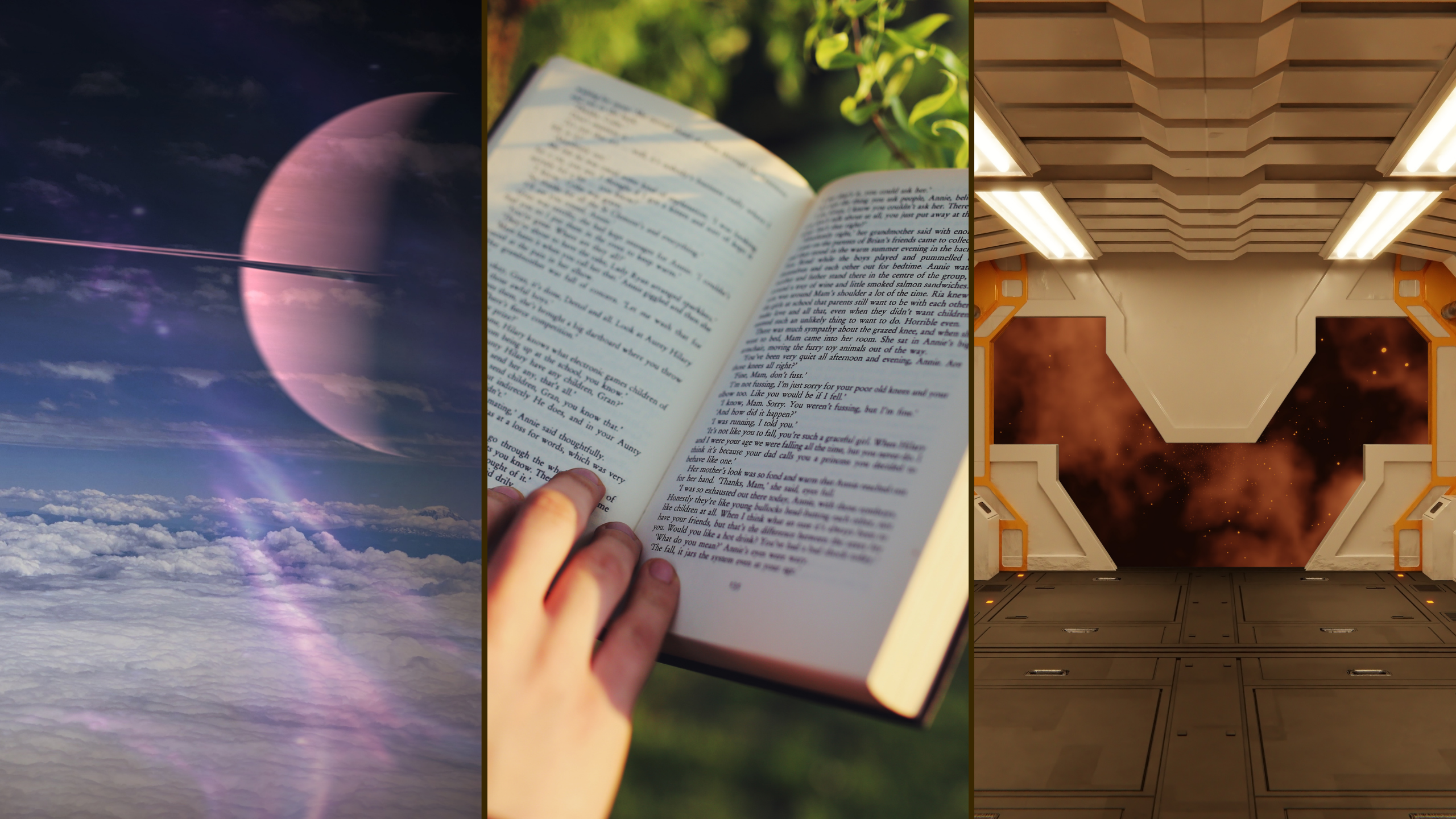
An open book transforming into a desert planet, orbital ring, alien ocean, and cylindrical spacecraft

5. The Culture, Iain M. Banks

Most science fiction is very comfortable with scarcity.

There is not enough food.

Not enough fuel, land, or time.

The Culture makes a different problem.

What happens when you mostly solve that stuff?

This is a civilization where incredibly powerful artificial intelligences called Minds do much of the heavy lifting. Material needs are basically handled.

So the interesting problems move somewhere else.

Should the Culture interfere with other civilizations?

Can you claim to value freedom while quietly manipulating entire societies?

What does ambition even look like when you can have almost anything?

I like the Culture because it reminds me that a setting does not need everybody fighting over bread to create conflict.

Give people everything.

They will find something else to argue about.

Probably something worse.

6. The Hainish Cycle, Ursula K. Le Guin

Le Guin is one of the writers I return to when I need to remember that worldbuilding is about people before it is about maps.

The Hainish stories move between different human societies scattered across different worlds.

Each one changes some assumption.

Gender.

Family.

Politics.

Social structure.

Language.

Then Le Guin follows the consequences.

That is what makes these stories so useful.

The planet itself can be interesting, but the real question is usually what kind of people emerge from living there.

If you change one cultural assumption, what else has to change with it?

That question can keep you busy for a very long time.

7. Hyperion and the Worldweb, The Hyperion Cantos by Dan Simmons

Hyperion should probably feel like too many things smashed together.

Religion.

Artificial intelligence.

Instant travel.

Poetry.

Pilgrimage.

Time problems.

Ancient mysteries.

Body horror.

Somehow it holds.

Mostly.

And that “mostly” is part of why I like it.

There is a weird confidence to a setting that lets myth and technology occupy the same space without constantly stopping to explain how they are supposed to fit together.

I think about that a lot when building science fiction.

We sometimes get obsessed with making everything line up perfectly.

Real cultures are messy.

Belief does not disappear because somebody invented a faster spaceship.

Old stories survive new technology.

People carry contradictions with them.

A world probably should too.

8. Panem, The Hunger Games by Suzanne Collins

Panem is not the biggest world on this list.

It might be one of the clearest.

You know very quickly who has power and who does not.

More importantly, you can see it in everyday life.

Food.

Clothing.

Jobs.

Travel.

Television.

Public ceremonies.

Even the way people are expected to perform emotion becomes political.

That is useful.

When I am thinking about some giant empire or government in a fictional world, it is easy to get stuck up at the policy level.

Who runs what?

Which faction controls which region?

Fine.

But what does that mean for somebody making breakfast?

That is where the world actually starts to feel real.

9. The Matrix

The world of The Matrix works because almost everything looks normal.

Office buildings.

Apartments.

Phones.

Traffic.

Bad cubicles.

Then somebody tells you none of it is real.

That one shift changes everything.

I still think this is one of the cleanest science-fiction premises ever built.

What if the world you accept every day is fake?

You can build a lot from that question.

More importantly, you do not need seventeen pages of setup to understand why it matters.

Sometimes worldbuilding gets stronger when the central idea can be said in one sentence.

10. The Star Wars Galaxy

Star Wars is probably one of the reasons I love science fiction in the first place.

And yes, I know it is as much fantasy as science fiction.

I don’t care.

The galaxy feels enormous because places actually feel different from each other.

Tatooine does not feel like Coruscant.

Coruscant does not feel like Endor.

A grimy little cantina and a giant capital city can exist in the same setting without flattening each other.

There is also a looseness to Star Wars that I think is worth remembering.

Not everything needs a technical explanation.

a strange creature can just be sitting at the bar.

Sometimes the old ship looks old because people have been repairing it for years.

That weird monk has a laser sword.

Worldbuilding can have rules without becoming allergic to fun.

11. The Star Trek Universe

Star Trek comes at science fiction from almost the opposite direction.

The unknown is usually something worth approaching.

Maybe carefully.

Sometimes very carefully.

But curiosity matters.

A lot of Star Trek episodes are basically philosophical problems wearing alien makeup.

What counts as life?

When should you interfere?

Who gets rights?

What happens when technology changes a society faster than its culture can handle?

That structure is great for creative work.

Build a world around a question and then drop people into it.

You do not always need a giant war.

Sometimes the problem is two civilizations trying to understand each other badly.

That is plenty.

12. The Halo Universe

Halo hooked me with big ring-shaped worlds and soldiers fighting aliens.

The thing that made the setting stick was everything buried underneath that.

The Forerunners.

The Flood.

Covenant religion.

Human history.

Ancient technology nobody alive fully understands.

The setting constantly gives you the feeling that everyone is living in the ruins of something much bigger than themselves.

That is a good feeling to steal.

Not the actual ruins.

The sense of age.

I like worlds where the current civilization did not invent everything it uses.

Someone came before.

Something happened.

Most people only understand pieces of it.

History should leave junk behind.

13. Mass Effect’s Milky Way

Mass Effect might be one of my favorite examples of making a galaxy feel connected.

Not just populated.

Connected.

Species have fought wars.

Governments remember old grudges.

Trade routes matter.

Technology spreads between cultures.

People stereotype each other.

Alliances exist because of things that happened before the player ever showed up.

That history gives the setting weight.

The krogan are not simply “the warrior species.”

The quarians are not simply “the people in suits.”

Everybody has baggage.

That is what makes them feel alive.

If two cultures have known each other for hundreds of years, they should have opinions about each other.

Probably unfair ones.

A collage of a neon simulated city, starship bridge, alien architecture, and distant planets

14. No Man’s Sky

No Man’s Sky is different because most of its worlds are generated by systems.

That could have made the whole thing feel empty.

Sometimes it does.

But there is also something creatively useful about seeing familiar ingredients recombine into things you would not have chosen yourself.

Maybe you get a red ocean.

Another planet has some bizarre animal wandering around.

Then you land on a frozen world filled with giant plants.

Eventually you find a landscape that just looks completely wrong.

Randomness can break habits.

That is useful when you keep designing the same planet over and over without realizing it.

Give yourself a few rules.

Roll something unexpected.

Then make it make sense.

15. The Dying Earth of Cage of Souls

I love settings that feel old.

Not fake-old, where somebody put moss on a ruin.

Actually tired.

Cage of Souls takes place on an Earth so far into the future that humanity itself feels like something that has already had its moment.

Things are breaking.

Knowledge has been lost.

Nature has become strange.

People keep living anyway.

That is a very different kind of worldbuilding than imagining the shiny new colony.

What does civilization look like after the golden age?

What do people keep fixing long after they have forgotten how it was originally built?

Decay creates its own kind of creativity.

16. The Mulefa World, His Dark Materials

The Mulefa are one of those ideas that could have been completely ridiculous.

They use naturally occurring seed pods as wheels.

That sentence should probably not work.

But it does because the biology, environment, and behavior connect.

That is the lesson I take from it.

You can get very strange.

You just have to follow through.

“Weird” is not the same thing as random.

If an animal evolves in a strange way, what else changes around it?

How does it move?

What kind of terrain does it need?

What does that do to tools and culture?

Keep asking.

Eventually the weird thing starts feeling obvious.

17. Pyrrus, Deathworld by Harry Harrison

Pyrrus is basically a planet that wants humans dead.

The plants are dangerous.

So are the animals.

Even the environment itself seems determined to make survival miserable.

The whole ecosystem appears to respond to human presence with escalating hostility.

I like it because the planet itself becomes part of the conflict.

A lot of fictional environments are scenery.

Characters travel across them while the actual story happens somewhere else.

Pyrrus will not let you do that.

The world is the problem.

That is a useful question to ask when designing a setting.

What if the environment stopped being background?

18. The Grid, Tron

I love the basic trick behind Tron.

Take something abstract and make it physical.

Programs become people.

Data becomes geography.

Computer systems become places you can actually enter.

Once you start thinking that way, the exercise gets strange pretty quickly.

What does a memory look like if you can walk into it?

What would an argument look like as a physical place?

Could a rumor move through a city?

Could a lie decay?

You can get a lot of creative mileage out of turning something invisible into something with shape.

19. Mars, Total Recall

The Mars of Total Recall already has enough going on without the memory stuff.

Colonies.

Corporations.

Workers.

Terraforming.

Political control.

Then the story starts messing with whether the main character’s memories are even real.

That makes the setting feel unstable in a way I really enjoy.

The physical world is dangerous.

So is your own perception of it.

I tend to like stories that make reality slippery.

Not everything needs a giant twist.

But uncertainty can change how a reader looks at every part of a world.

20. Guardians of the Galaxy

This one is here because science fiction is allowed to be fun.

That sounds obvious.

Sometimes I forget it anyway.

The cosmic side of Guardians of the Galaxy throws weird planets, alien prisons, dead civilizations, outlaw crews, giant space stations, ridiculous creatures, and old technology into the same universe.

It moves.

It jokes.

Then every once in a while it gets surprisingly sad.

I like that mix.

A world does not have to stay in one emotional lane.

You can have grief sitting next to something completely ridiculous.

You can have wonder without treating everything like sacred scripture.

Sometimes the strange planet can just be a strange planet.

A person walking through an unfinished science-fiction city made of sketches, portals, maps, and alien ecology

How I Actually Use This Stuff

I don’t think the useful part of reading science fiction is finding something cool and copying it.

That usually leads somewhere pretty obvious.

The better move is figuring out what made the idea stick.

Take Arrakis.

The useful lesson is not “build a desert planet.”

It is consequences.

Take Solaris.

The lesson is not “make an intelligent ocean.”

It is letting something remain genuinely unknowable.

Ringworld is scale.

Mass Effect is history between cultures.

Panem is power showing up in ordinary life.

Those ideas can go somewhere completely different.

One exercise I like is grabbing three of them and forcing them into the same small scene.

Do not design the entire galaxy.

Write somebody eating dinner.

Or repairing a machine.

Or trying to get home.

Maybe the world has Arrakis-style resource scarcity, Mass Effect-style political history, and something nobody understands lurking underneath it like Solaris.

Fine.

What does that do to dinner?

That sounds small because it is small.

That is the point.

I have spent enough time dreaming up giant civilizations to know that the giant civilization is usually the easy part.

The hard part is making one person feel like they actually live there.

What do they complain about?

Think about what they take for granted.

Maybe they are absolutely wrong about something everyone around them accepts as obvious.

And there should be things they never bother explaining because, to them, everybody already knows.

Start there.

The big map can wait.

That is part of what I am trying to do with Epic Again anyway.

I want to go back through the science fiction that made me love this stuff in the first place, find the pieces that still get my imagination moving, and use some of that energy to build something of my own.

You can find more of that in the science-fiction collection and the Books category.

The Original Universe is where a lot of my own worldbuilding is slowly starting to take shape.

And if the bigger problem is finding the time or energy to make anything at all, I have also been writing about making time to create and about why science fiction still feels like home.

I don’t really believe creativity comes back because you finally find the perfect system.

Sometimes you just see one strange idea and your brain starts chewing on it.

That can be enough.

One question turns into another.

Then maybe there is a person.

A place.

A problem.

And suddenly you are building again.

5 New Sci-Fi Movies and Shows Out Now That Are Worth Your Time (2026)

There is something I really like about finding a science-fiction story before everyone has already decided what it means.

Before the big takes. Before the arguments harden. Before every interesting idea gets boiled down to the same few talking points.

That is where a lot of these movies and shows are right now.

I have been looking through what is out in science fiction this year, trying to find the stuff that actually interests me. Big space adventures are fine. I love those. But I also want stories that leave something behind after the credits. Something strange to think about later.

These five caught my attention for very different reasons.

This list is current as of August 28, 2026. Most are 2026 releases, with one exception that I think is still too relevant to leave off.

1. The Dog Stars: The End of the World Gets Very Small

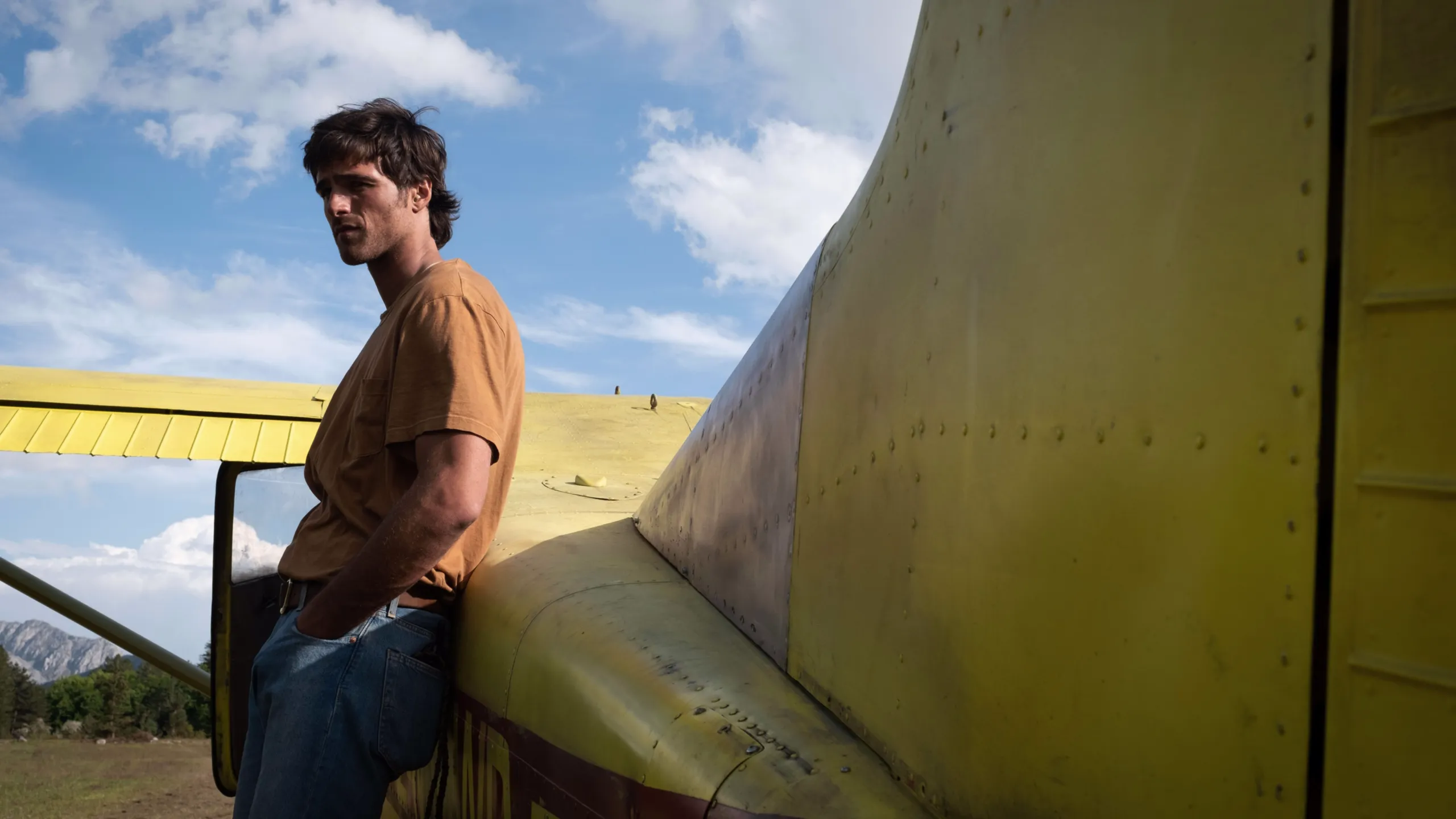
Jacob Elordi as Hig in The Dog Stars, standing in a post-apocalyptic landscape

Jacob Elordi as Hig in The Dog Stars, standing in a post-apocalyptic landscape

The Dog Stars arrived in US theaters on August 28, 2026, so this is the newest movie here.

It may also be the one I am most curious about.

Ridley Scott directs the adaptation of Peter Heller’s novel, with Jacob Elordi playing Hig, a young pilot trying to survive after a pandemic has wrecked most of civilization.

He lives on an isolated airfield with his dog and Bangley, a heavily armed survivalist played by Josh Brolin.

That setup alone works for me.

There is an uneasy little life happening here. Hig flies. Bangley protects the perimeter. They tolerate each other because survival has made the arrangement necessary.

Then Hig hears something over the radio.

Maybe someone else is out there.

Post-apocalyptic stories obviously are not new territory, and I don’t think another ruined-world movie automatically deserves attention because someone found a dusty highway and an abandoned gas station.

What interests me about The Dog Stars is how small the story seems willing to get.

Once the world is gone, what exactly are you staying alive for?

Hig has food, shelter, weapons and a plane. Technically, he is surviving. But survival by itself starts to look pretty empty after a while.

That is the part I want to see Ridley Scott dig into.

The cast also includes Margaret Qualley, Allison Janney, Benedict Wong and Guy Pearce, but this really seems built around Hig and the question of whether reaching toward another person is worth the danger that comes with it.

There will be violence. There are planes. There are guns. The world looks brutal.

Still, I suspect the stuff that sticks will be much quieter.

Best for: Post-apocalyptic fans who want something more personal than another story about rebuilding civilization.

Read the official Disney overview of The Dog Stars for the trailer, cast and release information.

2. Lanterns: Green Lantern as a Detective Story

Official Lanterns key art featuring Hal Jordan and John Stewart in the HBO Max sci-fi mystery seriesOfficial Lanterns key art featuring Hal Jordan and John Stewart in the HBO Max sci-fi mystery series

Lanterns premiered on HBO and HBO Max on August 16, 2026, with its eight-episode first season running weekly through October 4.

Of all the things DC could have done with Green Lantern, making it partly a detective show is probably the choice that got my attention fastest.

Kyle Chandler plays Hal Jordan. Aaron Pierre plays John Stewart. The two are investigating a series of crimes that start pointing toward something much bigger.

Nathan Fillion’s Guy Gardner is in there too, connecting the series to the larger DC Universe.

Yes, there are Green Lantern rings.

Yes, this thing eventually has to deal with aliens, cosmic threats and all the wonderfully ridiculous scale that comes with Green Lantern.

But it starts with an investigation.

I like that.

There is something inherently strange about taking characters who can cross space and create almost anything they can imagine, then asking them to slow down and figure out what actually happened.

Evidence matters.

People lie.

Two investigators can look at the same thing and come away with completely different conclusions.

Then you throw the universe into the middle of it.

Chris Mundy, Damon Lindelof and Tom King are behind the series, which probably explains why it seems comfortable letting things breathe instead of sprinting toward the next effects sequence.

The early response has also been strong. At the time of writing, Lanterns is sitting at 94% on Rotten Tomatoes.

I am curious to see whether it can keep the mystery feeling human once the cosmic side of Green Lantern inevitably starts getting bigger.

That balance is probably the whole game.

Best for: Anyone who likes superhero stories but wants an actual mystery holding the thing together.

You can follow the current Lanterns listing on Rotten Tomatoes as the season continues.

3. Disclosure Day: Okay, Aliens Exist. Now What?

Official Disclosure Day poster art for Steven Spielberg’s 2026 first-contact science-fiction filmOfficial Disclosure Day poster art for Steven Spielberg’s 2026 first-contact science-fiction film

Disclosure Day released in theaters on June 12, 2026, and its basic idea is almost absurdly simple.

Humanity learns we are not alone.

Fine.

Now what?

That second part is much more interesting to me than the first.

Science fiction has spent decades imagining the moment aliens arrive. Spaceships appear. Governments scramble. Someone stares into the sky.

Spielberg has already played in this territory himself.

But the thing I keep coming back to is what happens the next morning.

Do people still go to work?

What happens in churches?

What happens to markets?

What happens when every government on Earth suddenly has to explain what it knew, what it didn’t know and whether anyone should believe them?

How quickly does humanity manage to turn the biggest discovery in our history into another thing to fight about?

Probably pretty quickly.

That is what makes the premise interesting.

Disclosure Day treats first contact as something that happens to civilization itself, not only to the handful of scientists or soldiers standing closest to it.

The aliens matter.

Our reaction might matter more.

That is the kind of science fiction I tend to gravitate toward anyway. Give me the impossible discovery, sure. Then show me what it breaks.

Because every major discovery changes the story people tell themselves about where they fit.

Finding out that humanity is not alone would be one hell of a rewrite.

Rotten Tomatoes lists the movie with its June theatrical release followed by streaming beginning in July, so it is already fairly easy to catch up with if you missed the theater run.

Best for: First-contact fans who are more interested in the consequences than the spaceship.

See the Disclosure Day page on Rotten Tomatoes for current viewing information and reviews.

4. Supergirl: Sometimes I Just Want the Big Space Movie

Official Supergirl poster art featuring Kara Zor-El in the 2026 cosmic adventure filmOfficial Supergirl poster art featuring Kara Zor-El in the 2026 cosmic adventure film

Not everything on this list needs to stare into the void for two hours.

Sometimes I want planets.

I want ships.

I want impossible landscapes and characters getting hurled across half the galaxy because something has gone horribly wrong.

That is where Supergirl comes in.

Released on June 26, 2026, the movie sends Kara Zor-El, played by Millie Alcock, across the universe on a story built around loss, revenge and justice.

And honestly, Supergirl makes sense as a science-fiction character in a way I think superhero movies sometimes forget.

She is an alien.

Her world is dead.

She remembers it.

That last part changes everything.

Superman was raised on Earth. Earth is home to him.

Kara carries Krypton with her.

So putting her back into space gives all that grief somewhere enormous to go.

Science fiction is good at doing that. It can take something painfully personal and give it ridiculous physical scale. A dead family becomes a dead world. Distance becomes light-years. Running away can literally mean leaving the planet.

That does not automatically make a story deeper, obviously.

Sometimes a laser fight is still just a laser fight.

But when the two sides actually connect, when the spectacle carries the character instead of burying them, this kind of movie is exactly my thing.

And after several darker entries on this list, I am perfectly happy having one that wants to move.

Best for: Anyone who wants their science fiction loud, cosmic and emotional without needing it to become relentlessly grim.

See the Supergirl page on Rotten Tomatoes for release details and current viewing options.

5. Alien: Earth: We Were Probably Safer in Space

Official Alien: Earth series art showing the dark corporate sci-fi horror of the showOfficial Alien: Earth series art showing the dark corporate sci-fi horror of the show

This one technically cheats.

Alien: Earth premiered in August 2025, not 2026. But with a second season renewed and development continuing this year, I am leaving it on the list.

Mostly because it is still one of the more interesting things happening in science fiction television.

Noah Hawley’s series takes place in 2120, with Earth effectively controlled by five massive corporations.

Humans share the world with synthetics and cyborgs. Prodigy Corporation is experimenting with hybrids as part of its attempt to get around that irritating little problem called death.

Then a Weyland-Yutani spacecraft crashes into Prodigy City.

Things go badly.

Obviously.

This is Alien.

But the xenomorphs are almost the easy part.

What makes Alien: Earth interesting is everything people were already doing before the monsters arrived.

Corporations are building bodies.

People are chasing immortality.

Human beings are deciding which forms of life count as people and which ones count as property.

Then something shows up that absolutely does not care about any of their categories.

That is where Alien works best for me.

The creature is terrifying, but the humans keep building the conditions that make everything worse.

Every time.

Space was frightening in the original film because nobody could help you out there. Alien: Earth turns that around.

Now the monster is here.

It is inside the systems we built.

And the people running those systems still think they are the smartest things in the room.

The first season currently holds a 94% Tomatometer score on Rotten Tomatoes, with Sydney Chandler, Alex Lawther, Timothy Olyphant, Essie Davis and Babou Ceesay leading the cast.

If you missed it last year, I would catch up before season two arrives.

Best for: Anyone who likes science fiction where the corporation may be at least as dangerous as the thing with acid for blood.

See the current Alien: Earth listing on Rotten Tomatoes for viewing information.

Where I Would Start

This really depends on what kind of science fiction you are hungry for.

If you want something big, go with Disclosure Day or Supergirl.

If you want something darker, Alien: Earth is an easy recommendation.

The Dog Stars looks like the quietest of the bunch, and maybe the most human.

Then there is Lanterns, sitting somewhere in the middle with superheroes, cops, aliens and a mystery that could eventually become much bigger than either of its investigators expects.

That range is probably why I never really get tired of science fiction.

The genre can hold all of this.

A guy sitting alone with his dog after the world ends.

Two detectives carrying weapons powered by imagination.

Humanity finding out it has neighbors.

A Kryptonian crossing the galaxy because she cannot outrun what happened to her.

A corporation looking at the nightmare creature from Alien and somehow still thinking, Yeah, we can probably monetize this.

Science fiction gets enormous very easily.

The good stuff still finds a way to make all that scale come back down to us.

The 10 Best Science Fiction Books for New Fans (and Where to Start After Them)

I still remember the feeling of finishing a science-fiction book and realizing that the story had not really ended. The last page was only the edge of something larger: other authors, stranger worlds, older ideas, and questions that had been waiting somewhere beyond the cover.

That is what I want this list to offer. Not a final ranking of the genre, because no list could contain everything science fiction has become, but a set of welcoming entry points into its deserts, starships, laboratories, dystopias, and impossible futures.

Science fiction can be funny, frightening, political, intimate, philosophical, or wonderfully strange. It can ask what technology changes, what power costs, what humanity might become, and whether we would recognize ourselves after the world around us had been rebuilt.

The books below cover several of those possibilities. I have included classic science fiction novels, modern page-turners, and a few books that sit close to the borders of the genre. Each one offers a different way in. After each recommendation, I have also included a suggested next step, because the best science fiction books often leave you with one simple question:

What else is out there?

1. The Martian by Andy Weir

Start here if you like: survival stories, problem-solving, humor, and realistic science.

Mark Watney is stranded alone on Mars after a mission goes wrong, and the novel follows his attempt to stay alive using whatever knowledge, equipment, and stubbornness he can find. The situation is enormous, but the storytelling remains grounded in immediate problems: food, water, shelter, communication, and the next thing that might kill him.

That clarity makes The Martian one of the easiest modern science fiction books for new fans to pick up. You do not need a background in physics to follow it. The technical details become part of the suspense, while Watney’s dry humor keeps the story moving.

Where to start after it: Try Andy Weir’s Project Hail Mary for another accessible hard-science adventure, this time involving amnesia, deep space, and first contact.

2. The Hitchhiker’s Guide to the Galaxy by Douglas Adams

Start here if you like: comedy, absurdity, fast-paced adventures, and deeply questionable advice.

Earth is destroyed, Arthur Dent escapes with an alien friend, and the universe becomes considerably stranger from there. Douglas Adams approaches science fiction with the energy of a radio sketch, but beneath the jokes is a genuine affection for the genre’s grand traditions: space travel, alien civilizations, improbable technology, and the search for meaning.

This is a short, welcoming book for anyone who worries that science fiction might be too serious or too technical. It is neither. It is playful, sharp, and full of ideas that arrive disguised as jokes.

The publisher describes it as the first of five books in a “trilogy,” which is exactly the sort of decision the series makes without apology. You can find more background through Pan Macmillan’s guide to the book.

Where to start after it: Read Terry Pratchett’s Strata for another humorous approach to big science-fiction concepts, or move toward space opera with Leviathan Wakes.

3. The Invisible Man by H.G. Wells

Start here if you like: classic horror, scientific experiments, and stories about power changing people.

H.G. Wells published The Invisible Man in 1897, but its central question remains immediate: what happens when a person gains extraordinary power without gaining extraordinary wisdom?

Griffin’s invisibility begins as a scientific achievement. It quickly becomes a practical problem, then a moral one. Clothes can still be seen. Food creates complications. Weather becomes a threat. Most importantly, the discovery does not make Griffin better. It gives his existing ambitions and resentments more room to grow.

This is one of the classic science fiction novels I return to because the premise is so simple, and because Wells keeps making it less convenient. At Epic Again, Gary has written about returning to The Invisible Man, the book that began his own science-fiction reading journey. The novel is also available through Project Gutenberg.

Where to start after it: Explore more H.G. Wells, especially The Time Machine, or move to Octavia Butler’s Kindred for another speculative story where the impossible exposes difficult truths about human power.

A reader at a library table surrounded by books as a circular portal opens onto several science-fiction worlds

4. Fahrenheit 451 by Ray Bradbury

Start here if you like: short novels, dystopias, questions about censorship, and lyrical writing.

In Bradbury’s future, firemen do not put out fires. They start them, burning books in a society that has decided difficult ideas are too uncomfortable to keep around.

The premise is familiar now, but the book remains powerful because it is not only about government censorship. It is also about distraction, speed, conformity, and the gradual disappearance of the desire to think deeply. Bradbury’s world is full of screens, noise, empty entertainment, and people who have forgotten what books can ask of them.

At around two hundred pages, Fahrenheit 451 is a manageable introduction to dystopian science fiction. It also creates a natural bridge between genre reading and wider literary fiction.

Where to start after it: Read Aldous Huxley’s Brave New World for a different vision of social control, or Lois Lowry’s The Giver for a quieter and more intimate dystopian entry point.

5. The Left Hand of Darkness by Ursula K. Le Guin

Start here if you like: character-driven stories, anthropology, politics, and thoughtful worldbuilding.

Ursula K. Le Guin sends an envoy to the planet Gethen, a world whose inhabitants do not live within the fixed gender system familiar to the visitor. The resulting story involves diplomacy, survival, mistrust, cultural misunderstanding, and a long journey across an ice-covered landscape.

The book is quiet in places, but never small. Le Guin builds an alien society carefully enough that its customs begin to challenge the assumptions we bring with us. What would change if a culture understood gender differently? How much of identity comes from biology, language, history, or social expectation? What does it take to trust someone whose entire way of seeing the world is unfamiliar?

The Left Hand of Darkness is one of the best science fiction books for readers who want ideas to emerge through relationships rather than lectures.

Where to start after it: Continue with Le Guin’s The Dispossessed, or explore Ann Leckie’s Ancillary Justice for another story about identity, language, and power.

Two figures connected by amber light across an alien landscape, surrounded by symbols of ecology, politics, identity, and artificial intelligence

6. Dune by Frank Herbert

Start here if you like: epic fantasy, political intrigue, ecology, prophecy, and immersive worldbuilding.

On the desert planet Arrakis, Paul Atreides is drawn into a conflict involving noble families, imperial power, religion, natural resources, and the people who have learned to survive in one of the harshest environments imaginable.

Dune can look intimidating from the outside. It has unfamiliar terminology, a large cast, multiple political factions, and a history that seems to extend far beyond the opening chapters. But the central story is clear: a young man loses his home, enters an unfamiliar culture, and begins to understand the forces shaping his future.

What makes the novel endure is the way its adventure story is tied to ecology and politics. The desert is not just scenery. It determines how people live, what they value, and what kinds of power are possible.

Where to start after it: If you want more political and environmental science fiction, try Le Guin’s The Dispossessed. If you want another sweeping space opera, try James S.A. Corey’s Leviathan Wakes.

7. The Martian’s companion in wonder: Project Hail Mary by Andy Weir

Start here if you like: mysteries, first contact, scientific puzzles, and emotional adventure.

Although Project Hail Mary shares Andy Weir’s interest in practical science, it has a different shape from The Martian. The narrator wakes far from Earth with no memory of who he is or why he has been sent into space. The story unfolds as a mystery as much as a survival novel.

The science remains central, but so does discovery. The book asks what cooperation might look like when communication itself is a problem, and when the being on the other side of that communication may not share anything familiar with us.

It is a particularly good recommendation for readers who enjoy watching characters solve problems one step at a time.

Where to start after it: Try Ted Chiang’s collection Stories of Your Life and Others, which includes the story that inspired the film Arrival. Pan Macmillan’s book page offers more information.

8. The Giver by Lois Lowry

Start here if you like: dystopias, quiet emotional reveals, memory as a theme, and accessible speculative fiction.

Jonas lives in a society built on order, sameness, and the careful removal of pain. When he is chosen for a unique role within that system, he begins to encounter memories, feelings, and forms of knowledge that his community has tried to leave behind.

What makes The Giver such a strong entry point is its clarity. The prose is simple, the concept is easy to grasp, and the deeper questions arrive gradually. What is lost when a society chooses comfort over freedom? What disappears when suffering is removed along with love, color, risk, and memory?

It is shorter and more immediately approachable than many classic dystopias, but it still opens onto the same large concerns about control, conformity, and the cost of a carefully managed world.

Where to start after it: Follow it with Bradbury’s Fahrenheit 451 and Huxley’s Brave New World to compare different visions of controlled societies.

9. Ender’s Game by Orson Scott Card

Start here if you like: military strategy, fast pacing, gifted young characters, and moral dilemmas.

Ender Wiggin is recruited into a military training program designed to prepare children for a future conflict with an alien species. The story moves quickly, but its most interesting questions appear beneath the battles and simulations.

What does it mean to understand an enemy? Can empathy become a weapon? How much can adults ask of children in the name of survival? The novel is easy to read on the surface, while leaving room for more complicated interpretations underneath.

It is a useful introduction to military science fiction, especially for readers coming from games, blockbuster films, or strategy stories.

Where to start after it: Try Joe Haldeman’s The Forever War for a more reflective military science-fiction novel, or move toward modern space opera with Ancillary Justice.

10. Ancillary Justice by Ann Leckie

Start here if you like: artificial intelligence, space opera, unusual narrators, and questions of identity.

Breq was once an artificial intelligence spread across an entire starship and its many ancillary bodies. Now only one human-shaped body remains, carrying the memory of a much larger self.

That idea gives Ann Leckie room to explore empire, loyalty, language, gender, and the boundaries of personhood. The novel asks what makes an individual an individual when consciousness can exist across many bodies, and what happens when an enormous intelligence is reduced to one vulnerable form.

It is a more demanding introduction than some of the other books on this list, but it offers a clear path into contemporary science fiction and its interest in artificial intelligence, distributed identity, and political power.

Where to start after it: Continue with the rest of the Imperial Radch trilogy, or explore Arkady Martine’s A Memory Called Empire for another politically intricate space opera.

A luminous path leads from an old paper book through Mars, starships, artificial intelligence, and an unknown planet

Where should a new science-fiction reader begin?

There is no correct order. That is part of the pleasure.

If you want the easiest modern entry, start with The Martian or Project Hail Mary. If you want classic science fiction novels, choose The Invisible Man, Dune, or The Left Hand of Darkness. If you want dystopia, begin with Fahrenheit 451 or The Giver. If you want humor, pick up The Hitchhiker’s Guide to the Galaxy.

The important thing is not to read the books in the order of their reputation. Start with the question that already interests you: What if technology changed survival? What if society changed gender? What if power could rewrite reality? What if the universe was stranger than human language could describe?

The Epic Again Books category is where I will keep returning to those questions through reviews, reflections, and new recommendations. Some books will feel immediately right. Others may take time. A few may send you somewhere I could not have predicted.

That is how a science-fiction reading life begins: one book opens, one world appears, and the horizon quietly grows.