Two free guides. One small creative adventure. Start your adventure here!

Hear Me Out: The Skyborne Fit Classic Warcraft Better Than You Think

  • Why the Skyborne Fit Classic Warcraft Better Than You Might Think

    I understand why the Skyborne feel wrong to some Classic Warcraft players.

    They are new.

    And when you are talking about Classic Warcraft, “new” can feel like a dangerous word.

    We remember what this version of Azeroth is supposed to look like. The battered roads outside Stormwind. The fires burning through the Valley of Trials. The ruins of Lordaeron. The forests of Teldrassil.

    Even Warcraft’s weirdest places have had twenty years to become familiar.

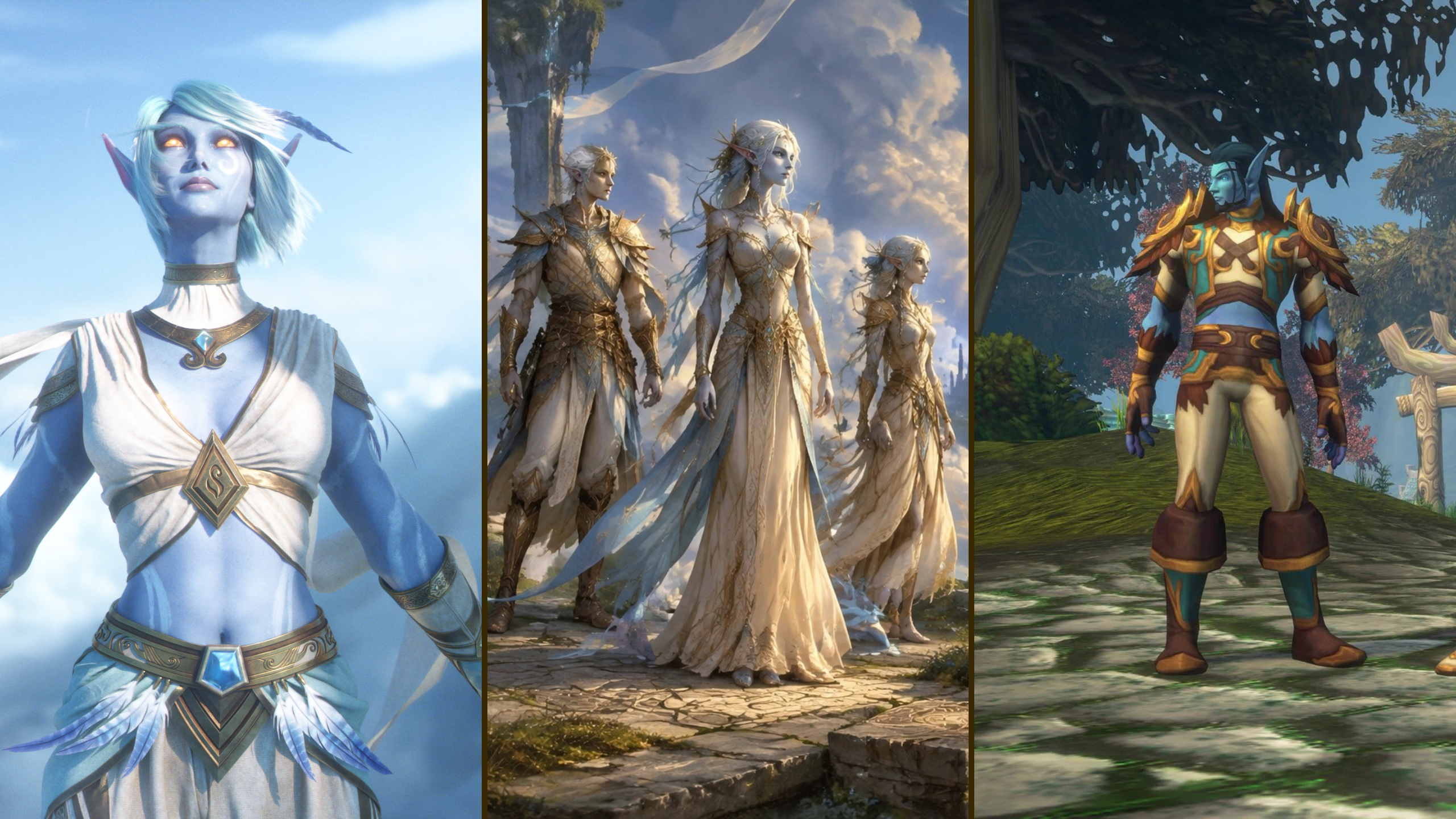
    Then Warcraft Forever introduces the Skyborne, or shen’dorei.

    They are pale, sky-touched elves living on a floating island hidden away in the elemental plane of Air. Their home is held together by failing pylons. Their culture has been shaped by wind spirits. A religious cult wants to expose them to Al’Akir.

    On paper?

    Yeah.

    I can see why someone looks at that and thinks, “This sounds like something from a modern expansion that wandered into Classic by accident.”

    That was pretty close to my first reaction too.

    But the more I started looking at who the Skyborne actually are, the less that argument worked for me.

    Because underneath the floating islands, elemental magic, feathers, and very dramatic elf aesthetics is something surprisingly familiar.

    A displaced people.

    A damaged homeland.

    A society divided over magic and tradition.

    A civilization depending on powers it does not fully understand.

    And a generation of people being forced out into a world they have been hidden from for thousands of years.

    That sounds pretty Warcraft to me.

    So hear me out.

    Being New Is Not the Same Thing as Not Belonging

    I think part of the problem is that we sometimes confuse familiarity with authenticity.

    The original Warcraft races feel like they belong because we have lived with them for decades.

    But when World of Warcraft originally launched, those races were not interesting because players had twenty years of nostalgia attached to them.

    They were interesting because every culture had a problem.

    Humans were rebuilding after catastrophe.

    The orcs were trying to create something new after the destruction caused by demonic corruption.

    The Darkspear trolls were displaced survivors who had lost their home.

    The gnomes had lost Gnomeregan.

    The Forsaken had escaped the control of the Lich King and found themselves unwanted almost everywhere else.

    Even the night elves, despite being ancient and powerful, were dealing with the consequences of losing their immortality and reconnecting with a world they had spent thousands of years separated from.

    Classic Warcraft did not introduce us to civilizations sitting comfortably at their peak.

    It introduced us to people dealing with what happened after everything went wrong.

    And that is exactly where the Skyborne begin.

    Their version just happens to involve a floating island slowly falling apart.

    Subtle metaphor, Blizzard.

    What Actually Makes a Warcraft Race Feel Like Warcraft?

    When I look back at the original playable races, there are three things that keep showing up.

    Their culture comes from their history.

    Something is putting that culture under pressure.

    And individual characters have a reason to leave home.

    That combination does a lot of work.

    The tauren are not interesting because they are “the nature race.”

    They were nomadic tribes being hunted by the centaur. Thrall and the Horde helped them survive. Their connection to the Horde grows from something that happened to them.

    The Darkspear are not simply trolls with red banners.

    They were driven from their home, rescued by Thrall, and forced to figure out what being Darkspear meant away from the larger troll empires.

    The Forsaken are not interesting because undead characters look cool.

    They are people trying to figure out what they are after losing their lives, their kingdoms, their families, and their place among the living.

    Even dwarven archaeology connects back to their desire to understand where they came from.

    Gnomish technology is inseparable from the loss of Gnomeregan and their obsession with eventually reclaiming it.

    That is the pattern I keep seeing.

    Warcraft cultures become interesting when something is pushing against them.

    And once I started looking at the Skyborne that way, they started making a lot more sense.

    Their Story Begins in One of the Most Classic Places Possible

    This is probably the biggest thing I think gets overlooked.

    The Skyborne are not completely disconnected from old Warcraft lore.

    Their story begins with Eldre’Thalas.

    Yes.

    Dire Maul.

    Their ancestors were Highborne living in the city after the War of the Ancients.

    When they lost access to the Well of Eternity, the Highborne of Eldre’Thalas began suffering from magical withdrawal.

    Prince Tortheldrin eventually attempted to solve that problem by summoning the demon Immol’thar and siphoning its power through a network of crystal pylons.

    Some Highborne believed this was a terrible idea.

    Which, to be fair, “let’s solve our magical addiction by trapping a demon and draining its power forever” probably deserved at least one skeptical committee meeting.

    A group of nobles opposed Tortheldrin because they feared the ritual could give the Burning Legion a foothold and place their entire society at the mercy of something they could not control.

    Tortheldrin responded by purging the opposition.

    Dozens of noble families were killed.

    The rebels eventually gathered behind a masked leader known as Shal’nan, the Veiled One.

    They sabotaged the pylons and attempted to stop Tortheldrin’s ritual.

    It went badly.

    Portals to the Twisting Nether opened.

    Wild magic tore through the city.

    The rebels suffered devastating losses.

    Shal’nan survived, but was permanently changed.

    The remaining rebels fled Eldre’Thalas.

    Eventually, they encountered wind spirits and made a bargain.

    The spirits would protect them from Tortheldrin.

    In exchange, the survivors would serve them.

    Zephras Isle was lifted into Skywall and hidden away from the outside world.

    And that bargain became the foundation of Skyborne civilization.

    That is where the race started clicking for me.

    Because now we are not talking about “random blue elves from the sky.”

    We are talking about Highborne refugees who escaped one magical dictatorship and built an entire civilization around dependence on another supernatural power.

    That is a much more interesting Warcraft story.

    The Skyborne Built an Entire Culture Around Survival

    The Skyborne did not simply move into the clouds and continue being Highborne.

    Thousands of years living alongside the elementals changed them.

    Their windstones became a major energy source.

    They maintained elemental instruments.

    They lived alongside magical constructs provided by the spirits.

    Their funeral traditions involved scattering ashes into the wind.

    Heirlooms belonging to the dead were passed down to young Skyborne as part of coming-of-age traditions.

    Their biology changed too.

    The Sky-Touched Blessing became increasingly common throughout the population, resulting in many of the physical traits that now separate them from their kaldorei ancestors.

    What matters to me is that these details connect back to the same question:

    What happens to a refugee culture after thousands of years?

    They keep pieces of where they came from.

    They build new traditions.

    They reinterpret old ones.

    And eventually those traditions start creating disagreements of their own.

    The Skyborne have exactly that.

    Their Society Was Built by Someone Who Gave Up Power

    There is another detail here I really like.

    After the construction of the Shrine of the Four Winds began, Shal’nan stepped away from leadership.

    Authority passed to a Council of Elders made up of democratically elected provincial leaders.

    Think about what that means for this culture.

    Their civilization began because a ruler abused magical power, murdered political opposition, and refused to listen to anyone questioning his decisions.

    Their founding leader eventually did the opposite.

    Shal’nan surrendered authority.

    That does not magically make Skyborne society perfect.

    But it gives their political traditions context.

    They are descendants of people who learned firsthand what happens when magical dependence and unchecked authority become the same problem.

    And thousands of years later, they are still arguing over how much trust should be placed in powerful forces.

    Which brings us to the part I think feels the most like old Warcraft storytelling.

    The High Order and Windshapers Are Arguing About Something That Actually Matters

    I was worried these groups were going to feel like two convenient faction-colored versions of the same race.

    Alliance Skyborne over here.

    Horde Skyborne over there.

    Problem solved.

    Thankfully, there is more going on.

    The High Order comes from the old Highborne magical tradition.

    They believe the powers of Skywall need to be studied and understood.

    When the wind spirits disappeared, the High Order looked at thousands of years of dependence on those beings and came to an uncomfortable conclusion:

    Maybe relying on the elementals this completely was always dangerous.

    Their answer is arcane study and self-reliance.

    That worldview helps explain why Alliance Skyborne can become mages.

    The Windshapers come from the spiritual and shamanic side of Skyborne culture.

    They trust the elementals.

    From their perspective, these spirits saved the Skyborne, protected them for thousands of years, and became part of their entire way of life.

    Questioning those beings can easily become disrespecting the very powers responsible for their survival.

    That worldview helps explain why Horde Skyborne can become shamans.

    And this is where the faction split becomes much more interesting to me.

    Because the argument is bigger than Alliance versus Horde.

    It is about dependence.

    If another power saved your civilization and protected it for thousands of years, when does gratitude become blind faith?

    And if you reject that dependence completely, how do you know you are becoming independent instead of repeating the magical arrogance that helped destroy your ancestors?

    There is no comfortable answer.

    Warcraft has always been good when its cultures are stuck inside questions like that.

    We Have Seen This Kind of Conflict Before

    The Skyborne are not copying one older race directly.

    But the structure of their problem is familiar.

    The orcs have spent generations dealing with the consequences of abandoning shamanic traditions for destructive magical power.

    Night elf history is full of arguments about druidism, arcane magic, the Highborne, and what parts of their ancient civilization should ever be allowed to return.

    Dwarven cultures have their own conflicts over history, technology, identity, and ancestry.

    The Skyborne take that familiar Warcraft idea and move it somewhere new.

    Their question becomes:

    What happens when your religion and your survival strategy are basically the same thing?

    That has some teeth to it.

    Their Homeland Is Falling Apart

    This might be the most Classic part of the entire setup.

    A few centuries before the current story, the wind spirits disappeared.

    Shal’nan vanished too.

    Then the pylons holding Zephras Isle together began failing.

    Parts of the island started breaking apart.

    Contact with other Skyborne settlements was lost.

    Refugees began arriving.

    Some people turned to banditry.

    Others became vulnerable to the promises of the Al’Aketh.

    This is where the floating-island presentation can distract from what is actually happening.

    The Skyborne are living through social collapse.

    Their infrastructure is failing.

    Their religion has lost contact with the beings at its center.

    Their political factions disagree about what should happen next.

    People are being displaced.

    Extremist groups are gaining influence because they are offering answers during a crisis.

    We have seen this story all over Warcraft.

    The Skyborne version just happens to involve the ground literally disappearing underneath them.

    Again, subtle.

    The Al’Aketh Exist Because the Skyborne Never Got an Answer

    The Al’Aketh are another part of this story that could easily have become generic “evil cultists.”

    But I think their origin is more useful than that.

    Some Skyborne used shamanistic sight and discovered Al’Akir.

    The strange thing was that the wind spirits never talked about him.

    They avoided his name.

    They appeared afraid of him.

    Imagine growing up in a civilization built around communion with elemental spirits and discovering there is an enormously powerful elemental ruler nobody wants to explain.

    People are going to ask questions.

    And silence has a way of making those questions louder.

    When the wind spirits later disappeared, the Al’Aketh gained influence.

    Eventually they decided the pylons protecting Zephras Isle needed to be destroyed because those pylons were also hiding the Skyborne from Al’Akir.

    Their goal was not simply destruction.

    They wanted the hiding to end.

    They wanted Al’Akir to see them.

    High Priestess Lorthuna even created a beacon intended to attract his followers.

    Eventually the High Order, Windshapers, and Peacekeepers were forced into a temporary alliance against them.

    Then Rohash of the Conclave of Wind arrived with the answer everyone had been missing.

    The wind spirits had been hiding the Skyborne from Al’Akir.

    And eventually the Windlord would notice.

    That is where the conflict gets interesting.

    The Windshapers were right that the spirits protected their people.

    The High Order were right that those spirits were withholding incredibly important information.

    Both positions suddenly become more complicated.

    I love that kind of Warcraft problem.

    Nobody gets to walk away saying, “See? We were completely right.”

    Their Connection to Azeroth Has a Reason

    This matters a lot when you introduce a new playable race.

    Why are they suddenly here?

    Why have we never seen them before?

    And why would thousands of them now start wandering around Azeroth doing adventurer things?

    The collapsing Skyborne civilization answers that surprisingly well.

    Their isolation is no longer sustainable.

    Their old protections are failing.

    They need knowledge.

    They need allies.

    They need another way forward.

    The arrival of organizations like the Kirin Tor and Earthen Ring gives the Skyborne their first major connection to modern Azeroth.

    That creates a natural reason for Skyborne characters to leave home.

    They are entering the world because staying hidden is becoming impossible.

    That feels much stronger to me than introducing a race whose problems are already solved.

    But Yes, They Still Look More Modern

    This is where I think we need to be fair.

    There are criticisms of the Skyborne that I completely understand.

    Visually, they look much more polished than the original Classic races.

    Their floating islands, elemental architecture, elaborate customization, and strong fantasy silhouette are a long way from the fences, farms, mud, and extremely aggressive local wildlife of many original starting zones.

    And yes.

    A lot of people are going to look at them and say:

    “They are blue elves.”

    I am not going to pretend I cannot see it.

    They are elves.

    Many of them are blue.

    We are not solving that particular argument today.

    Their starting zone also carries a much larger sense of importance than some original Classic zones.

    Zephras Isle is collapsing.

    A cult is trying to expose the civilization to an Elemental Lord.

    Their entire society may be entering a new age.

    That sounds a little more important than killing kobolds because somebody needs candles removed from a mine.

    Eurogamer’s coverage of the debate reflects that concern.

    Even if individual quests remain relatively grounded, the setting makes your level-one character feel much closer to a major cosmic storyline.

    I think that criticism is completely reasonable.

    The Price Conversation Is Going to Follow Them Everywhere

    There is also the $29.99 issue.

    You can enjoy the Skyborne lore and still dislike the idea of paying separately for access to a playable race.

    Those two opinions can exist at the same time.

    And I think the monetization has made the lore conversation harder.

    Every discussion about whether the Skyborne belong eventually gets pulled toward whether Blizzard should be charging for them.

    That frustration is understandable.

    The same goes for players who simply did not want another elf race.

    There are already a lot of elves in Warcraft.

    Adding another one that can join either faction absolutely changes part of Classic’s visual identity.

    You can think the lore works and still prefer Blizzard had gone in another direction.

    Those are different conversations.

    Classic Warcraft Was Weirder Than We Sometimes Remember

    Here is where I keep coming back to the Classic comparison.

    Classic Warcraft feels grounded in our memory.

    But the actual world was never especially restrained.

    We had undead kingdoms.

    Old Gods.

    Elemental Lords.

    Demonic portals.

    Dragon conspiracies.

    Cursed forests.

    Titan ruins.

    A massive underground kingdom.

    And an entire dungeon built inside the remains of the Highborne civilization we are talking about right now.

    Classic’s grounded feeling did not come from refusing to use big fantasy ideas.

    It came from how those ideas were presented.

    Most of the time, you experienced the world through local problems.

    A village had disappeared.

    A mine had been overrun.

    A road had become dangerous.

    Something strange was happening in the woods.

    Those problems slowly pointed toward something larger.

    That is why Blizzard’s “found photographs” idea for Warcraft Forever matters here.

    The pitch has been about discovering stories that could have been happening alongside the original game.

    Unexplored corners.

    Old factions.

    Places we knew existed but never fully explored.

    Stories happening just outside the edge of the photograph.

    And the Skyborne have a connection straight back to Eldre’Thalas.

    That gives them roots.

    They are new.

    But they are growing out of something Warcraft has been carrying around since Classic.

    Blizzard Wanted Them to Feel Like a Risk

    The developers have not exactly hidden the fact that they wanted to do something unexpected.

    Senior designer Josh Greenfield explained that the team knew it wanted to add some kind of elves.

    Chris Metzen apparently encouraged them to get a little weird with it instead of simply choosing the safest version of playable high elves.

    The team reportedly considered placing high elves in Northshire Abbey alongside humans but decided that approach did not feel right.

    Other developer comments have also been pretty straightforward about another reason elves were considered.

    Players like elves.

    A lot.

    Which might be the least shocking Warcraft revelation of 2026.

    So I do not think we need to pretend the decision was made purely because this was the one story Warcraft desperately needed.

    There are gameplay, popularity, and product reasons involved too.

    But those reasons do not automatically mean the writers failed to build something that fits.

    The important question is what they did with the idea.

    And I think tying the Skyborne back into Eldre’Thalas was the decision that gives the whole concept a chance to work.

    Where I Think the Skyborne Really Shine: Roleplay

    This is probably the part that matters most to me.

    Because when I look at a race in Warcraft, I am eventually going to start asking:

    What kind of character can I make with this?

    And the Skyborne give roleplayers a lot to work with.

    You do not need to create the chosen hero of Zephras Isle.

    You can make someone caught inside all these arguments.

    A High Order mage could leave home looking for arcane knowledge that might help stabilize the islands.

    Maybe they believe dependence on the elementals nearly destroyed their civilization.

    Maybe they are absolutely convinced of that.

    Or maybe they are starting to worry that the High Order’s obsession with self-reliance is becoming another version of the magical arrogance their ancestors fled.

    A Windshaper could be searching for the missing spirits.

    They could believe outsiders fundamentally misunderstand the relationship between the Skyborne and the elementals.

    Or maybe learning that the spirits hid the truth about Al’Akir has created a crisis of faith they do not know how to talk about.

    A druid could come from the Nightclaw Druids of Shadowgale Forest, operating outside the two major political factions.

    A warrior could have served among the Peacekeepers.

    A rogue might have grown up around refugees who survived through smuggling, theft, or traveling between failing settlements.

    An older Skyborne could carry an heirloom passed through generations, representing a tradition built during a time when everyone believed the wind spirits would always be there.

    Then there are the Empyrean Blades, once Shal’nan’s personal guard.

    That gives you a direct connection to the founder’s legacy without requiring your character to secretly be a prince, legendary hero, or owner of six forbidden magical artifacts.

    Please do not own six forbidden magical artifacts.

    One is already enough paperwork.

    Their Differences Give Them Better RP Boundaries

    Something else I appreciate is that the Skyborne are not simply night elves with a different starting zone.

    Their spiritual traditions developed differently.

    Their relationship with the elementals is different.

    Elune does not occupy the same place in their culture.

    They cannot become priests.

    They are also the first playable elven race able to become shamans.

    Those restrictions matter.

    Limits are useful when you are creating characters.

    They force a culture to have its own shape.

    And the Skyborne have enough differences that I can imagine playing one without feeling like I am simply reskinning a night elf.

    They Arrive With Questions Instead of Answers

    This might be my favorite part of the race.

    Skyborne culture is unfinished.

    Not unfinished from a writing perspective.

    Unfinished from their perspective.

    They do not know what their civilization is going to become.

    Do they keep trusting the spirits?

    Do they become more independent?

    Can the High Order and Windshapers actually coexist once the immediate crisis is over?

    What happens when thousands of years of isolation end?

    What happens when young Skyborne begin traveling through Stormwind, Orgrimmar, Thunder Bluff, Ironforge, and the rest of Azeroth?

    Which traditions survive?

    Which ones change?

    What happens when somebody who grew up believing Zephras Isle was the entire world walks into Ironforge for the first time?

    Those are fantastic roleplaying questions.

    And they are exactly the kind of questions I want from a Warcraft race.

    So Do the Skyborne Belong in Classic?

    I do not think everyone is going to look at the Skyborne and suddenly love them.

    And they do not need to.

    The visual design is more modern.

    The starting-zone stakes are bigger than some players want from early Classic leveling.

    Another playable elf race is going to exhaust people who were already tired of elves.

    The faction situation changes part of Warcraft’s traditional silhouette.

    And the price is going to remain controversial regardless of how good the lore is.

    Those criticisms are worth talking about.

    But when I look specifically at their story?

    I have a much harder time saying they do not fit Warcraft.

    They have a culture shaped by catastrophe.

    They have political and spiritual disagreements caused by their own history.

    Their homeland is failing.

    Their old solutions are no longer working.

    They have understandable reasons to enter the wider world.

    And their people now have to decide whether survival means holding onto tradition, rejecting it, or trying to build something between the two.

    That is basically Warcraft’s favorite kind of problem.

    The Skyborne feel strange because they are new.

    Maybe that feeling never completely goes away.

    But after digging into their history, I no longer think the interesting question is whether they have existed long enough to belong.

    The question I am more interested in is this:

    Now that you know where the Skyborne came from, do they feel like a natural extension of Classic Warcraft to you, or does the floating-island setting still push them too far away from the Azeroth you remember?

    I am genuinely curious where people land on this one.

    Sources

  • Blizzard: Meet the New Skyborne
  • Blizzard: World of Warcraft Forever “Found Photos” Panel Recap
  • Blizzard: World of Warcraft Forever “What’s Next” Panel Recap
  • Warcraft Wiki: Skyborne
  • GamesRadar: The developer interview behind the Skyborne
  • Windows Central: why is World of Warcraft Forever adding another elf race?
  • Eurogamer: Debate over the Skyborne starting zone’s Classic tone
Ep. 3 – Warcraft Forever…We Need This!

The Warcraft Forever cinematic drew a lot of heat, but the backlash misses what’s actually exciting about Blizzard’s plan. In this episode we dig into why Classic’s world-first design still matters, why Warcraft needs ordinary life — not just war — to feel meaningful, and what ‘Azeroth is our home’ really promises for both the lore and the players living in it. We also work through the concerns: where’s the line between a true Classic Plus and ‘diet retail,’ and can an evergreen Azeroth actually deliver for longtime fans, new players, and the next generation all at once?

A Beginner’s Guide to Science Fiction Anime and Its Major Subgenres

A Beginner’s Guide to Science Fiction Anime and Its Major Subgenres

I think a lot of science-fiction fans are missing out on anime.

Not because they dislike it.

A lot of people just never really know where to start.

They see giant robots, enormous hair, shows with hundreds of episodes, and titles that somehow contain seventeen words. Then they quietly head back to The Expanse.

Fair enough.

But science-fiction anime is much bigger than giant robots.

It has political wars that stretch across generations. Cyberpunk stories about bodies and identity. Hard science fiction about people doing dangerous jobs in orbit. Artificial intelligence, genetic engineering, ruined Earths, time loops, alien worlds, surveillance states, and some genuinely weird attempts to figure out what being human even means.

That is what pulled me toward it.

Anime can take an idea that might get five minutes in a movie and actually live with it.

What happens after the technology becomes normal?

Who repairs the giant machine?

What does a war look like to the people loading supplies instead of firing the weapon?

At what point does replacing parts of your body start changing how you think about yourself?

Those are the kinds of questions I want to explore in this series.

So this is not my ranking of the greatest science-fiction anime ever made.

It is a map.

If you already love science fiction and have been looking at anime from the outside wondering where the door is, start here.

Watch the companion video:
https://www.youtube.com/watch?v=UHKSTEA3CyY

First, Anime Is Not a Genre

This is probably the easiest misconception to clear up.

Anime is not a genre any more than live-action television is a genre.

It is a medium.

Which means it can be almost anything.

Comedy. Romance. Horror. Sports. Historical drama. Fantasy. Quiet stories about somebody going to work every morning.

And science fiction.

A lot of science fiction.

That freedom makes anime a particularly good home for ideas that would be expensive, awkward, or nearly impossible to put on screen another way.

You can destroy a city.

Build another one underneath it.

Jump two hundred years forward.

Put twenty thousand ships into orbit.

Then spend the next scene with two people sitting in a kitchen talking about what all of that did to their family.

Anime moves between those scales really well.

More importantly, the technology often feels like part of the world instead of the thing the story is constantly pointing at.

A cybernetic body can become a legal issue.

A space station becomes somebody’s boring workplace.

The giant robot needs maintenance.

A time machine can start as a stupid experiment somebody built with junk lying around the lab.

That is usually where I get interested.

The impossible thing becomes ordinary enough that people actually have to live with it.

So What Counts as Science-Fiction Anime?

I am not interested in drawing a hard border around this.

Science fiction anime is generally built around imagined technology, science, biology, future societies, space travel, altered reality, or some other speculative idea that changes how the world works.

Sometimes it takes place thousands of years from now.

Sometimes it looks almost exactly like today until one thing changes.

And anime loves mixing genres.

A show might technically be mecha, military science fiction, political drama, and coming-of-age story at the same time.

Good.

That is part of what makes this fun.

The labels below are useful because they help you find more of the thing you already like.

They are not filing cabinets.

Mecha: Yes, This Is the Giant Robot Part

We might as well start with the obvious one.

Mecha means giant machines.

But if you stop there, you miss most of what makes the genre interesting.

The robot is often just the thing that gets you through the door.

After that, the story might be about war, trauma, politics, class, nationalism, technology, or the unpleasant reality of handing a teenager an incredibly expensive weapon.

There are two broad traditions worth knowing.

Super Robot stories tend to treat the machine almost like a superhero. The abilities are bigger, the conflicts more dramatic, and realism is not necessarily the point.

Real Robot stories lean toward military hardware. Machines need fuel, repairs, ammunition, pilots, logistics, factories, and governments willing to pay for all of it.

That second approach is one reason Mobile Suit Gundam became so important.

The mobile suits are cool.

But Gundam is usually much more interested in why people keep putting them into wars.

Then you get something like Neon Genesis Evangelion, which looks like a giant-robot show from across the room and turns into something much stranger once you actually sit down with it.

That happens a lot in anime.

Read the forthcoming Mecha guide.

A grounded mobile suit on a launch platform surrounded by pilots, technicians, orbital colonies, and distant fleets

Cyberpunk: The Future Got Better. Your Life Didn’t.

Cyberpunk is easy to recognize visually.

Neon.

Crowded cities.

Cybernetic bodies.

Screens everywhere.

Rain, apparently. Always rain.

But the aesthetic is not really the point.

Cyberpunk gets interesting when technology has advanced faster than the society using it.

Corporations have enormous power.

People can replace parts of their bodies.

Memory becomes data.

Governments know too much.

The line between person and machine starts getting blurry enough that nobody agrees where it should be anymore.

Ghost in the Shell is probably the place I would send most science-fiction fans first.

It can give you action, politics, cybercrime, artificial intelligence, and then casually leave you wondering whether the thing you call “you” is mostly a collection of information anyway.

Akira goes somewhere much more chaotic.

Psycho-Pass takes the technological future and turns it toward policing and social control.

Same broad neighborhood.

Very different streets.

Read the forthcoming Cyberpunk guide.

Space Opera: The Galaxy Is Everybody’s Problem Now

If your science-fiction taste runs toward Star Wars, Dune, Foundation, or The Expanse, this is probably your easiest entry point.

Space opera goes big.

Empires.

Fleets.

Rebellions.

Political factions.

Ancient grudges.

Entire planets having very bad days.

The scale can get ridiculous.

That does not mean every space opera feels the same.

Legend of the Galactic Heroes is one of the obvious giants here. It dives into politics, military leadership, ideology, democracy, authoritarianism, and the people caught between all of them.

Then there is Cowboy Bebop.

Same broad category.

Completely different energy.

Instead of following enormous empires from the top, Cowboy Bebop spends much of its time with broke bounty hunters trying to keep their ship running and occasionally afford dinner.

Honestly, that may be one of the best ways into anime for somebody coming from Western science fiction.

You get the spaceships.

You also get people being people.

Read the forthcoming Space Opera guide.

Military Science Fiction: Somebody Has to Actually Fight the War

Military science fiction overlaps with mecha constantly, but I think it deserves its own category.

Because sometimes the machine really is secondary.

These stories care about soldiers, officers, command decisions, supplies, intelligence, occupation, morale, civilian casualties, and the enormous gap between somebody deciding to start a war and the person who has to survive it.

That is one of the things anime can do really well.

The heroic charge may still happen.

But somebody had to fuel those ships first.

Somebody has to repair them afterward.

Orders get misunderstood.

Leadership fails.

People get scared.

And occasionally everyone realizes the political reason they were fighting in the first place was much less clean than anyone wanted to admit.

That is where military science fiction gets interesting.

Read the forthcoming Military Science Fiction guide.

Post-Apocalyptic: The World Ended. Now What?

Post-apocalyptic stories usually get grouped together because everything is ruined.

I think the more useful question is:

What ruined it?

Nuclear war creates one kind of world.

Climate collapse creates another.

Disease changes who survives.

Alien invasion leaves different scars than technological failure.

And sometimes the people living afterward barely understand what happened at all.

That changes everything about the story.

Some post-apocalyptic anime is about survival.

Other stories are about rebuilding.

A few are more interested in wandering through the remains and slowly realizing the old civilization may not have deserved to survive in the first place.

I love that last version.

Ruins are more interesting when they mean something.

Read the forthcoming Post-Apocalyptic guide.

AI, Androids, and Personhood: When Does the Machine Become Someone?

This is probably one of my favorite corners of science fiction in general.

At what point does an artificial intelligence stop being a tool?

That sounds simple until you actually try to answer it.

Intelligence?

Memory?

Emotion?

Self-awareness?

Fear of death?

And who gets to decide?

The humans who built it?

The company that owns it?

The AI itself?

Anime has been poking at these questions for a long time.

Ghost in the Shell naturally crosses into this territory because once human minds and artificial bodies start mixing together, “person” becomes a much messier category.

That is what makes these stories work for me.

The interesting version is rarely “robots become evil.”

It is what happens when something artificial starts making a convincing argument that it deserves the same moral consideration we give ourselves.

Then everybody gets uncomfortable.

Good.

Read the forthcoming AI, Androids, and Personhood guide.

Biopunk: Forget the Robot. Change the Body.

Cyberpunk usually modifies us with machines.

Biopunk goes after the biology.

Genetic engineering.

Viruses.

Designer organisms.

Mutations.

Artificial life.

Bodies created for specific purposes.

This stuff can get gross pretty quickly.

It can also become deeply personal.

Because changing someone’s technology is one thing.

Changing their body is harder to separate from who they are.

Who owns a genetically engineered person?

Can a company patent life?

What happens when wealthy people can redesign themselves and everybody else cannot?

What if the weapon is alive?

Biopunk can move from beautiful to horrifying without much warning.

That is part of the appeal.

Read the forthcoming Biopunk guide.

Time Travel: Congratulations, You Made Everything Worse

I love time-travel stories because people almost never learn the obvious lesson.

Leave it alone.

They do not.

Of course they do not.

So somebody changes the past, creates another timeline, traps themselves in a loop, or discovers that fixing the thing they regret creates something worse.

That is the machinery.

The better stories eventually become about something more personal.

Regret.

Responsibility.

Grief.

Whether knowing what happens next actually makes your choices easier.

Steins;Gate is probably the clearest recommendation here.

It starts weird.

Then it keeps tightening the screws.

By the time the consequences really hit, the time travel matters because you care about the people trapped inside it.

That is exactly how it should work.

Read the forthcoming Time Travel guide.

Hard Science Fiction: Physics Is the Villain

Not literally.

Usually.

Hard science fiction tries to take the actual constraints seriously.

Fuel matters.

Gravity matters.

Radiation matters.

Orbital mechanics really, really matters.

Space is trying to kill you in several extremely boring ways before the exciting problem even arrives.

That can sound dry.

It does not have to be.

Planetes is one of my favorite examples because its characters basically work in orbital garbage collection.

Space debris.

That is the premise.

And it works.

Because once people actually live and work in space, somebody has to clean up the junk.

Space Brothers takes another grounded approach, focusing on the work and preparation required to become an astronaut.

These stories make space feel impressive because they do not pretend it is easy.

Read the forthcoming Hard Science Fiction guide.

Dystopian and Surveillance Science Fiction: Everything Is Working Exactly as Designed

This is the category that tends to feel a little too familiar.

The system usually promises something reasonable.

Safety.

Efficiency.

Stability.

Reduced crime.

Convenience.

Then you look closer.

Now cameras are everywhere.

Algorithms decide who is dangerous.

People are scored.

Corporations know everything about you.

Privacy becomes suspicious.

The frightening part is usually that the system is not malfunctioning.

It is doing exactly what somebody designed it to do.

Psycho-Pass is a great example.

Its society can evaluate a person’s psychological state and potential for criminal behavior.

That sounds useful right up until the system decides what kind of person you are allowed to become.

I like dystopian science fiction most when the technology itself is not obviously evil.

It should be tempting.

Otherwise nobody would have built the nightmare in the first place.

Read the forthcoming Dystopian and Surveillance guide.

Philosophical and Cosmic Science Fiction: Things Are About to Get Weird

Eventually science fiction anime reaches the point where somebody asks whether reality exists.

Welcome.

This part of the genre gets into consciousness, simulation, memory, identity, existence, alien intelligence, and things in the universe that may be completely beyond human understanding.

Sometimes there is an answer.

Sometimes the credits roll and you stare at the screen for a while.

I am fine with that.

Not every strange thing needs an encyclopedia entry.

A story can show us something enormous and leave part of it unresolved.

Actually, I usually prefer when it does.

The universe should occasionally be allowed to be stranger than the characters living inside it.

Read the forthcoming Philosophical and Cosmic guide.

A lone figure in an observatory surrounded by clocks, orbital paths, fractured timelines, a black hole, and a post-apocalyptic landscape

None of These Categories Stay in Their Lane

This is where genre guides start lying to you a little.

Most good science-fiction anime does not fit neatly into one box.

Ghost in the Shell is cyberpunk.

It is also AI and personhood.

And political science fiction.

And sometimes police procedural.

Gundam is mecha.

But it is also military science fiction, space opera, political drama, and occasionally a long argument about whether humanity learned anything from its last war.

That overlap is useful.

If you discover that you like one part of a show, follow that part into something else.

Love giant machines but care more about the politics?

Go deeper into military science fiction.

Like cyberpunk because of the identity questions?

Follow AI and personhood.

Want spaceships without galaxy-ending wars every twenty minutes?

Try hard science fiction.

The labels are there to help you move around.

Do not worry about getting them “right.”

Where Should You Actually Start?

Start with something you already like.

Seriously.

Do not begin with the anime somebody tells you that you are required to appreciate before you are allowed into the club.

There is no club.

If you like Pacific Rim, try mecha.

If The Expanse is your thing, look at Planetes, military science fiction, and space opera.

Love Blade Runner? Go straight toward Ghost in the Shell, cyberpunk, and AI stories.

If Star Wars is home territory, Cowboy Bebop is an easy jump into space anime. When you are ready for something much denser, there is Legend of the Galactic Heroes.

Into time loops?

Steins;Gate.

Want surveillance, algorithms, and uncomfortable questions about whether society should trade freedom for safety?

Psycho-Pass.

If I were putting together a starter pack for somebody who already likes science fiction, I would probably go:

  • Cowboy Bebop for an easy first step into space anime
  • Planetes for grounded science fiction
  • Ghost in the Shell for cyberpunk and identity
  • Steins;Gate for time travel
  • A Gundam series once you are ready to discover that giant robots involve a surprising amount of politics and emotional damage

You do not have to watch them in that order.

You definitely do not have to watch all of them.

Find the one that makes you want to see what else is out there.

This Is Where the Series Starts

This guide is the starting point for Epic Again’s Science Fiction Anime series.

From here, I want to slow down.

Each upcoming article and video will take one of these subgenres and actually dig into it.

Where did it come from?

What makes it different?

Which shows are worth trying first?

Why does it keep coming back?

And what is the science-fiction idea underneath all the cool machines, ruined cities, cybernetic bodies, and spaceships?

First up is Mecha, because we might as well deal with the giant robot in the room.

Read Mecha: Why Science Fiction Anime Is Usually Less About the Robot Than You Expect (forthcoming).

You can also explore more of the Science Fiction section on Epic Again, along with Books, Films, and Games and Worlds and Storytelling.

Science-fiction anime is enormous.

That is probably the intimidating part.

It is also the good part.

You do not need to understand all of it.

Pick a door.

See what is on the other side.

Ep. 2 – Sci-fi in Anime

Science fiction anime is a lot bigger than giant robots.

In this episode of EpicAgain, I break down the major subgenres of science-fiction anime and explain what makes each one worth exploring, from mecha and cyberpunk to space opera, AI, dystopian futures, time travel, post-apocalyptic worlds, and hard science fiction. If you already love Blade Runner, The Expanse, Star Wars, Dune, Foundation, or big questions about technology, identity, war, and the future, this episode is designed to help you find the anime doorway that fits you best.

We’ll also talk about where beginners should start, why these subgenres overlap so much, and why the giant robot is often the least interesting thing about giant-robot anime.

This episode kicks off EpicAgain’s broader Science Fiction Anime series.

Next up: Mecha, and why it is usually about far more than the machine.

Warp Chat: Which Sci-Fi Universe Would You Actually Want to Live In?

I love science fiction because it lets us go somewhere impossible without actually having to deal with the consequences.

You can visit Arrakis.

You can walk onto a Federation starship.

You can wander through Coruscant, poke around an abandoned alien station, or watch somebody open a portal that is very obviously going to become a problem.

Then you close the book or turn off the screen and go make dinner.

Which raises a much more interesting question.

What if you could not leave?

That is where I want to start Warp Chat, a weekly Epic Again discussion built around the questions science fiction leaves rattling around after the story is over.

And the first one is pretty simple:

Which sci-fi universe would you actually want to live in, and which one would be an absolute nightmare?

There is one rule.

You are not the hero.

No secret powers.

No mysterious destiny.

No plot armor.

You are just some person who lives there.

You need somewhere to sleep. You probably have neighbors. You might need a job. You have to figure out transportation, healthcare, food, taxes, local laws, and whether the giant object in the sky is normal or a reason to start running.

That changes the answer pretty quickly.

A great story does not always make a great place to live

A lot of my favorite science-fiction universes would be terrible places to actually wake up in.

That is not a flaw.

Most of them are interesting because something has gone wrong.

There are wars.

Governments are collapsing.

Corporations have way too much power.

Ancient machines are waking up.

Somebody has opened the sealed door everybody was specifically told not to open.

Great story.

Terrible Tuesday.

That is the distinction I keep coming back to.

There are worlds I love reading about that I would never, under any circumstances, move my family into.

Adventure is fun when you know the credits eventually roll.

Living there means asking different questions.

Is the hospital good?

Can I walk outside at night?

Does the government occasionally vaporize cities?

How often do ancient cosmic beings return?

These things matter.

The Culture is probably the easy answer

If I had to pick a universe based purely on quality of life, Iain M. Banks’ Culture is hard to beat.

It is basically post-scarcity.

Food is handled.

Housing is handled.

Medicine is absurdly advanced.

You can travel, make art, study something for two hundred years, change your body, do nothing for a while, or disappear into some bizarre hobby nobody else understands.

Honestly, that sounds pretty good.

The catch is that much of the civilization is managed by incredibly powerful artificial intelligences called Minds.

And I mean incredibly powerful.

They are smarter than you.

They know more than you.

They are better at running almost everything than you.

That is where my answer gets a little less automatic.

I like the Culture.

I am not completely sure how comfortable I would be living inside a society where the machine running the ship could probably predict what I am going to do before I have finished deciding to do it.

Still, if the alternative is getting drafted into an interstellar war somewhere else, I can probably learn to live with the sarcastic spaceship.

Star Trek is probably where I would actually choose

The Federation is the answer I keep landing on.

Maybe that is boring.

I am fine with boring.

Replicators exist.

Healthcare is wildly better than ours.

People are generally educated.

Basic survival does not seem to dominate every waking moment.

Humanity has somehow managed to move beyond at least some of the dumb things we currently spend our time fighting over.

You can also explore the galaxy if that is your thing.

Personally?

I am not sure I am joining Starfleet.

Watching Star Trek makes starship life look exciting because the camera follows the interesting people.

The camera does not spend much time with the crew member who gets assigned to Deck 14 right before something tears through the hull.

I think I would be perfectly happy on a nice Federation world.

Maybe visit a starbase.

Look at some ships.

Drink something weird at Quark’s.

Then go home.

I have kids. My tolerance for surprise alien invasions has gone down.

Star Wars looks much worse when you are not a Jedi

I love the Star Wars galaxy.

I absolutely do not want to live there.

At least not during most of the eras we actually see.

The galaxy looks incredible from a distance.

Thousands of worlds.

Ancient civilizations.

Spaceports.

Droids.

Ships everywhere.

Alien cultures.

You could probably find some quiet planet, start over, and disappear.

That part is appealing.

Unfortunately, the political situation is almost always a disaster.

The Republic collapses.

The Empire takes over.

Then the Empire collapses.

Then everybody has to figure out what comes next.

Then somehow there is another giant authoritarian military force with an even bigger superweapon.

At some point I am moving somewhere without strategic value and hoping nobody discovers it.

That is also the thing about Star Wars.

We imagine ourselves as Han Solo.

Statistically, we are much more likely to be the guy whose speeder gets destroyed because the protagonists were having a chase scene through his neighborhood.

Firefly is cool until you need a dentist

The Firefly universe has a kind of life I find weirdly appealing.

Small ship.

Small crew.

Fix your own stuff.

Take jobs.

Move around.

Eat together.

Try to stay out of trouble.

There is something human about it.

It feels dirty and patched together in a way that makes the world easy to imagine living inside.

Then I remember the part where the whole system is deeply unequal.

Healthcare is not exactly guaranteed.

The Alliance can be oppressive.

Some colonies are barely hanging on.

And there are Reavers.

So maybe I like the idea of living on Serenity more than the actual reality.

Give me the ship.

Give me the kitchen table.

Give me the found family.

Maybe also give me Federation medical care.

I am already cheating.

Stargate might actually be manageable

The Stargate universe is a strange one because your answer depends almost entirely on whether you know what is happening.

If you are an ordinary civilian on Earth, life could be pretty normal.

You go to work.

You complain about traffic.

You have no idea that somebody was fighting an alien god through a giant ring yesterday.

That might actually be the best arrangement.

The problem starts when you join Stargate Command.

Now every week somebody asks you to walk through a portal to an unknown planet where absolutely nobody can guarantee there will be breathable air, friendly locals, or a functioning return trip.

I love exploration.

I am also pretty attached to coming home.

So I think I would stay Earth-side.

Maybe give me a job somewhere near the program.

Not too near.

Warhammer 40,000 is an immediate no

There is no debate here.

I love Warhammer 40,000.

I paint the miniatures.

I like the lore.

I enjoy how completely excessive the entire setting is.

I do not want to live there.

At all.

There are almost no good outcomes.

You might live on a hive world where billions of people are stacked on top of each other.

You might end up on some brutal industrial planet.

You could get drafted.

You could meet aliens.

You could meet Chaos.

You could discover that your neighbor has been worshipping something with too many arms.

The Imperium itself is hardly reassuring.

Even the people supposedly protecting humanity are part of a gigantic authoritarian machine fueled by war, fear, religion, sacrifice, and paperwork.

And that is before the Tyranids arrive.

This is a universe where “quiet farming planet” feels less like a lifestyle and more like the opening twenty minutes before something horrible happens.

Wonderful fiction.

Hard pass.

The Alien universe is almost worse because it feels normal

Warhammer 40,000 is so enormous and grotesque that it almost becomes abstract.

Alien bothers me more because I can imagine working there.

That is the problem.

You are not some legendary warrior.

You work for a company.

You have a contract.

There are safety procedures.

The equipment is old.

Your employer keeps sending people into situations it definitely knows are dangerous.

That part feels believable.

Then somebody finds the egg.

No.

Absolutely not.

The moment anyone says, “We found some kind of biological specimen,” I am resigning.

Weyland-Yutani can keep the pension.

The Matrix might be the worst answer because you may already be trapped

The Matrix gets ugly once you remove the cool coats and martial arts.

Most people are not Neo.

They are batteries.

Worse, they do not even know it.

That hits differently from a universe where you can at least see the monster coming.

In Alien, I know there is a xenomorph.

In Warhammer, I know something awful is happening because the sky has turned red and people are screaming about daemons.

Inside the Matrix, I could have a completely normal morning and never realize my entire reality is artificial.

That is terrifying.

I think I would rather know the problem exists.

Probably.

Ask me again after I see the real world outside the simulation.

Black Mirror scares me for another reason

Black Mirror might be the most uncomfortable answer on this list because it rarely feels very far away.

Nobody needs to invent faster-than-light travel.

There does not need to be an alien invasion.

Somebody creates a useful new piece of technology.

People adopt it.

Companies find ways to make money from it.

Society decides this is normal.

Then, somewhere along the way, everyone realizes the thing has changed human behavior in ways nobody really planned for.

That is much harder to dismiss.

I can look at Warhammer 40,000 and say, “Well, at least we do not have Chaos Gods.”

Black Mirror occasionally feels more like somebody moved one slider five years forward.

I don’t like that nearly as much.

The ordinary life test changes everything

The more I think about this question, the less interested I am in what universe has the coolest technology.

I want to know what my day looks like.

Where do I live?

What does breakfast cost?

Can my kids go outside?

Is medicine available?

Do I have time to make things?

Can I travel?

Does some enormous government monitor everything I do?

Is artificial intelligence helpful, dangerous, or both?

How often does somebody accidentally wake up an ancient enemy?

That is where worldbuilding gets interesting for me.

The giant fleet is cool.

The map is cool.

The twenty-thousand-year timeline is cool.

But eventually somebody has to take the trash out.

What does that life feel like?

That is the question that makes a fictional place turn into an actual world.

It is also something I keep thinking about while building the Original Universe here at Epic Again.

Big empires and ancient history are fun to design.

I can lose hours doing that.

The harder part is figuring out what it means to be some ordinary person living underneath all of it.

That is where I think a setting really starts working.

You can find more of those conversations in the science-fiction section, along with more of my ongoing worldbuilding and the Epic Again podcast.

Your Turn: Warp Chat #1

So now I want your answer.

And remember, you actually have to live there.

Give me three things:

  1. The science-fiction universe you would choose
  2. What you would actually do there
  3. The universe you would refuse to live in

You do not get to say you are a Jedi unless your normal life already suggests that mysterious space wizards are recruiting you.

You do not automatically get a starship.

You are probably not saving the galaxy.

Pick the world where you would actually want to wake up on an ordinary Tuesday.

For me, I think I am taking the Federation.

Nice planet.

Replicator.

Good healthcare.

Occasional trip to a starbase.

And I am staying very, very far away from Warhammer 40,000.

Your turn.

Creative Spark: How Exploring Sci-Fi Worlds Can Rekindle Your Own Creativity

Some ideas hit all at once.

Others sit around for years waiting for something to wake them back up.

That has happened to me more times than I can count.

I can go through long stretches where I feel like I should be making more. Writing more. Finishing more of the ideas that keep circling around in my head.

Then I read a book.

Watch a movie.

Paint a miniature.

Play a game that drops me into some strange place I have never seen before.

And suddenly something starts moving again.

That is one of the reasons I keep coming back to science fiction.

I do not think it creates imagination out of nowhere.

I think it gives imagination somewhere to go.

That is where I want to start Creative Spark, a monthly Epic Again series about getting creativity moving again without pretending the rest of life disappears first.

Science Fiction Starts With a Dangerous Question

Most science fiction begins with some version of:

What if?

That is about as simple as a creative prompt can get.

What if humanity actually spread across the stars?

What if memories could be bought and sold?

What if artificial intelligence became part of everyday life instead of something sitting behind a screen?

What happens if a society solves one huge problem and accidentally creates five new ones?

You can keep going forever.

That is the fun part.

A question that takes ten seconds to ask can turn into planets, cities, religions, governments, ecosystems, technology, wars, families, and some poor person who still has to get up and make breakfast in the middle of all of it.

Science fiction gives us permission to mess with things we normally accept as fixed.

Change gravity.

Remove scarcity.

Make death optional.

Put humanity underground.

Give everybody perfect memory.

Make communication between stars take decades.

Then follow the mess that creates.

That is where the creative part gets interesting for me.

The first idea is usually easy.

The consequences are where the world starts growing.

There is research suggesting that actively engaging with science-fiction ideas can support creative thinking. One study looking at science fiction, creativity, and moral imagination found that participants engaging with science fiction showed stronger creative performance on a later design task than a comparison group.

What I find more interesting is the idea underneath that.

It was not just about sitting in front of science fiction and absorbing it.

They were thinking about it.

That feels familiar.

The stories that stick with me are usually the ones I keep arguing with after they are over.

An open sketchbook transforming into a detailed alien city and worldbuilding map

Worldbuilding Is Basically Asking “Then What?”

Worldbuilding can sound intimidating.

You hear the word and immediately picture maps covering an entire wall, twelve thousand years of fictional history, invented languages, family trees, trade routes, religious schisms, and somebody explaining a currency system nobody asked about.

It can be that.

It does not have to start there.

Most of the time it begins with one thing.

Say you have a city on a planet where massive storms never stop.

Fine.

How do people get around?

Maybe nobody builds tall buildings.

Maybe the city is underground.

Where does food come from?

How does somebody make money?

Who owns whatever technology keeps everyone alive?

What happens when that system breaks?

Now you are building a world.

You did not need a map.

You needed another question.

That is what I like about worldbuilding when I am trying to get unstuck creatively.

It gives the imagination some rails without telling it exactly where to go.

Start with a red desert.

That is just an image.

Now say the people living there collect all their water from morning fog.

Better.

Then decide the families who control the fog collectors are also the families with political power.

Now something is happening.

You can feel the world starting to push back.

I find the same thing happening with miniature painting.

A figure starts as plastic.

Then I pick colors.

Add wear.

Change the base.

Suddenly I am wondering where this person has been.

Why is the armor damaged?

Who made the weapon?

What kind of place leaves that color of dust behind?

That is part of what keeps pulling me deeper into miniature painting.

The miniature becomes a tiny worldbuilding prompt sitting on the desk.

It does not need a complete answer.

It just needs to make me ask one more question.

I Get Stuck When I Demand the Finished Thing Too Early

This is probably one of my bigger creative problems.

I want to know whether the idea is worth doing before I have actually done enough with it to find out.

That sounds ridiculous when I write it down.

Still true.

I want the finished story.

The finished article.

The finished paint scheme.

The finished world.

And if I cannot see that finished version clearly enough, I can convince myself the idea is not ready.

Sometimes I just kill it there.

Science fiction is useful because the genre is very comfortable with unfinished questions.

What happens if people can share memories?

Maybe it creates empathy.

Maybe privacy collapses.

Probably both.

What if a machine can predict violent crime incredibly well?

Sounds useful.

Until it predicts you.

What happens when people live for three hundred years?

Maybe relationships become deeper.

Maybe everyone gets really good at avoiding commitment.

You do not need to decide immediately.

Stay with the question.

Turn it around.

Make the optimistic version.

Then make the ugly version.

Usually the interesting version is somewhere in between.

Three circular portals showing alternative futures and speculative worlds

That is where science fiction becomes useful beyond cool technology and alien planets.

It lets us take an idea and poke at it.

Who benefits?

Who gets left out?

Who controls it?

Who hates it?

What does the first generation think about it?

What does the fifth generation think is completely normal?

Now we are getting somewhere.

A Few Ways I Use Sci-Fi to Get Creativity Moving

I do not think the answer is just consuming more stuff.

Trust me, I am perfectly capable of buying another book and calling it creative research.

Sometimes that counts.

Sometimes I am just buying another book.

The useful part is doing something with the idea afterward.

Here are a few easy ways to start.

1. Steal the Question, Not the Answer

Pick something from a story that stuck with you.

Do not copy the spaceship.

Figure out why the spaceship interested you.

Maybe it is because everyone on board lives for generations.

Good.

That is your question now.

What happens when a ship becomes somebody’s entire world?

Or maybe the interesting thing was a city controlled by an algorithm.

Forget the specific city.

Ask what happens when people stop understanding how the rules governing their lives are being made.

Take the question somewhere else.

That is usually more useful than borrowing the surface.

2. Write Something Tiny

Do not start with Chapter One.

That is how you accidentally give yourself homework.

Write 100 words.

A courier lands on the wrong moon.

Someone finds an old robot under their house.

A city changes its laws every morning.

A kid gets a message from the adult version of themselves.

That is enough.

You only need one person, one problem, and enough room for something to happen.

If you want to keep going afterward, great.

If not, you still made something.

3. Give an Ordinary Object a Different World

Pick something sitting near you.

A coffee mug.

Headphones.

A key.

A receipt.

Now pretend it came from somewhere else.

Who owns it?

What is it made from?

Is it valuable?

Disposable?

Illegal?

Would somebody from that world understand why you use it the way you do?

This gets weird faster than you would think.

A key gets especially interesting in a society where nobody owns physical property.

Now why does it exist?

There is your story.

4. Make Something You Can Touch

Draw a bad map.

Seriously.

It can be terrible.

Paint a miniature.

Cut images out and make a mood board.

Build something out of cardboard.

Make a fake newspaper clipping from your fictional city.

Sketch a building you have no idea how to actually draw.

The point is getting the idea out of your head.

Sometimes the moment it becomes physical, you notice something you could not see while you were just thinking about it.

A small creative worktable where a miniature structure and blank materials become an imagined ecosystem

Creativity Has to Fit Inside the Life I Actually Have

This is the part I keep coming back to.

I can create the perfect imaginary version of my creative life pretty easily.

I have hours every day.

The office is clean.

Nobody needs anything.

I am completely rested.

Every idea works.

Apparently I also live in science fiction.

My actual life has work, family, responsibilities, unfinished chores, tired evenings, kids, schedules, and plenty of days where I do not feel especially creative.

Waiting for all of that to clear out is not a plan.

That was a big part of why I wrote Returning to Creativity: Why I’m Making EpicAgain.

I am trying to figure out how creativity fits inside the life I already have.

Not some imaginary life where I suddenly get six uninterrupted hours every afternoon.

Sometimes I get ten minutes.

Fine.

Ten minutes is enough to write down a strange idea.

Or sketch a doorway.

Or paint one part of a miniature.

Or think through why the people in some imaginary city never build windows.

That still counts.

I am slowly trying to stop treating small creative work like it is the consolation prize.

Sometimes small is how you stay connected.

The Spark Usually Looks Smaller Than I Expect

I think I spent a long time expecting creativity to come back dramatically.

Some huge idea.

A rush of motivation.

Suddenly I would be writing every night and finishing projects again.

That sounds nice.

It is also not usually how it happens.

More often, I notice something.

A color.

A line in a book.

A weird ship design.

A miniature somebody else painted.

Then I start thinking about it.

One question shows up.

Then another.

Maybe I make a note.

That is usually the spark.

Tiny.

Easy to ignore.

And if I follow it for a little while, sometimes it turns into something bigger.

Keep Following the Weird Thing

I am still figuring out exactly what Creative Spark is going to become.

That feels appropriate.

Some months it will probably be writing.

Other months painting, worldbuilding, hobbies, routines, movies, games, or whatever else has managed to get my imagination moving.

I do not want this series to become another collection of advice telling busy people they just need better discipline.

That is not what I am looking for.

I want to pay attention to the things that actually make me want to create again.

Science fiction happens to be one of the biggest.

It gives me impossible places to visit.

Then it sends me home with questions.

Every once in a while, one of those questions refuses to leave.

That is usually when I know I should follow it.