
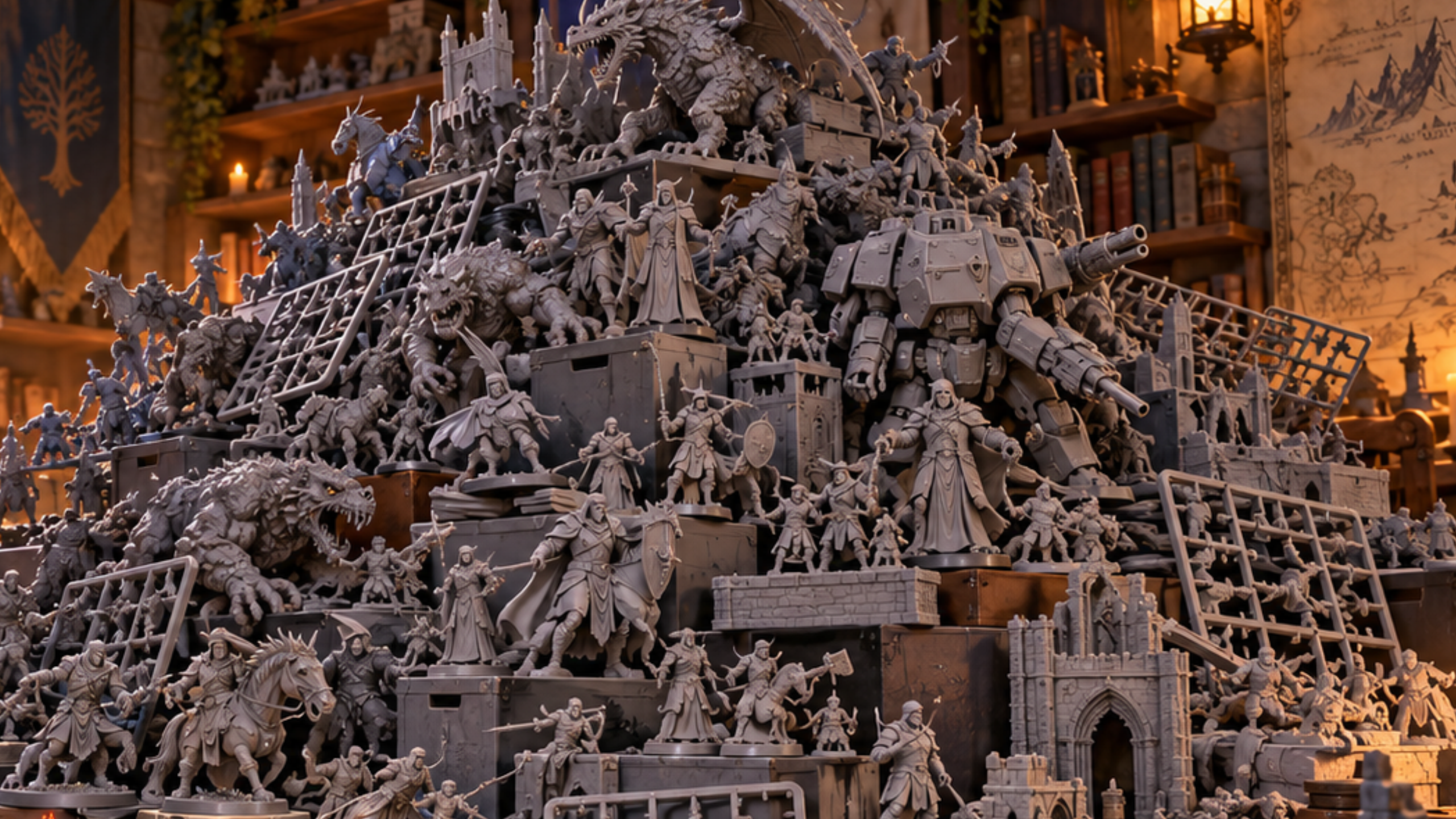
Your Pile of Shame Is Lying to You: Turn the Gray Mountain Back Into a Hobby
The first box is exciting. You open it, look at the sprues, imagine the colors, and briefly become the kind of person who absolutely has a plan for every miniature.
Then another box arrives. Perhaps there is a starter set you wanted, a character model that looks fantastic, or a discount that seemed rude to ignore. Life gets busy. A few assembled models wait for primer. A few primed models wait for paint. Somewhere in the cupboard, an unopened army is developing its own civilization.
Warhammer players have a name for this: the pile of shame.
It is a funny name right up until you start believing it. A hobby that was supposed to offer a few hours of creativity begins to resemble a warehouse with a very disappointed manager.
Here is the part I think we get wrong: unpainted plastic is not a debt. It is a collection of possible projects. The problem begins when every box on the shelf gets an equal vote in what you should do next.
You do not necessarily need to paint faster. You need to be able to choose again.
When the Joke Starts Sounding Like an Invoice
The pile of shame joke works because nearly everyone who collects miniatures recognizes some version of it. We buy a model because it looks wonderful. We set it aside for a free weekend. Then the free weekend goes somewhere else, usually into laundry, errands, family plans, or recovering from the week.
There is nothing especially mysterious about that. A miniature is not an emergency. It should be allowed to wait.
But the language we use changes how the shelf feels. If every unpainted model is unfinished business, then even sitting down to paint one miniature can feel insufficient. You finished a Guardian? Lovely. There are forty-nine more behind it, and the large centerpiece model has been staring at you since spring.
Now your hobby session has a performance review.
That does not mean every collection is healthy or every purchase was wise. Buying beyond your budget or available space deserves an honest look. But guilt is a poor project manager. It tells you everything is urgent while offering no useful advice about where to begin.
What helps is separating the pleasure of owning options from the decision of what you want to work on next.
Stop Counting Models. Start Counting Hours.
A pile of forty miniatures sounds like one number. It is not one amount of work.
Forty simple infantry models are different from forty highly detailed characters. A single large vehicle might take more of your attention than an entire squad. Assembly, cleanup, priming, painting, basing, and the inevitable moment when you decide the shoulder pads need another color all count.
So make a rough estimate in hours. Not because you should schedule every brushstroke, but because time is the resource your adult life actually asks you to manage.
Imagine ten infantry models that you think will take forty-five minutes each to paint to a finish you like. That is roughly seven and a half hours, before setup or assembly. Add a centerpiece you expect to spend four hours on, and you are already looking at more than eleven hours. Those are examples, not universal painting speeds.
If you paint for thirty minutes twice a week, eleven hours represents quite a few evenings. That is not a moral failing. It is a useful reality check.
Write an estimate beside each project: one short session, a few sessions, or a longer project. If numbers make the hobby feel too much like work, use those categories instead.
The point is not to calculate how far behind you are. It is to stop promising yourself that you will finish an entire army during the mythical weekend when nothing else happens.
The Three-Box Hobby Queue
Here is the system I would use to give the shelf some breathing room. You need three boxes, three shelves, or three headings on a piece of paper. The containers can be imaginary. The decisions should be real.
Box One: Next 5 Models
Choose five miniatures you actually want to work on next. Not the five you feel most guilty about. Not necessarily the five that have been waiting longest. The five that would make you happy to sit down with a brush.
If you are working on a large vehicle or monster, let that count as several slots, or even the whole box. Five is a limit on active attention, not a weekly quota.
Keep these models easy to reach, ideally with the paints you need nearby. When you finally get twenty quiet minutes, you should not have to negotiate with the entire collection.
Box Two: Later
This is the home for projects you still genuinely want. That squad you plan to use in a future game? Later. The terrain piece that needs a clear table and a free afternoon? Later. The army you love but are not ready to start? Also Later.
Later is not a punishment box. It is a way of saying, “I still like this, and I do not have to do it today.”
Revisit it when the Next 5 are done or when your interests change. You do not need to keep shuffling every model around each night.
Box Three: Maybe Never
This is the most useful box and, for some of us, the hardest.
Maybe you bought an army because the rules sounded exciting two editions ago. Maybe you planned a huge display board before realizing you prefer painting individual characters. Maybe you inherited models that simply do not interest you.
You are allowed to change your mind.
Maybe Never does not require an immediate sale or dramatic purge. It simply removes the project from the list of promises you keep making to yourself. Later, you can trade it, gift it, sell it, use it for experiments, or leave it on the shelf without pretending it has a deadline.
The useful question is not “How much did I spend on this?” That money is already spent. The useful question is “Would I choose to spend my next ten hobby hours on this?”
Let One Joy Project Break the Rules
Every good system needs one rule that keeps it from becoming another boss fight.
For this one, it is the joy project.
At any time, you can move one miniature into your active space simply because you want to paint it. A strange little character. A monster you have been thinking about for months. A bright pink space elf that does not match the color scheme you originally planned.
No explanation required.
This is not permission to scatter twenty unfinished projects across the table. Keep the joy project to one at a time, and decide whether it replaces a Next 5 slot or temporarily sits beside it.
Why make an exception? Because a hobby queue should protect curiosity, not train it to ask permission.
When I wrote about restoring old Aeldari Guardians, the interesting part was not clearing inventory. It was having inexpensive models that gave me room to experiment with a black-and-pink scheme, make mistakes, and see what worked. The experiment was the hobby. The finished tally was secondary.
A 20-Minute Reset for the Gray Mountain
You do not need to spend an entire Saturday cataloging plastic. In fact, please do not turn this into a spreadsheet project unless spreadsheets are secretly your second hobby.
Set a timer for twenty minutes. For the first five, gather the obvious unfinished projects into view. You do not have to empty every cupboard. Start with the shelf or box that bothers you most.
For the next five, pick your Next 5. Put them somewhere visible and accessible. Ask which models you would choose if nobody were keeping score.
Spend another five sorting the rest into Later and Maybe Never. If a model is difficult to place, Later is fine. You are not making a legally binding declaration to the High Lords of Terra.
Use the last five minutes to make the first session easy. Put out the brush, select two or three paints, and write down the first action: “Prime the base,” “Paint the cloak,” or “Try pink on one shoulder plate.”
Stop when the timer ends. You can improve the system later. Today you are just making it easier to begin.
What If the Buying Really Is the Problem?
It would be too easy to say every pile is harmless and every new box is self-care. Sometimes collecting outruns the budget, the storage space, or the time you actually want to spend building and painting. That is worth noticing without turning it into a character judgment.
Try a pause before the next purchase. Ask three questions: Do I have room for it? Can I comfortably afford it? Do I want this model enough to give it some of my limited hobby time, or do I mostly want the feeling of buying something new?
If the answers are uncomfortable, set a spending limit, make a wishlist, or try a thirty-day pause on new kits. Those are boundaries, not punishments.
There is no universal rule that says you must finish a box before buying another. Some people enjoy collecting, converting, and planning as much as painting. That is a legitimate part of the hobby when it fits their means and brings them pleasure.
The warning sign is not the raw number of unpainted models. It is when purchases stop feeling like choices and start creating stress.
Your Miniatures Do Not All Need the Same Finish
Another trap hides inside the word “finished.”
A rank-and-file unit you want on the table may only need a straightforward color scheme and a tidy base. A character you love might deserve three evenings of careful highlights. A used miniature might be a test model whose entire purpose is to survive several questionable color decisions.
Those are different jobs. Give them different definitions of done.
If you play organized events, check the event’s painting requirements before deciding what is table-ready. But at your own hobby desk, you can decide whether a model is a practice piece, a playable unit, or a display project.
I like separating “ready to enjoy” from “perfect.” Perfect has a remarkable ability to keep moving whenever you get close to it.
There is no prize for giving every belt buckle the same amount of attention, especially if doing so makes you dread the next session.
A Week With Five Models, Not Fifty Promises
Suppose your Next 5 are four infantry models and one character. You have a couple of short evenings and perhaps one longer session. What does progress look like?
On the first evening, you clean up two models and decide on the base colors. That counts. On the second, you paint armor on one miniature. Also counts. If the weekend opens up, you finish a base, add a wash, or start the character. If it does not, the models are still waiting exactly where you left them.
Nothing about this requires finishing five models in seven days. “Next 5” is a focus limit, not a weekly quota.
At the end of a session, leave yourself a tiny instruction for next time. One sentence is enough. “Finish the helmets.” “Try the brighter green.” “Find the missing shield.” Future-you should not need twenty minutes to remember what past-you was doing.
If a week passes without painting, the queue has not failed. It has simply stayed put while you lived your life. That is one of its better features.
Sometimes the Best Hobby Decision Is Letting a Project Go
There may be a box on your shelf that belongs to an older version of you. Someone with different tastes, different plans, or a wildly optimistic estimate of how much free time adulthood would provide.
You do not owe that version of yourself an entire painted army.
You can keep a favorite miniature and pass the rest along. You can sell a kit to fund the project you actually want. You can decide that assembling models is fun even when painting them is not. You can leave something unfinished because the experience of working on it was enough.
This matters especially when the hobby is part of how you are trying to reconnect with creativity. The goal is not to recreate a younger person’s endless weekends. It is to find something that fits the life you have now.
The Shelf Should Invite You Back
The next time you look at your unpainted Warhammer collection, try not to see a list of overdue assignments.
See five models you want to touch next. See a Later box full of options. See a Maybe Never box that is allowed to be honest. Give yourself one joy project that can interrupt the plan when curiosity shows up with a paintbrush.
You might still have a lot of gray plastic afterward. That is fine. The number on the shelf was never the whole problem.
The better question is whether, when you finally have half an hour to yourself, the shelf makes you want to sit down and create something.
If it does, the mountain is becoming a hobby again.
No Comments yet!