
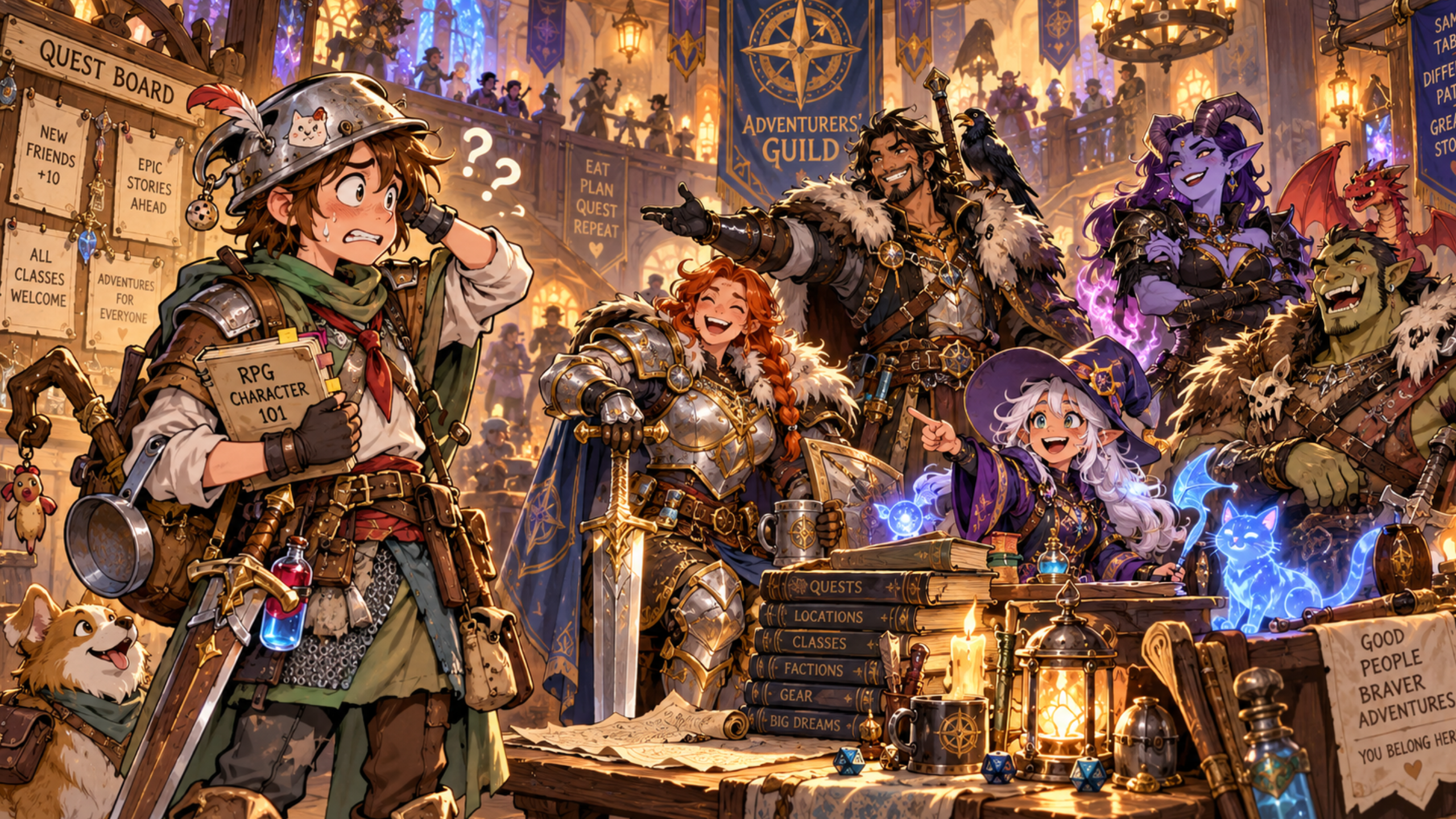
You sit down to make a new character.
This time, you tell yourself, they are going to be original.
Not another edgy rogue.
Not another noble paladin.
Not another bard who attempts to seduce anything with a measurable pulse.
Definitely not another mysterious orphan with a hood, two daggers and a relationship with eye contact that could best be described as hostile.
You are going to create something nobody has ever seen before.
Three hours later, your character is the exiled half-vampire heir to a forgotten moon kingdom who carries the soul of an ancient dragon, cannot remember their true name, secretly serves two rival gods and owns a sentient hat.
The hat has trauma.
We may have overcorrected.
There is nothing wrong with wanting your character to feel fresh. Most of us do.
The problem is the assumption hiding underneath that goal:
A good character must begin with an original concept.
I don’t think that’s true.
In fact, trying to eliminate every recognizable trope can make character creation harder than it needs to be. You start judging ideas by whether anyone has done them before rather than whether they give you something interesting to roleplay.
And people have done almost everything before.
Warriors have been reluctant.
Necromancers have been sympathetic.
Paladins have doubted their faith.
Rogues have secretly had hearts of gold.
Somewhere, someone has probably already played your incredibly specific mushroom wizard.
That’s fine.
Originality doesn’t have to come from inventing a character nobody has ever imagined.
It can come from combining familiar pieces in a way that creates tension.
That’s where the Contradiction Engine comes in.
Tropes Aren’t the Enemy
Before we build anything, we need to stop treating tropes like creative contamination.
A trope is just something recognizable.
The noble knight.
The greedy rogue.
The curious wizard.
The angry barbarian.
The idealistic priest.
The charming bard.
You see a few details and immediately understand roughly what kind of character has walked into the tavern.
That’s useful.
Especially in roleplay.
Other players need something they can react to.
If your character requires a twelve-minute explanation before anyone understands what kind of person they’re talking to, you may have created an excellent short story protagonist and a slightly exhausting tavern companion.
Recognizable archetypes give people handles.
They provide expectations.
And expectations are valuable because expectations can be broken.
That’s where things get interesting.
An edgy rogue is not automatically a bad character.
A noble paladin is not automatically boring.
A flirtatious bard is not inherently a creative crime.
The problem starts when the archetype is the entire character.
If everything the rogue says, believes, fears and wants can be predicted from the words “edgy rogue,” there isn’t much left to discover.
You don’t need to destroy the archetype.
You need to give it something to fight with.
The Contradiction Engine
The basic method is simple.
Start with four pieces:
Archetype → Contradicting Value → Ordinary Pleasure → Social Weakness
That’s it.
You do not need a bloodline chart.
You do not need six pages of historical events.
You do not need to know what your character ate on their seventh birthday unless something truly catastrophic happened to the cake.
You need enough tension to generate decisions.
Let’s break it down.
Step One: Pick an Archetype
Start with something familiar.
Seriously.
Do not try to impress anyone yet.
Pick the thing you actually want to play.
Maybe it’s:
- A knight
- A thief
- A priest
- A scholar
- A mercenary
- A necromancer
- A hunter
- A noble
- A healer
- A soldier
- A bard
- A wandering mage
You can get more specific if your setting calls for it, but the point is to choose something immediately understandable.
Let’s use:
A warrior.
Right now, that isn’t much of a character.
That’s fine.
We haven’t turned the engine on yet.
Step Two: Give Them a Value That Creates Friction
This is the important part.
Ask:
What does this person deeply believe that makes being this archetype difficult?
Not quirky.
Difficult.
There is a difference.
“A barbarian who enjoys reading” is a nice detail.
It tells us something about them.
But unless reading creates meaningful choices, it probably won’t drive much roleplay.
Now try:
A warrior who is terrified of violence but believes protecting other people is sacred.
That creates a problem.
They don’t want to fight.
They may hate fighting.
They may freeze before a battle.
They may secretly envy people who can walk away.
But when someone else is threatened, their values drag them toward the exact thing they fear.
Now we have decisions.
Do they intervene?
Do they hesitate?
Do they resent the people who rely on them?
Do they feel ashamed of being afraid?
Do they mistake courage for fearlessness?
That character can walk into dozens of scenes and produce different outcomes without needing a prophecy.
That’s the goal.
Contradiction Is Not Just “The Opposite”
There is a tempting shortcut here.
Take an archetype and reverse it.
Strong warrior who hates fighting.
Greedy rogue who gives money away.
Necromancer who loves life.
Done.
Sometimes that works.
But the strongest contradictions usually aren’t just opposites.
They are competing truths.
Both sides of the character should make sense to them.
Consider the necromancer.
You could write:
A necromancer who hates death.
Interesting.
But let’s push it.
A necromancer who believes preserving life is sacred and studies death because they cannot accept how easily people disappear.
Now necromancy isn’t a random reversal.
It comes from the value.
Maybe every corpse is evidence of failure.
Maybe they preserve bodies with extraordinary care.
Maybe they find casual attitudes toward death horrifying.
Maybe other people assume they’re morbid while they privately think everyone else is disturbingly comfortable with mortality.
The contradiction isn’t decoration.
It shapes how they see the world.
That’s when it becomes useful.
Try the “Both Things Are True” Test
A good contradiction usually allows you to say:
Both of these things are genuinely true.
The warrior is afraid.
The warrior believes protecting people matters more than their fear.
Both are true.
The priest wants certainty.
The priest cannot stop questioning doctrine.
Both are true.
The noble genuinely believes in duty.
The noble also desperately wants a life that belongs to them.
Both are true.
You don’t need to decide which side is “the real character.”
The tension between them is the character.
Step Three: Give Them Something Wonderfully Ordinary
Characters become strange when every detail exists at maximum dramatic intensity.
They have a sacred oath.
A tragic childhood.
A forbidden power.
A bitter rival.
A secret destiny.
A scar given to them by the Emperor of Pain.
And then you ask what they do when everyone stops adventuring for ten minutes and the character appears to shut down like someone unplugged them.
People have ordinary things.
Your character should too.
Give them one completely mundane pleasure.
Maybe they love:
Fresh bread.
Fishing.
Bad romance novels.
Cooking.
Collecting cheap souvenirs.
Card games.
Tea.
Dancing badly.
Expensive soap.
Watching thunderstorms.
Fixing broken furniture.
Trying every local dessert they encounter.
This sounds small.
It isn’t.
Ordinary pleasures create easy roleplay.
Your grand tragic necromancer suddenly has an opinion about pie.
Your terrifying mercenary spends twenty minutes trying to bargain for a ridiculous ceramic bird.
Your ancient wizard knows more about regional cheeses than arcane politics.
These things give other characters somewhere safe to meet them.
Not every interaction needs to expose trauma.
Sometimes you need something to talk about while waiting for the dragon.
Step Four: Give Them a Social Weakness
Not a combat weakness.
Not “vulnerable to silver.”
Not “loses control when angry and becomes more powerful.”
That is suspiciously close to a feature.
Give them something that makes relationships harder.
Maybe they:
Cannot admit when they are wrong.
Try to fix people’s problems when people only wanted to be heard.
Apologize constantly.
Treat every disagreement like a debate.
Become overly formal when nervous.
Cannot accept compliments.
Assume people are angry with them.
Tell the truth at spectacularly inconvenient times.
Avoid asking for help.
Promise things they cannot realistically deliver.
Get jealous easily and hate that they do.
Now your character has friction with other people.
That matters because roleplaying games are social.
You can write the most fascinating internal monologue ever created, but eventually another character is going to say hello.
You need something to happen next.
Put the Four Pieces Together
Let’s build a few.
The Cowardly Warrior
Archetype: Warrior
Contradicting value: Terrified of violence, but believes protecting vulnerable people is sacred.
Ordinary pleasure: Loves cooking breakfast for other people.
Social weakness: Tries to hide fear behind sarcasm and sometimes comes across as cruel.
That character doesn’t need much more before you can start playing.
You already know what happens when danger appears.
You know what happens around a campfire.
You know what might go wrong in a tense conversation.
That’s a lot of fuel from four decisions.
The Life-Preserving Necromancer
Archetype: Necromancer
Contradicting value: Believes life is precious and studies death because they cannot accept losing people unnecessarily.
Ordinary pleasure: Collects pressed flowers.
Social weakness: Talks about grief clinically when other people need empathy.
Suddenly “necromancer” is not the personality.
It is the lens.
Imagine this character meeting someone who recently lost a family member.
They genuinely want to help.
They probably have more experience with death than almost anyone.
And they are absolutely terrible at saying the right thing.
That is a scene.
The Questioning Priest
Archetype: Devout priest
Contradicting value: Desperately wants certainty but cannot stop questioning doctrine.
Ordinary pleasure: Loves terrible mystery novels.
Social weakness: Turns sincere conversations into theological discussions when uncomfortable.
Now imagine someone asks them a simple question about faith.
They want to give reassurance.
They also see twelve philosophical problems hiding inside the wording of the question.
There goes the afternoon.
The Honorable Thief
Here’s one where the contradiction isn’t simply “thief but nice.”
Archetype: Professional thief
Contradicting value: Believes promises are sacred.
Ordinary pleasure: Loves street performances.
Social weakness: Holds grudges far longer than they should.
This person will happily steal your jewelry.
But if they gave you their word, that is different.
Now you have a moral system.
It may not be everyone else’s moral system.
That makes it even better.
The Gentle Monster Hunter
Archetype: Monster hunter
Contradicting value: Believes most dangerous creatures are frightened animals or misunderstood beings until proven otherwise.
Ordinary pleasure: Keeps a little notebook rating inns.
Social weakness: Gives dangerous people too many second chances.
Now every hunt contains a question.
Is this creature actually a monster?
When does compassion become recklessness?
What happens the first time their mercy gets someone hurt?
That’s an entire character arc waiting quietly inside one contradiction.
Why This Works Better Than “Being Original”
The problem with originality as a goal is that it gives you nothing useful to measure.
How original is original enough?
Has someone else played this before?
Does your character resemble a book character?
What if someone at another table had basically the same idea in 2017?
You can spiral forever.
But ask:
Does this character contain a meaningful tension that creates choices?
Now you can answer.
A contradiction produces motion.
It gives your character two things they want that may not peacefully coexist.
Duty and freedom.
Safety and curiosity.
Faith and doubt.
Mercy and justice.
Recognition and privacy.
Independence and belonging.
Those conflicts are ancient.
That’s not a problem.
We’ve been telling stories about them for thousands of years because they keep working.
The particular way your character wrestles with them is where the personality appears.
Complicated Does Not Mean Deep
This is another trap worth avoiding.
You can have an incredibly complicated character who isn’t especially deep.
They may have:
Three aliases.
Four organizations hunting them.
Two secret parents.
An ancient curse.
A missing sibling.
A mysterious tattoo.
A prophecy.
An evil duplicate.
And the hat.
We cannot forget the hat.
But if every situation produces the same response, there isn’t much character underneath all that architecture.
Depth doesn’t come from the number of facts in the backstory.
It comes from how beliefs collide when the character has to choose.
A simple farmer who desperately wants adventure but believes abandoning their family would be unforgivable may contain more useful roleplay tension than someone carrying seventeen paragraphs of supernatural lore.
Complexity is information.
Depth is pressure.
They can coexist.
They are not the same thing.
Your Character Does Not Need to Surprise Everyone
Sometimes we become so focused on avoiding clichés that we forget what roleplay actually requires.
Your character does not need to make everyone at the table gasp when you explain the concept.
They need to be interesting to interact with.
Those are completely different goals.
“A paladin who believes strongly in justice” sounds incredibly familiar.
Fine.
What kind of justice?
What happens when justice conflicts with mercy?
What happens when the law protects someone cruel?
What happens when breaking an oath would save someone innocent?
What happens when the paladin discovers they were wrong?
Now we are roleplaying.
The archetype gave us the starting position.
The contradictions give us somewhere to go.
You Also Don’t Need to Reveal Everything Immediately
One of the nice things about building characters this way is that you can discover them during play.
You don’t need to explain:
“My character is a cowardly warrior whose sacred belief in protection conflicts with his fear of violence.”
Please don’t.
That’s a character design note.
Let everyone else meet the person.
Maybe they notice he jokes before fights.
Maybe he volunteers to cook.
Maybe he hesitates when combat starts.
Maybe he steps forward anyway when someone is threatened.
Eventually another character asks why.
Now the contradiction has become a relationship instead of a biography.
That is much more interesting.
The Contradiction Engine in Five Minutes
If you’re staring at a blank character sheet right now, try this.
Pick an archetype you genuinely enjoy.
Then finish these four sentences:
I am a __________.
But I deeply believe __________, which makes that difficult because __________.
When nothing important is happening, I love __________.
Other people sometimes struggle with me because I __________.
Done.
You probably don’t have a finished character.
Good.
You have something better.
You have somewhere to start.
One Final Test: Does the Contradiction Create Decisions?
Before adding another paragraph of lore, ask one question:
Will this contradiction affect what my character actually does?
If not, it may simply be a fun detail.
Fun details are good.
Keep them.
But don’t confuse them with the engine.
“A barbarian who enjoys poetry” might be charming.
“A barbarian who believes anger makes people dangerous and is terrified of becoming the kind of person everyone expects them to be” changes decisions.
“A noble who likes sleeping outdoors” is texture.
“A noble who believes deeply in their family’s duty but has discovered that the family itself may be corrupt” creates pressure.
The best contradictions force choices.
And choices are where roleplay lives.
Stop Trying to Invent Something Nobody Has Seen
You probably aren’t going to create the first warrior.
Or rogue.
Or paladin.
Or conflicted priest.
Or charming criminal.
Or reluctant hero.
Good.
You don’t need to.
Start with something recognizable.
Give it one belief that makes the archetype harder to live with.
Give the character something ordinary to enjoy.
Give them one way they make relationships unnecessarily difficult.
Then start playing.
You can add the lost kingdom later if you really need it.
Maybe even the sentient hat.
But first, give the character something to wrestle with.
Because originality isn’t always inventing a new piece.
Sometimes it is taking two familiar pieces that don’t sit comfortably together and asking:
What happens when both are true?
That’s usually where the interesting character has been hiding.
No Comments yet!