

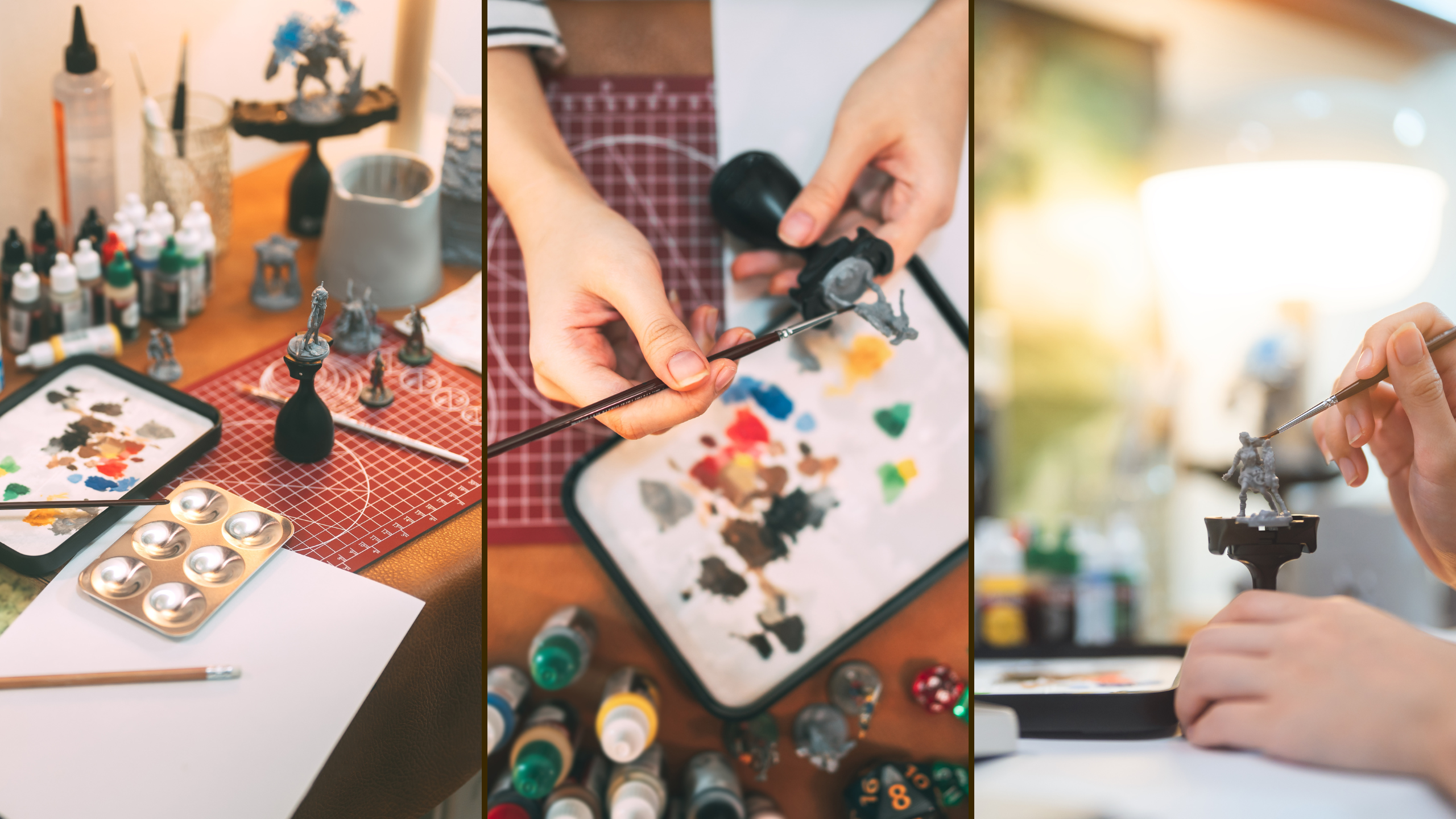

I have reached the dangerous stage of a new hobby.
The stage where I know just enough to understand that there are approximately nine thousand things I could buy, but not enough experience yet to know which of them I actually need.
Miniature painting has an impressive ability to turn a simple idea like, “I think I’ll paint some little space elves,” into an online shopping cart containing seventeen brushes, forty-six paints, a compressor, an airbrush booth, specialized lighting, sanding sticks, miniature holders, basing compounds, three different varnishes, and something called a vortex mixer.
I decided not to do that.
At least not yet.
Instead, I’m trying to approach starting miniature painting the same way I wish I approached more hobbies: buy enough tools to experiment, use inexpensive alternatives where they make sense, and figure out what I actually enjoy before investing heavily in the premium version of everything.
My first real subjects are going to be a collection of used Aeldari miniatures, which are currently sitting in a paint-removal bath looking considerably less majestic than the ancient space-faring civilization they represent.
Once they emerge from miniature purgatory, the experiment begins.
And right now, my painting setup is a strange mixture of actual miniature paints, craft-store acrylics, spray cans, paint markers, and whatever Hobby Lobby and Michaels happened to have that looked useful.
Honestly, that feels appropriate.
I Didn’t Want to Start With a Wall of Expensive Miniature Paint
One of the first things you discover when researching miniature painting is that there are some fantastic dedicated paint ranges.
Citadel.
Army Painter.
Vallejo.
AK Interactive.
Pro Acryl.
And plenty more.
You can very easily convince yourself that the first step toward painting miniatures is purchasing an enormous coordinated set of tiny paint bottles.
I decided to resist that urge.
Instead, I picked up some Army Painter paints for colors and applications where I wanted something specifically designed for miniatures, then supplemented them with regular craft acrylic paints from stores like Hobby Lobby and Michaels.
That probably isn’t how someone preparing for a Golden Demon competition would build their paint collection.
Fortunately, I am not preparing for Golden Demon.
I am preparing to discover whether I can make pretty old plastic space elves look cool.
Those are slightly different standards.
Why Mix Miniature Paints and Craft Acrylics?
Dedicated miniature paints have some obvious advantages.
They tend to have finer pigments, better consistency for detail work, and formulations specifically intended for painting small models.
But craft acrylic paints are inexpensive, easy to find, and come in a ridiculous number of colors.
For a beginner, that creates an opportunity.
Instead of spending several dollars on every single shade I might possibly need, I can experiment.
Maybe the cheap craft-store pink works perfectly for a large section of armor.
Maybe it doesn’t.
Maybe I discover that a particular color is difficult to thin or doesn’t cover well enough for miniature work.
If that happens, I haven’t ruined the hobby.
I’ve learned which colors are worth replacing with better miniature paint.
That’s really the philosophy behind most of my starter setup.
Experiment first. Upgrade second.
The Craft Store Has Become My Miniature Hobby Supply Store
I’ve now developed the dangerous habit of wandering through Hobby Lobby and Michaels looking at completely unrelated products and asking:
Could I use that on a miniature?
This is apparently how hobbies mutate.
The miniature-painting aisle doesn’t have to say “miniatures” on the sign.
The craft store has brushes.
Paint.
Cutting tools.
Storage containers.
Foam.
Glue.
Palette supplies.
Paint markers.
Craft acrylics.
Spray paint.
Airbrush supplies.
Random texture materials that could eventually become bases, terrain, rubble, alien plants, or something equally unnecessary and therefore essential.
That has made getting started much less intimidating.
Instead of believing I need a specialized product for every step, I’m trying to understand what the specialized product actually does and then decide whether I need it.
Sometimes the answer will absolutely be yes.
Other times, there may be a $4 craft-store solution sitting two aisles away.
I Even Found an Affordable Airbrush
The airbrush was where I expected the budget philosophy to collapse.
Airbrushing miniatures can quickly become its own hobby.
There are compressors.
Airbrushes.
Needle sizes.
Cleaning tools.
Thinners.
Flow improvers.
Spray booths.
Masks.
Hoses.
Moisture traps.
Quick-release fittings.
And dozens of videos debating equipment that I currently lack enough experience to have opinions about.
I still wanted to try it.
Aeldari are actually part of the reason.
Their armor has smooth surfaces, curved shapes, vehicles, jetbikes, and sleek transitions that seem perfect for experimenting with an airbrush.
So rather than buying an expensive professional setup immediately, I raided Hobby Lobby and Michaels and found a budget-friendly airbrush setup that should be enough for me to start learning.
That’s the key phrase:
start learning.
I don’t need the airbrush I might want after painting 500 miniatures.
I need an airbrush capable of teaching me whether I enjoy airbrushing miniatures at all.
If I eventually outgrow it, fantastic.
That means I’ve actually used the thing enough to understand why an upgrade matters.
Spray Paint Is Going to Do a Lot of Heavy Lifting
I have also accumulated what is probably an unreasonable amount of spray paint.
But spray paint makes a lot of sense for what I’m trying to do.
Primer alone immediately puts spray cans into the miniature-painting workflow, and depending on the scheme, a good spray color can establish a huge portion of the model before I ever touch it with a brush.
For someone painting an army rather than a single display miniature, that seems incredibly useful.
If twenty Guardians are ultimately going to share the same major armor color, I would rather establish that color efficiently than lovingly brush three coats onto every individual kneecap.
There is probably a beautiful metaphor about efficiency hiding in there somewhere.
Mostly, I just don’t want to paint forty tiny Aeldari knees more times than necessary.
I’m interested in seeing how much I can accomplish through a combination of:
primer → spray/base color → airbrush → brush details → washes/highlights
rather than treating every miniature as a tiny oil painting.
That may change once I actually start.
But that’s the workflow currently forming in my head.
And Yes, I Bought Paint Markers
This may be the part where miniature-painting traditionalists begin slowly backing away from me.
I bought paint markers too.
I don’t know yet how useful they’ll ultimately be.
That’s precisely why I bought them.
Miniatures contain plenty of areas where extremely controlled application could theoretically be useful: weapon details, armor panels, markings, edges, larger flat details, basing elements, or quick color blocking.
Paint markers are inexpensive enough that I’m curious to experiment.
Maybe they become one of my favorite shortcuts.
Maybe I use them twice and discover that brushes are better for almost everything.
Either result is useful.
Part of the fun of beginning something new is that I haven’t yet developed enough opinions to tell myself what I’m “supposed” to be doing.
I can just try things.
My First Army Is Aeldari
The miniatures waiting at the end of all this experimentation are Aeldari.
That choice has already started shaping how I’m thinking about painting.
Aeldari aren’t exactly chunky armored bricks.
They have flowing armor, smooth helmets, elegant weapons, strange shapes, curved vehicles, and an aesthetic that feels somewhere between ancient warrior culture and impossibly advanced alien technology.
Which means there are a lot of opportunities to make terrible painting decisions.
Excellent.
I’m also deliberately building my color scheme around pink.
Part of that choice is for my daughter, but I also like the challenge of taking a color people might not immediately associate with a grim science-fiction battlefield and finding a way to make it feel sharp, alien, dangerous, and intentional.
I don’t want them to look like I accidentally dropped them into a bucket of bubblegum.
I want the pink to feel like it belongs there.
That is one of the things I’m most excited to experiment with once the models are clean.
Except My Aeldari Currently Look Terrible
There is one obstacle between me and actually painting all of this.
My used miniatures.
A chunk of the army came secondhand, which is one of the reasons I was able to get into the hobby without buying everything brand new.
The tradeoff is that somebody else already painted them.
So right now my mighty Aeldari warhost is undergoing what can generously be described as a spa treatment.
They are soaking in paint remover.
It is not dignified.
Every so often I check on them to see how much of their previous life has begun peeling away.
Soon they’ll come out.
I’ll scrub away the remaining paint.
Clean them up.
Figure out what weapons everyone is actually holding.
Repair whatever needs repairing.
Prime them.
And then I will face the terrifying blank canvas of having no previous paint job left to blame.
I’m Trying Not to Optimize the Fun Out of This
One thing I’ve noticed while researching miniature painting is how easy it would be to spend more time preparing to paint than actually painting.
There is always another tutorial.
Another product comparison.
Another “10 Things Beginners Do Wrong” video.
Another paint range.
Another technique I apparently need to understand before touching plastic.
Eventually I have to stop researching.
The models have to come out of the bath.
Paint has to go onto them.
Some of it will be ugly.
I expect my first miniature will eventually look significantly worse than my twentieth.
That’s the point.
I’m not trying to build the perfect miniature-painting workstation before I’ve painted a miniature.
I’m trying to build enough of a workstation that I can begin.
That’s a very different goal.
My Current Beginner Miniature Painting Setup
So right now, my setup is roughly this:
- A small collection of Army Painter miniature paints
- Cheap craft acrylic paints for experimenting with colors and larger areas
- An affordable airbrush setup
- More spray paint and primer than I originally expected to own
- Paint markers because I want to see where they might be useful
- Basic brushes and hobby tools
- Used Aeldari miniatures currently undergoing paint removal
- An unhealthy amount of curiosity
There are unquestionably better tools.
There are better paints.
There are better airbrushes.
I don’t need those yet.
I need to paint.
What I Want to Learn First
I’m not especially interested in immediately mastering advanced miniature-painting techniques.
Right now I want to learn the fundamentals.
How thin should my paints actually be?
How much pressure should I use through the airbrush?
How do different paints behave?
What makes a clean base coat?
How do I create useful shadows?
How bright should highlights really go?
How do I paint dozens of models without each one taking the lifespan of a small civilization?
Which shortcuts look good?
Which shortcuts look like shortcuts?
And perhaps most importantly:
What part of miniature painting do I actually enjoy?
Maybe I’ll love airbrushing.
Maybe detail work becomes strangely relaxing.
Maybe I’ll become obsessed with basing.
Maybe painting faces will make me reconsider every decision that brought me here.
I don’t know yet.
That’s what makes the beginning interesting.
Starting Cheap Gives Me Permission to Experiment
I think there is another advantage to not buying the absolute best version of everything immediately.
I’m less afraid to experiment with it.
A $2 bottle of craft-store acrylic isn’t precious.
A budget airbrush isn’t precious.
A secondhand Guardian that has already survived one paint job and a chemical bath is definitely not precious.
I can try things.
Strip paint again if necessary.
Change the scheme.
Mix colors.
Test markers.
Spray something.
Regret spraying something.
Learn why everyone on the internet told me not to do the thing I just did.
That’s how this hobby is going to become mine rather than just a collection of techniques I copied from YouTube.
The Aeldari Are Almost Ready
For now, everything is waiting on the paint-removal bath.
There’s something oddly fitting about that.
These miniatures are literally being stripped back to their starting point while I’m doing roughly the same thing creatively.
I’m learning a new hobby without worrying too much about whether I’m doing it the “right” way.
I’m assembling tools.
Trying inexpensive options.
Following curiosity.
Making a few questionable purchases.
And getting ready to put paint on plastic.
Soon the Aeldari will emerge from the bath.
They’ll get cleaned.
Primed.
And then the first signal-magenta experiment begins.
I have no idea exactly what they’ll look like when I’m finished.
That’s probably the best part.

Other Articles

Why I Chose Aeldari for My First Warhammer 40K Army
Welcome to EpicAgain: Starting the Creative Journey Again
